
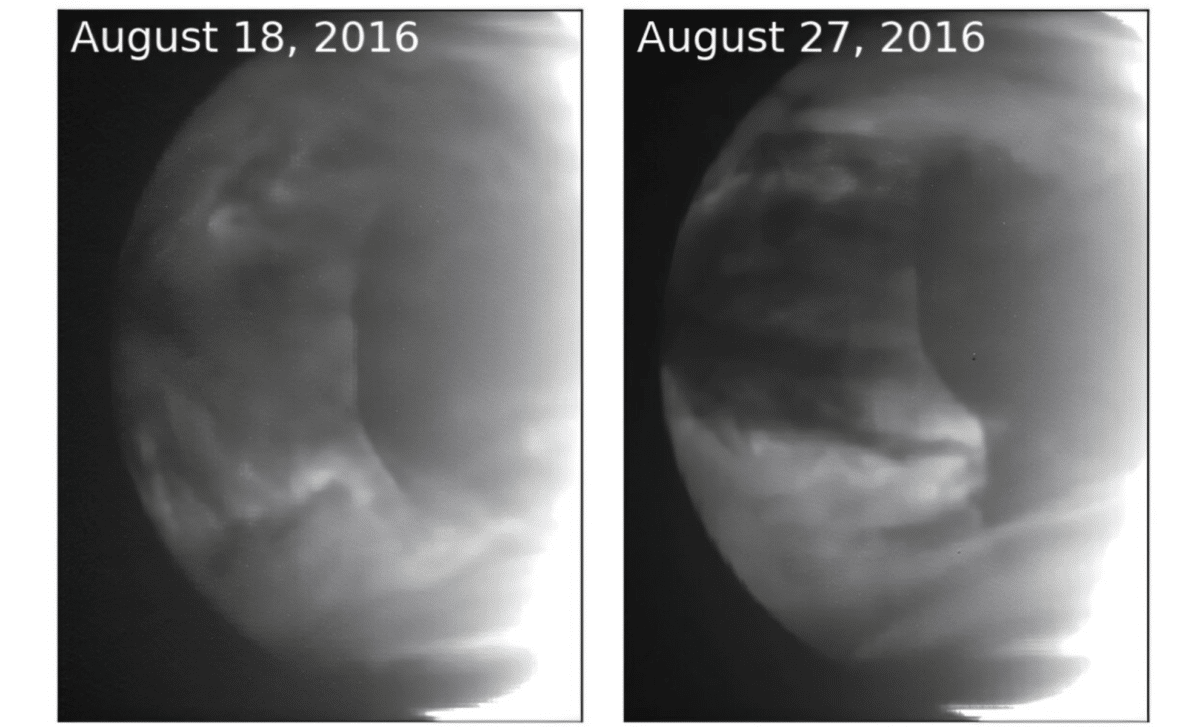
Venus continues to captivate researchers with its dense atmospheric layers, scorching temperatures, and perplexing meteorological patterns. Recent findings published in the Journal of Geophysical Research: Planets reveal the origins of a remarkable 6,000-kilometer-wide wave encircling the planet's equator. This extensive wave is now understood to stem from the solar system’s largest known hydraulic jump.
For a long time, the cause behind this vast atmospheric wave remained unclear. However, through meticulous simulations and analysis led by Professor Takeshi Imamura at the University of Tokyo, scientists have finally unraveled this mystery.
The Role of Hydraulic Jumps in Planetary Atmospheres
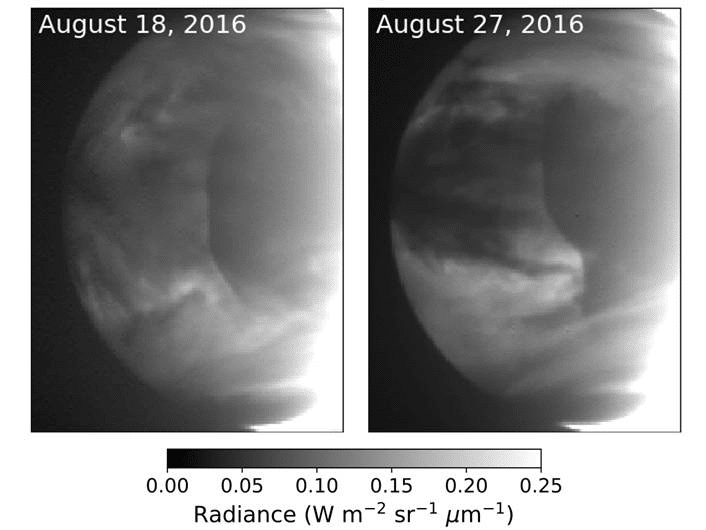
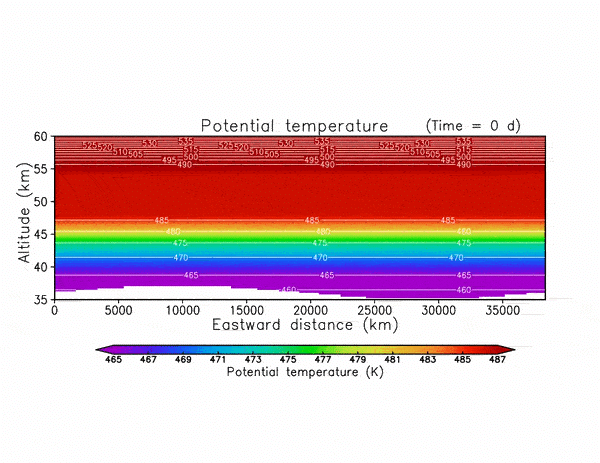
A hydraulic jump describes a rapid transition in fluid flow where the velocity decreases sharply and the fluid depth increases. A classic Earth example is water flowing from a faucet into a sink: a fast, narrow stream transforms into a wider, slower flow upon impact. An analogous process occurs on Venus. The eastward-moving wave in the planet’s lower clouds encounters a critical threshold, causing the airflow to destabilize. As the wind speed suddenly drops, powerful upward air currents transport sulfuric acid vapor to higher altitudes.

The clouds formed in the wake of these updrafts create the prominent wave pattern visible on Venus. This massive hydraulic jump phenomenon marks the first detection of its kind across any planet.
Professor Imamura comments,
“We identified the phenomena, but for years we couldn’t understand it. However, thanks to this research, we’re now able to show that this cloud disruption is caused by the largest known hydraulic jump in the solar system.”
A Comprehensive Model of Venusian Cloud Behavior
Earlier, researchers used global circulation models (GCM) inspired by Earth’s atmospheric dynamics to interpret Venus’s weather. These frameworks, however, didn’t incorporate the hydraulic jump now identified. By applying sophisticated fluid dynamics and microphysical box modeling, the research group showcased how this jump crucially influences cloud formation on Venus.
The published work in the Journal of Geophysical Research: Planets additionally sheds light on the planet’s superrotation—where winds blow around Venus roughly 60 times faster than the planet spins. This enduring enigma may be partially explained by the wave generated via the hydraulic jump.
Imamura elaborates,
“Venus has three distinct cloud layers, and the dynamics of the lower and middle layers are not so well understood. Our discovery of a hydraulic jump on Venus connecting a very large-scale horizontal process with a strong localized vertical wave is unexpected, as in fluid dynamics these are usually disconnected.”
Future Directions and Scientific Opportunities
With the hydraulic jump confirmed, the team plans to extend their models by integrating additional atmospheric processes. This effort demands substantial computational resources, involving complex simulations manageable only by today’s powerful supercomputers. Despite these hurdles, Imamura remains hopeful about advancing the research.
“Our next step will be to test this discovery within a more inclusive climate model that includes other atmospheric processes. We will face some challenges due to the huge amount of processing power required to run such simulations. Even with modern supercomputers, it isn’t easy,” said Imamura.
This breakthrough also encourages the exploration of similar phenomena on other planets, especially Mars. Imamura highlights, “Under some circumstances, Mars’ atmosphere may also have the right conditions for a hydraulic jump.” This insight suggests that future Martian missions could benefit from examining analogous atmospheric behaviors on the Red Planet.
- Categories:
- News








0 comments
Sign in to Comment