
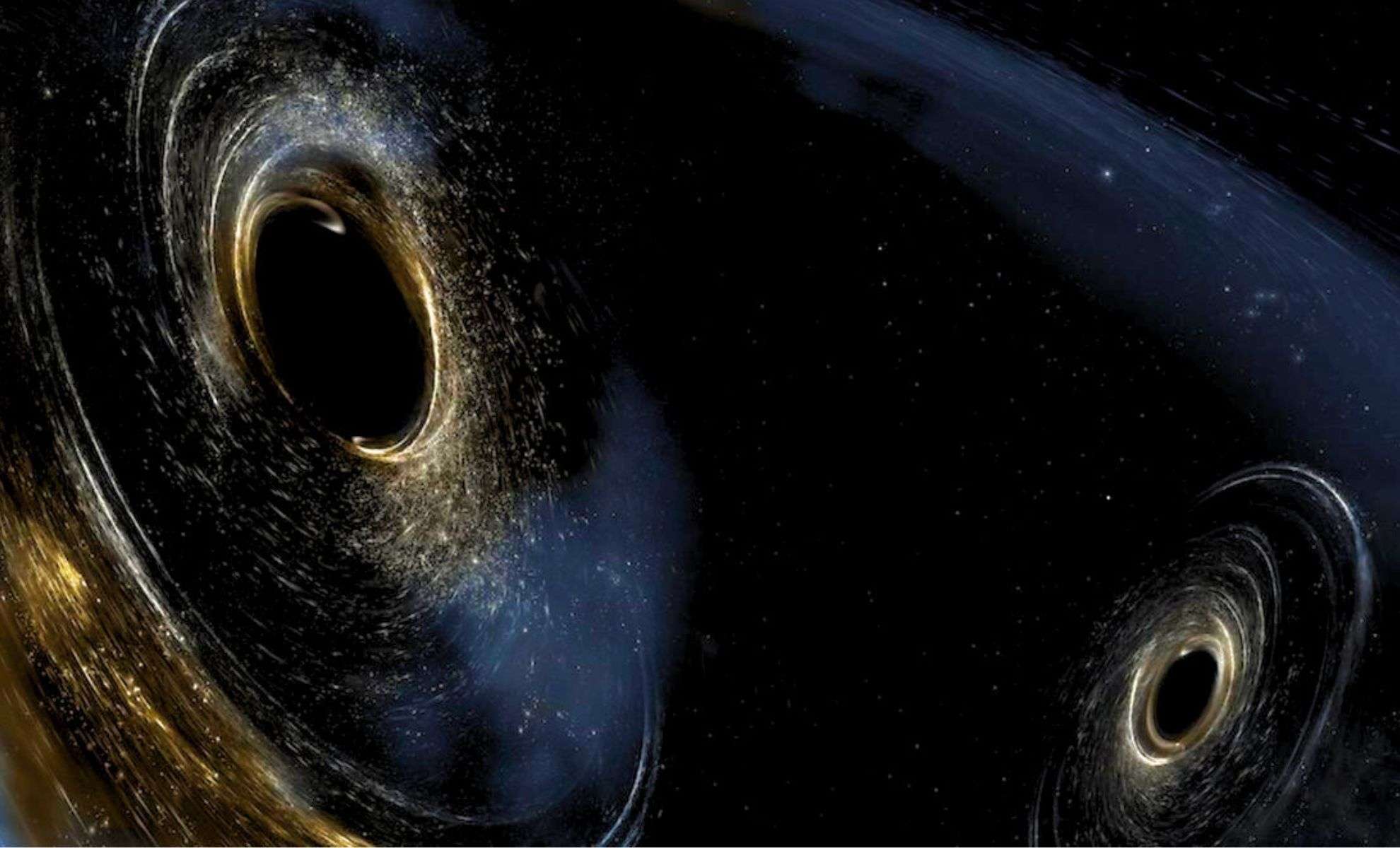
In early 2025, a subtle distortion in spacetime arrived on Earth, originating from over a billion light-years distant. This wasn’t a transmission of light or radio signals, but rather a delicate vibration marking the aftermath of a dramatic collision between two black holes. The enhanced LIGO observatories in the United States detected this cosmic whisper.
For a brief moment, the sensors in Hanford, Washington and Livingston, Louisiana responded simultaneously. What was recorded turned out to be the most pristine gravitational wave signal ever captured, enabling researchers to do something unprecedented: hear the “ringing” of black holes as they coalesced. This phase, known as the ringdown phase, was long anticipated by theorists but has never before been observed with such precision.
Crucially, this data gave physicists a chance to examine a five-decade-old hypothesis posed by Stephen Hawking: that the total surface area of a black hole cannot shrink. Though this concept seems straightforward, it has profound ramifications concerning gravity, entropy, and the fundamental laws that govern our universe. The analysis confirms Hawking’s prediction.

The announcement came from the LIGO-Virgo-KAGRA (LVK) consortium and appeared in Physical Review Letters. This milestone is already being hailed as one of the most compelling validations of general relativity in recent memory.
Decades of Theory: Hawking’s Black Hole Area Law
Introduced in 1971, Hawking’s area theorem postulates that when black holes merge, the resulting black hole’s surface area must be no smaller than the sum of its predecessors. Inspired by the second law of thermodynamics, which holds that entropy tends to increase, this theorem bridges thermodynamics, information science, and Einstein’s general relativity in an elegant synthesis.
Yet measuring a black hole’s surface area poses significant challenges, since black holes emit no light. Observation hinges on detecting their gravitational influences. The landscape changed dramatically with LIGO’s initial 2015 detection of the first gravitational waves, produced by violent events like black hole collisions. Since then, over 300 black hole mergers have been observed, but none as clear as the recent event named GW250114.
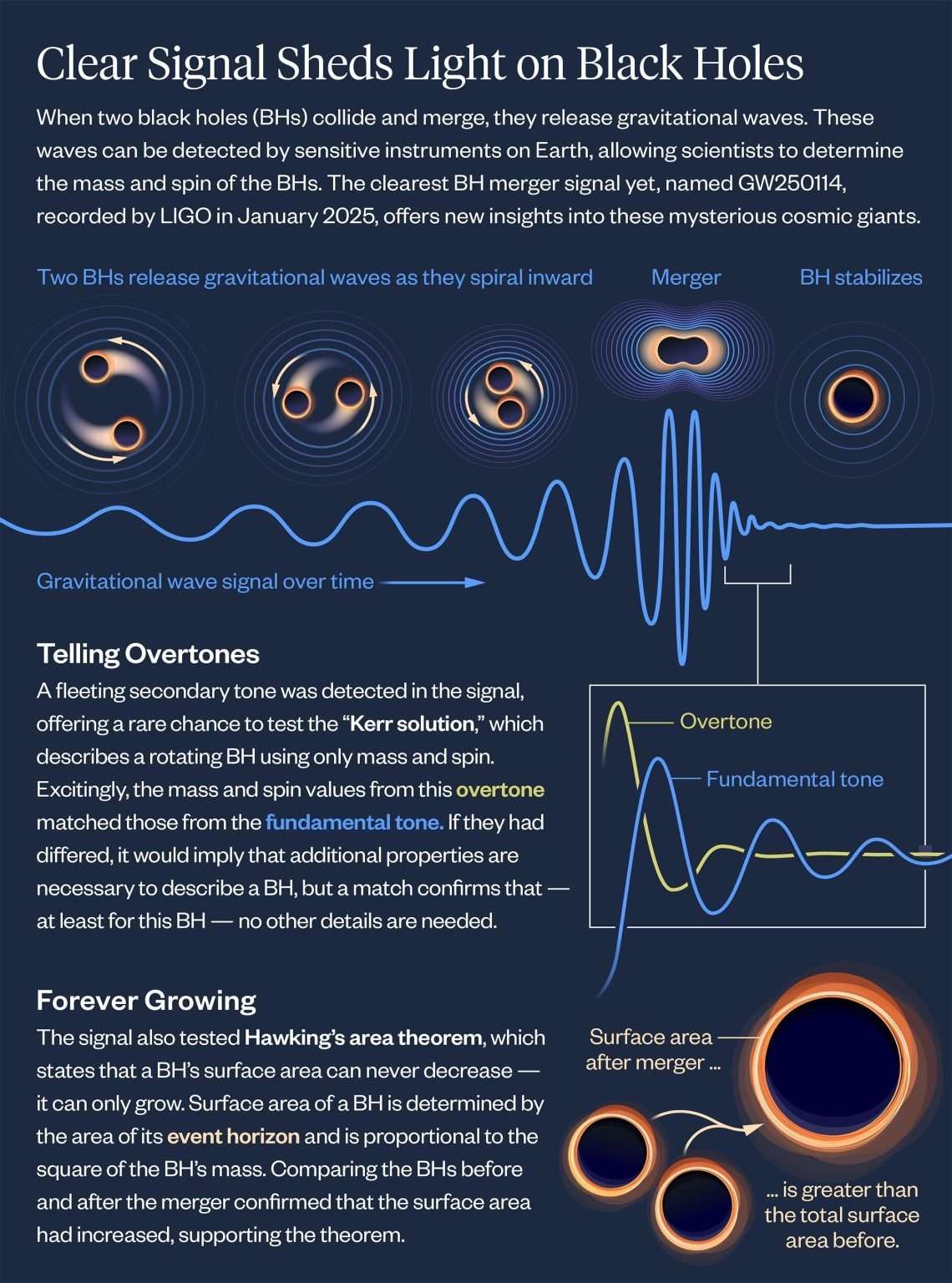
The GW250114 event involved two black holes with masses about 30 to 40 times that of the Sun. Their merger produced a black hole with a surface area near 400,000 square kilometers, considerably larger than the combined 240,000 square kilometers of the initial pair. These estimates, derived from analyzing the gravitational wave frequencies and amplitudes, strongly align with Hawking’s original theorem.
Advancing Astrophysics Through Gravitational Wave Precision
This discovery is significant not only for confirming an enduring theoretical prediction but also for the exquisite precision of the measurement. After merging, the final black hole entered what scientists identify as the ringdown stage—oscillating like a struck bell and emitting gravitational waves as it settled.
For the first time, researchers isolated two distinct gravitational wave modes from this ringdown, comparable to hearing individual overtones of a musical instrument. These modes provide direct insight into the mass and spin of the black hole, enabling exact characterization of its physical parameters. This represents a novel modality in astronomy, based on sound waves rather than electromagnetic signals.
Such advancements were made possible by recent upgrades to LIGO’s technology. Over the past decade, scientists have minimized background noise to detect spacetime distortions tinier than a ten-thousandth the diameter of a proton. Details about this achievement can be found in this SciTechDaily feature covering the full story behind GW250114’s discovery.
Today, the LVK network—including Virgo in Italy and KAGRA in Japan—registers black hole mergers approximately every three days. The combined detection capability allows astronomers to pinpoint the location of signals across the sky, providing valuable directional data alongside the gravitational wave events. This technology builds on decades of detector development.
Stephen Hawking’s Scientific Legacy Cemented by Spacetime Ripples
Stephen Hawking, who passed in 2018, long anticipated that gravitational wave observatories would one day validate his area theorem. As recounted by physicist Kip Thorne, a LIGO co-founder, Hawking inquired after LIGO’s initial 2015 discovery whether this theory could be tested with the collected data.
The first event’s data was too noisy for conclusive analysis. However, GW250114’s signal offers a remarkable 99.999% confidence level, greatly exceeding the previous threshold of 95%. This transforms Hawking’s area theorem from theoretical speculation into an empirically confirmed law.
The peer-reviewed research article, “GW250114: Testing Hawking’s Area Law and the Kerr Nature of Black Holes”, includes contributions from more than 100 institutions worldwide. Beyond confirming Hawking’s prediction, it paves the way for future investigations into quantum gravity, black hole thermodynamics, and potentially the elusive information paradox—one of physics’ most challenging enigmas.
- Categories:
- Physics



0 comments
Sign in to Comment