

For many years, researchers studying the cosmos have sought answers to some of humanity’s biggest mysteries: where do we originate? what exists beyond our cosmic horizon? and what governs the universe’s behavior? Recent findings using data from NASA’s James Webb Space Telescope (JWST) have introduced an unexpected twist — revealing patterns that challenge established views about the universe’s nature and dynamics.
The surprising focus of these revelations is the seemingly simple question of how galaxies spin. Spiral galaxies, including our Milky Way, rotate clockwise or counterclockwise from our vantage point. Conventional wisdom holds that these spin directions should be evenly distributed throughout the universe. However, new analyses of distant galaxies captured by JWST reveal a significant skew.
Out of 263 galaxies scrutinized in this research, close to 60 percent exhibited spin in the same direction, an imbalance that defies the expectations for a uniform cosmos. Even more intriguing, this asymmetry intensifies the further back in time — and deeper into space — scientists look. These unexpected observations have ignited debate and sparked speculation about whether the universe might possess an inherent orientation, or astonishingly, if it could be the inside of a black hole.

A New Perspective on Cosmic Symmetry
The majority of current cosmological models rely heavily on the principle of isotropy, meaning the universe appears uniform and lacks preferred directions when viewed on a large scale. This concept is fundamental to theories about cosmic expansion, the nature of dark energy, and the Big Bang itself. Yet, the new work by Shamir challenges this convention through a clear visual signal: galaxies detected by JWST tend to spin preferentially one way.
Capitalizing on images from JWST’s JADES deep field survey, the team classified the rotation of hundreds of early-universe galaxies, some dating to just a few hundred million years after the Big Bang. Thanks to the clarity of these images, shape-based spin direction analysis was possible. As Shamir commented in a Kansas State University press release, “the difference is so evident that it’s immediately visible to the naked eye.”

This detected anisotropy in galaxy spins is consistent with earlier, subtler results from major surveys like the Sloan Digital Sky Survey (SDSS) and the Hubble Space Telescope. However, JWST’s ability to peer deeper enhances the credibility of the bias, making dismissal as mere statistical noise harder to justify. A related open-access article in Symmetry also identified a similar skew by examining independent data from the Subaru Telescope’s Hyper Suprime-Cam (HSC).
Could Observation Bias or Physics Explain the Effect?
One explanation posits the presence of a Doppler-related bias. Our Milky Way rotates, and Earth’s position within that rotation might cause galaxies spinning in the opposite direction to appear brighter due to Doppler shifts. This brightness difference could lead to an overrepresentation of those galaxies in our surveys.
If so, this subtle effect might clarify longstanding puzzles like the Hubble tension, an ongoing discrepancy in measurements of the universe’s expansion rate. It could also impact how distances are calculated, especially for remote ancient galaxies observed by JWST that appear unexpectedly evolved given their redshift.
Still, the magnitude of the asymmetry suggests that the explanation may extend beyond observational biases. “If the cosmos was born spinning,” Shamir noted in an IFLScience article, “our current cosmological theories would need significant revision.” This idea aligns with the longstanding but speculative concept of black hole cosmology, which proposes that our entire universe could reside inside a black hole embedded in a higher-dimensional space.
Originally proposed in the 1970s by physicist Raj Pathria and later elaborated by scientists like Nikodem Popławski, this theory has, until now, remained largely theoretical.
Traces from the Dawn of Time
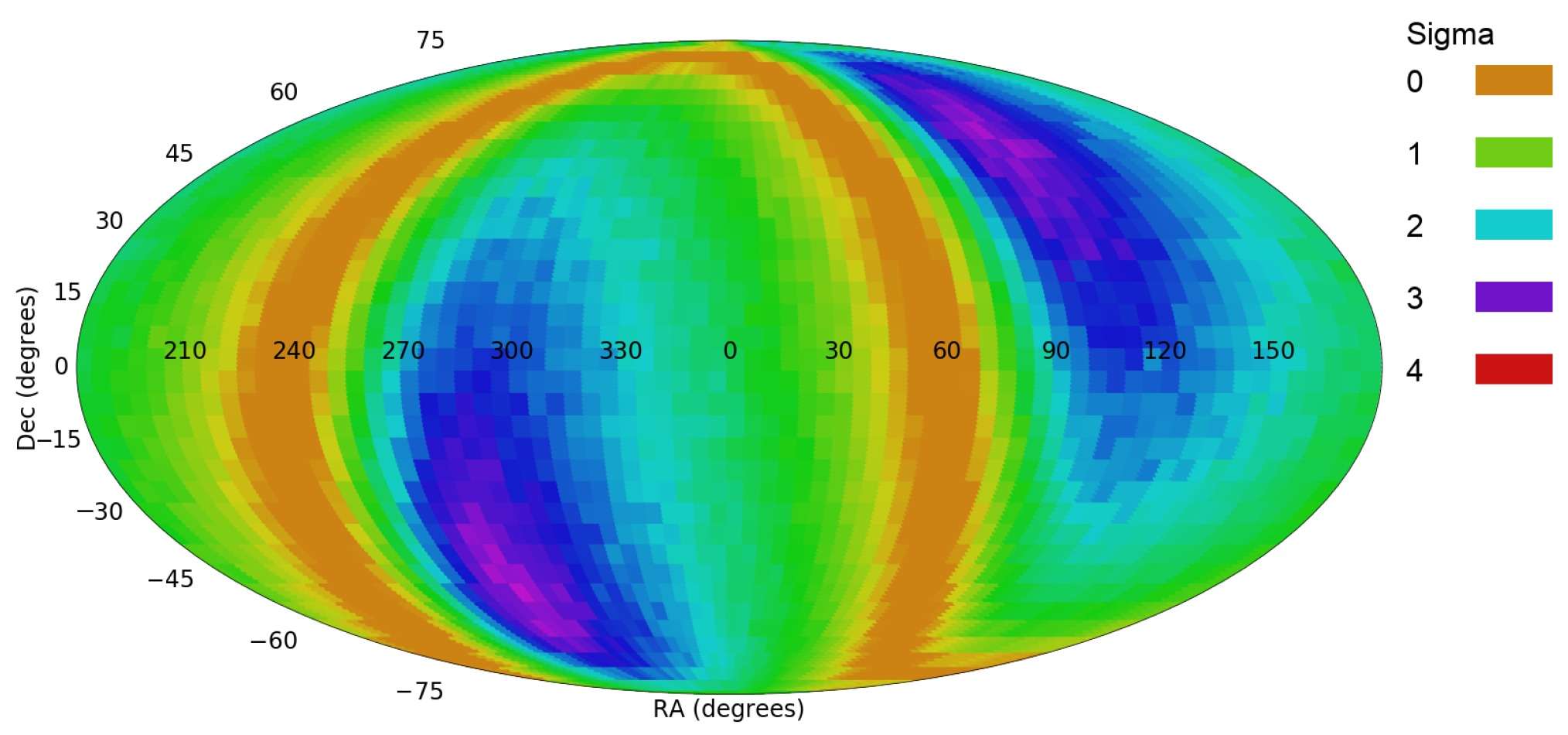
Interestingly, the spin asymmetry isn’t uniform across the sky. It appears oriented along a dipole axis, closely aligned with the Milky Way’s own rotational pole. Previous research has detected this axis within datasets from SDSS, Pan-STARRS, and Hubble. That JWST data, with entirely different instrumentation and observational parameters, also reveals this pattern strengthens its validity.

Further statistical analysis in the Symmetry paper showed that the asymmetry grows stronger with increasing redshift: the older the galaxy, the more likely it is to display aligned spin. This finding might imply that early cosmic structures exhibited greater order, lending support to models featuring anisotropic cosmic inflation or large-scale rotation.
Implications if Confirmed
Should these findings withstand further validation, they could overturn fundamental assumptions. The principle of isotropy forms the backbone of many cosmological models—from simulations of galaxy formation to mapping dark matter. Confirmed large-scale directional bias would necessitate a major reevaluation of the physics underlying the universe.
The results have already been published in a Monthly Notices of the Royal Astronomical Society peer-reviewed article, detailing the methods and statistical analyses employed. The authors have shared their datasets and software openly to encourage independent verification by the global scientific community.










0 comments
Sign in to Comment