
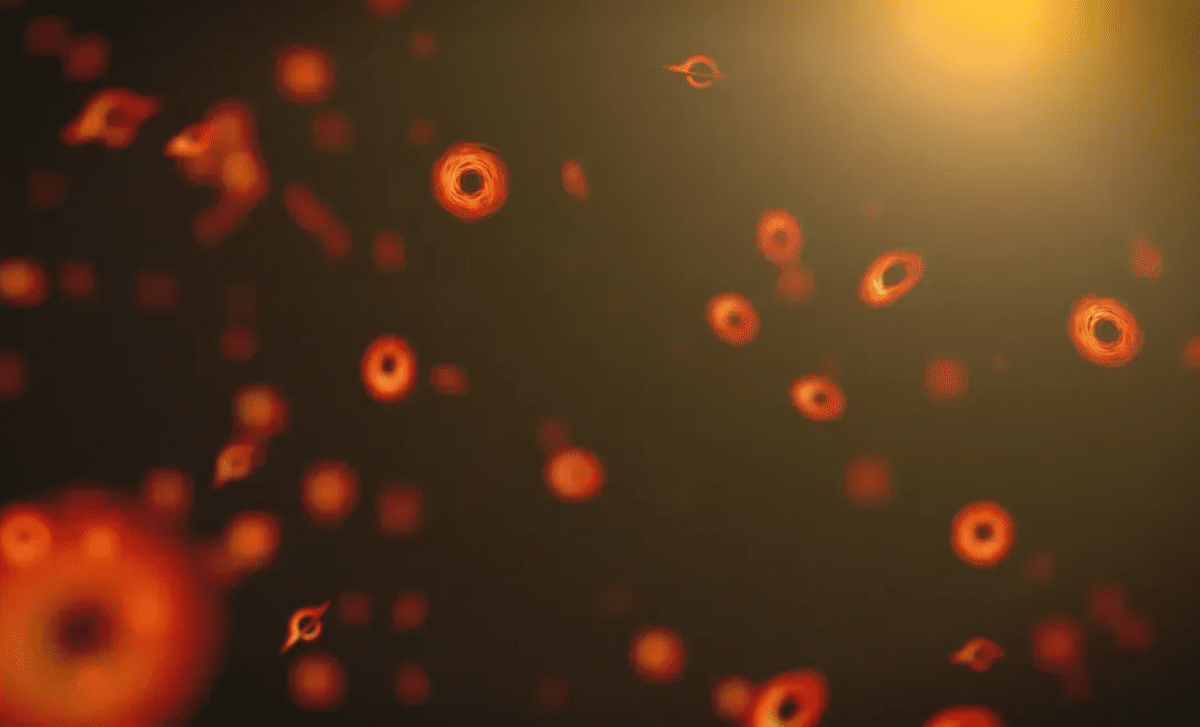
Scientists may have uncovered the first tangible proof of primordial black holes, offering a fresh perspective on the elusive nature of dark matter. The groundbreaking gravitational wave event, recorded by LIGO in November 2025, has sparked a novel theory: instead of involving typical stellar black holes, the source may have been black holes formed during the universe’s earliest epochs. The team from the University of Miami, releasing their findings on arXiv, propose that these primordial black holes might represent a substantial component of dark matter.
An Unusual Gravitational Wave Event
In November 2025, LIGO’s instruments detected a distinctive gravitational wave signal, labeled S251112cm, puzzling researchers with its unique features. The merging bodies were notably lighter than the standard stellar black holes or neutron stars usually observed in such scenarios, possessing masses between 10% and 87% of the Sun’s mass. This contrasted sharply with the minimum mass expected from conventional black holes, which generally exceed 1.4 solar masses, a value linked to supernova remnants as explained in related studies.
The unusual nature of this event encouraged scientists to entertain alternative explanations. One enticing possibility was that the objects were primordial black holes—hypothetical relics from the universe’s birth, formed shortly after the Big Bang. Unlike stellar black holes, these primordial remnants are theorized to have much smaller masses, potentially lighter than our Sun, as detailed in previous research.

A Paradigm-Shifting Proposal
This analysis, accessible via arXiv, posits that the gravitational wave signal could mark the first confirmed encounter of colliding primordial black holes.
“The research suggests that the most plausible explanation for the LIGO signal, which lacks any conventional astrophysical explanation, is the detection of a primordial black hole,” said senior author Nico Cappelluti, an associate professor at the University of Miami. He went on to emphasize the potential significance of this discovery, stating that “these primordial black holes could account for a significant portion, if not all, of dark matter.”
Dark matter, an invisible and enigmatic substance comprising nearly 27% of the universe’s total mass, remains one of the foremost mysteries in contemporary physics. Should primordial black holes prove to be the culprits behind dark matter, it would not only solve a cosmic riddle but also herald new directions for astrophysical exploration.
Origins of Primordial Black Holes
The theory of primordial black holes stretches back to the dawn of time. These entities are thought to have emerged amidst the intense density fluctuations present just moments after the Big Bang, during an epoch when the universe was an extremely hot, compact mix of elementary particles. Unlike black holes formed from dying stars, these primordial objects arose from early-universe conditions and density variations.
What makes primordial black holes especially compelling is their capacity to illuminate the dark matter mystery. Because they neither emit light nor interact strongly with normal matter, direct observation is profoundly challenging. Confirming their presence would provide a breakthrough in understanding dark matter and reveal clues about the very early universe’s state—conditions currently impossible to replicate experimentally.
Linking Primordial Black Holes to Dark Matter
Though not a novel hypothesis, the notion that primordial black holes contribute to dark matter has remained speculative until now. The recent gravitational wave finding may serve as the first concrete evidence reinforcing this idea.
Graduate researcher Alberto Magaraggia, principal investigator on the study, commented,
“We attempted to estimate how many primordial black holes may exist in the universe and how many of them LIGO should be able to detect. And our results are encouraging. We predict that subsolar black holes like the one LIGO may have observed should indeed be rare, consistent with how infrequently such events have been seen so far.”
This insight underscores the infrequency of such occurrences, while highlighting the potential for more discoveries as LIGO’s detection capabilities improve. Confirming primordial black holes would signify a landmark moment in unlocking the secrets of dark matter and early cosmic history.
- Categories:
- Astronomy







0 comments
Sign in to Comment