
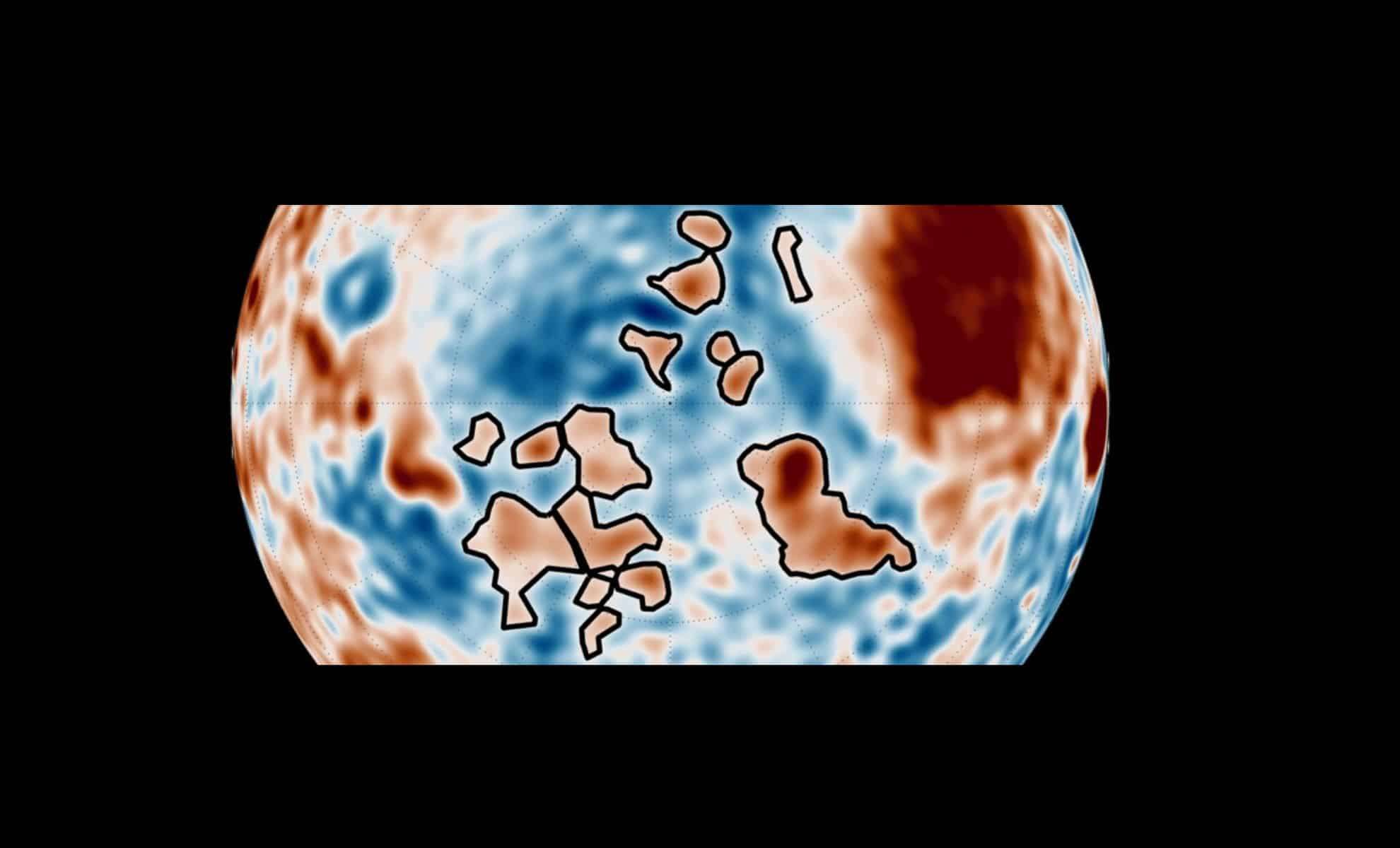
New gravity research on Mars has revealed extensive, dense formations below the planet’s crust, shedding light on possible ongoing geological activities on the Red Planet.
Unveiled at the Europlanet Science Congress 2024, these discoveries point toward persistent mantle dynamics within Mars. These internal movements could be influencing surface features such as the colossal volcanic structure Olympus Mons. This breakthrough has the potential to alter our perspective on Mars' geological development and its chances of future volcanic eruptions.
Peering Deeper Into Mars’ Subsurface
By integrating datasets from various Mars expeditions, including NASA’s InSight lander, scientists created a sophisticated gravity map revealing dense anomalies underneath Mars’ northern polar regions. These findings suggest harder geological activity than earlier assumed. The study was spearheaded by Dr. Bart Root of the Delft University of Technology.

Through analyzing subtle shifts in satellite orbit trajectories, the team identified gravitational irregularities located beneath a smooth sediment layer, possibly resting on a prehistoric seabed. These formations are about 300-400 kilograms per cubic meter denser than the surrounding materials. Dr. Root stated, “These dense masses might originate from volcanic deposits or compressed debris from ancient meteor impacts. We cataloged around 20 features of varying sizes near the northern ice cap, including one remarkably resembling a canine shape.” Though invisible on the surface, these structures offer valuable insights into Mars’ concealed geological past.
Active Volcanism Indicators Near Olympus Mons?
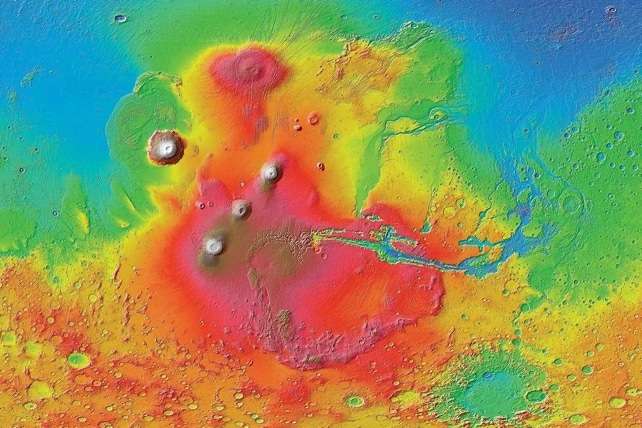
The investigation also brought new understanding of the Tharsis volcanic plateau, home to Olympus Mons, the solar system’s tallest volcano. Typically, such an enormous volcanic mass would depress the surrounding crust through flexural isostasy, a process where a planet’s solid outer shell bends under weight, as observed with Greenland’s ice sheet on Earth.
Contrary to expectations, the Tharsis area remains elevated instead of sinking. Gravity readings imply that a lighter region beneath—likely a mantle plume composed of rising molten rock—is uplifting the terrain. Dr. Root remarked, “This evidence points to Mars maintaining internal activity, which could drive the creation of new volcanic formations.” This challenges the prevailing view of a geologically inactive Mars and hints at potential ongoing volcanism.
Decoding Mars’ Geological Evolution
The newly identified subterranean anomalies give crucial hints about Mars’ evolutionary timeline. These dense signatures below the northern plains may be vestiges of previous volcanic episodes or debris from substantial asteroid impacts, though their precise nature is yet to be fully understood. Future missions are being planned to delve deeper into these mysteries.
One proposed effort is the Martian Quantum Gravity (MaQuIs) project, designed to employ advanced instrumentation similar to that used in the lunar and terrestrial gravity mapping missions GRAIL and GRACE. According to Dr. Lisa Wörner of the German Aerospace Center (DLR), “MaQuIs would vastly improve our insight into Mars’ hidden layers, helping clarify the cause of these enigmatic features and enhancing our understanding of ongoing mantle convection.” Besides geology, this mission could also investigate other surface phenomena such as seasonal atmosphere shifts and potential underground water deposits.
Significance for Upcoming Mars Exploration
These new insights could profoundly influence how future Mars missions are planned, especially those aiming for human exploration and colonization. The possibility of Martian geological activity could affect habitat construction stability and resource availability like water. A mantle plume beneath Olympus Mons might offer geothermal energy sources or assist in melting ice reservoirs, providing crucial water supplies.
Grasping Mars’ internal mechanics is essential for developing sustainable exploration and habitation strategies. As gravity field studies unravel more concealed structures, scientists will better understand the dynamic processes molding Mars across billions of years and anticipate future planetary changes.
This comprehensive gravity research marks a pivotal advancement in revealing the Red Planet’s interior. The identification of dense underground structures and evidence of ongoing mantle activity convey that Mars possesses a far more active geological character than once believed, opening new research pathways and exploration possibilities.
- Categories:
- Astronomy ,
- News ,
- Nasa








0 comments
Sign in to Comment