
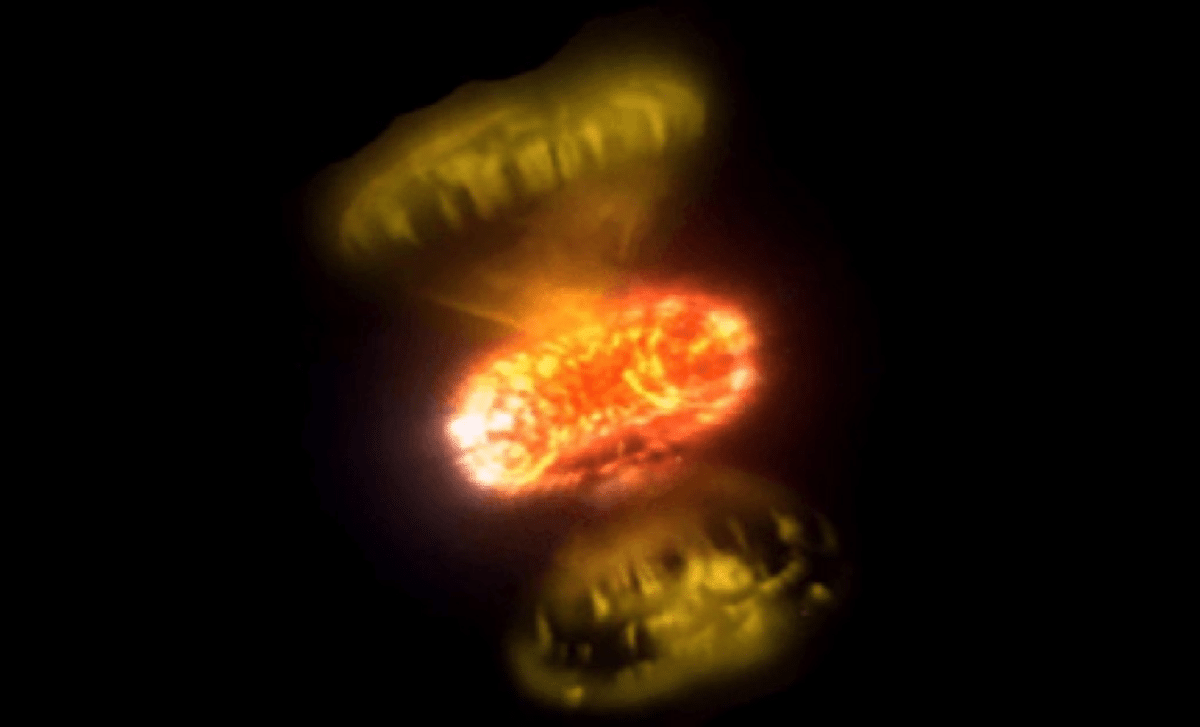
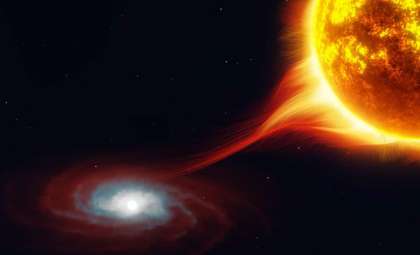
For years, capturing the detailed mechanics behind stellar nova events posed a significant challenge for astronomers. Utilizing state-of-the-art methods, a research team has now managed to visualize these spectacular cosmic blasts with remarkable clarity. Employing advanced imaging and interferometric observations at the CHARA Array in California, they uncovered unexpectedly complex structures within nova eruptions. Their results, featured in Nature Astronomy, shed new light on the energetic phenomena driving these explosions, substantially enhancing our comprehension of their nature and effects.
Revolutionizing the Study of Stellar Bursts
The fleeting and dynamic character of nova explosions has historically limited direct observation. Previously, researchers only observed the diffusing aftermath—a glowing, expanding gas cloud appearing as a singular point. However, in an innovative effort led by Georgia State University scientists, interferometry enabled capturing the initial phases of two nova outbursts, revealing intricate details of the processes at play.
“The images give us a close-up view of how material is ejected away from the star during the explosion,” said Gail Schaefer, director of the CHARA Array. “Catching these transient events requires flexibility to adapt our night-time schedule as new targets of opportunity are discovered.”
Add Cosmo Herald as a Preferred Source

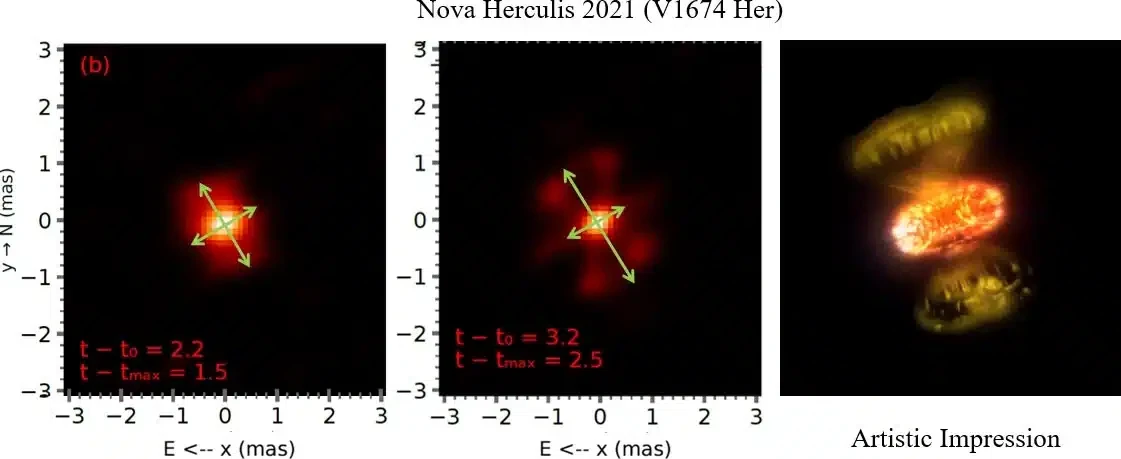
This landmark achievement provides a real-time glimpse of novae, a stark contrast to earlier indirect inferences. For the first time, researchers observed multiple streams of gas being expelled in almost perpendicular directions during an explosion, offering compelling proof of the event’s intricate mechanics. This challenges earlier assumptions of novae as uniform, one-stage explosions and reveals the nuanced dynamics of ejecta and shockwave development.
Insights from the Rapid Eruption of Nova V1674 Herculis
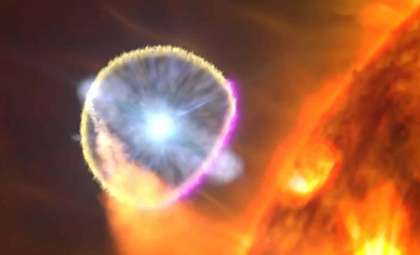
Among the novae examined, Nova V1674 Herculis stands out as one of the fastest observed stellar blasts. Captured within days following its eruption, images revealed two distinct and nearly perpendicular streams of gas expelled in rapid succession. Tracking these flows as they evolved offered remarkable insights into the explosion's dynamics. The collision of these gas streams generated shockwaves vital to decoding the high-energy emissions linked with such events.
By correlating these shockwaves with gamma-ray signals detected by NASA’s Fermi Gamma-ray Space Telescope, the study reinforced the relationship between nova explosions and particle acceleration at extreme energies. This research dispels the notion of nova eruptions as simple blasts, highlighting their complex and energetic nature.
Interferometry: Unlocking the Secrets of Stellar Explosions
These detailed observations were made possible by interferometry, a technique that combines light from multiple telescopes to construct highly resolved images of distant space phenomena. This approach has driven major achievements in astronomy, including the first black hole image. “This is an extraordinary leap forward,” explained John Monnier, co-author and interferometric imaging expert, in the Nature Astronomy publication.
“The fact that we can now watch stars explode and immediately see the structure of the material being blasted into space is remarkable. It opens a new window into some of the most dramatic events in the universe.”
Through interferometry, astronomers uncovered fine structural details within nova ejecta, clarifying their geometry and composition. Complementary spectral data from other observatories traced the chemical evolution of the expelled gas over time. These combined findings allowed researchers to develop a comprehensive model of the eruptive processes and the resultant shockwave formations.
Contrasting Dynamics in Nova V1405 Cassiopeiae
In contrast, the other nova examined, Nova V1405 Cassiopeiae, exhibited a much slower development. Unlike Nova V1674 Herculis’s rapid detonation, this star’s outer layers took over 50 days to fully eject. This prolonged expulsion unveiled previously unknown behaviors in nova explosions. The delayed material release triggered shockwaves upon gas expulsion, which again resulted in gamma-ray bursts seen by NASA’s Fermi telescope.
“This is just the beginning,” said Elias Aydi, lead author of the study and a professor of physics and astronomy at Texas Tech University. “With more observations like these, we can finally start answering big questions about how stars live, die, and affect their surroundings. Novae, once seen as simple explosions, are turning out to be much richer and more fascinating than we imagined.”
Novae as Laboratories for Extreme Physical Processes
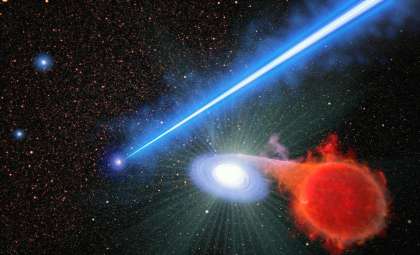
Beyond revealing explosion complexity, these new insights show how nova events act as natural laboratories to study extreme physics. The shockwaves energize particles to incredible levels, producing the gamma radiation detected by instruments like NASA’s Fermi telescope.
“Novae are more than fireworks in our galaxy—they are laboratories for extreme physics,” said Professor Laura Chomiuk, a co-author from Michigan State University. “By seeing how and when the material is ejected, we can finally connect the dots between the nuclear reactions on the star’s surface, the geometry of the ejected material, and the high-energy radiation we detect from space.”
Studying novae provides vital understanding about matter under intense conditions such as the extreme temperatures and pressures during stellar eruptions. These observations help unravel the fundamental physics governing stellar death throes and the generation of cosmic shockwaves.
- Categories:
- Space





0 comments
Sign in to Comment