
Amid mounting global challenges like workforce burnout, skill shortages, and rising living costs, the Netherlands has quietly redefined the conventional workweek—achieving a shorter work schedule not by policy mandates, but through deep-rooted cultural practices.
Recent data from Eurostat reveals that Dutch employees aged 20 to 64 now have the shortest average workweek in the European Union, clocking in at just 32.1 hours. This is notably less than France and Germany. Remarkably, this shift wasn’t enforced by legislation—it emerged gradually and naturally.
Over decades, a combination of evolving social policies, gender-related work patterns, and a national emphasis on achieving a healthy work-life balance has resulted in many full-time roles being effectively condensed into four-day schedules. Part-time employment, long a staple of Dutch labor, is no longer viewed as peripheral but as a respected career path.

“It’s become so embedded, people don’t even call it the four-day week,” says Bert Colijn, senior economist at ING. “I work five days, and sometimes I get side-eye for it.”
The Rise of Flexible Work and the One-and-a-Half Earner Household
This transition traces back to the 1980s and 1990s when more Dutch women began joining the labor market in part-time positions. At that time, the Netherlands largely adhered to a traditional “male breadwinner” model, but reforms in taxation and social welfare made shorter working hours more accessible and appealing.
This led economists to identify the “one-and-a-half earner” family structure: one partner working full-time and the other, often the mother, working part-time. The model became widely accepted, encouraging even fathers to reduce hours, especially when raising young children.
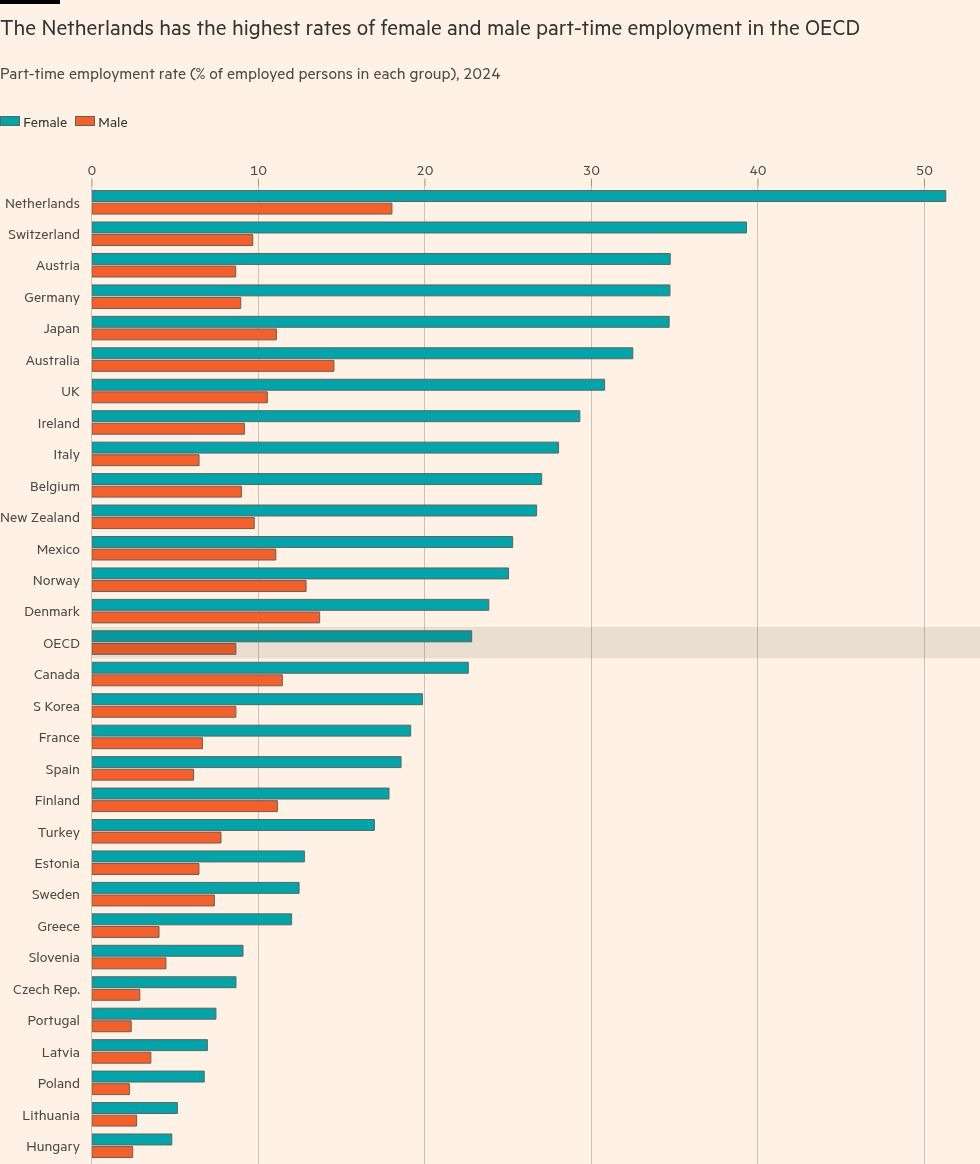
Currently, nearly 50% of Dutch workers hold part-time jobs, the highest share among OECD countries. Unlike many other nations, where part-time roles often lack security or adequate compensation, the Dutch workforce generally enjoys competitive wages, benefits, and career advancement opportunities within these positions.
This gradual adaptation contrasts with recent structured four-day workweek trials in the UK, Iceland, and Belgium, which have yielded gains in well-being and efficiency. As noted by Colijn, the Dutch situation simply developed over time without fanfare.
Economic Output Remains Strong Despite Fewer Hours
Detractors of shorter workweeks sometimes worry about negative impacts on productivity and competitiveness. However, data from the OECD suggests the Netherlands excels economically: it ranks among the EU’s wealthiest countries in GDP per capita while sustaining a high per-hour productivity rate of €45.3, surpassing Spain and nearing France and Ireland.
The nation also boasts elevated employment levels, with 82% of working-age individuals participating in the labor force—outpacing countries like the UK (75%) and the US (72%). Female labor force participation is particularly impressive compared to countries where longer working hours are standard.
Nevertheless, challenges persist. Gender disparities remain entrenched; only 27% of leadership roles in Dutch firms are occupied by women, ranking low within the OECD. Women continue to disproportionately occupy part-time positions, which can hinder career progression over time.
Labor shortages pose additional difficulties, notably in healthcare and education, where fragmented schedules complicate consistent staffing. An Amsterdam teacher shared to local press, “A staff shortage leads to chaotic school hours, which adds strain to parents juggling work and family.”
Lessons from the Dutch Example for Global Policy
While debates on implementing four-day workweeks intensify in countries such as the UK and the US, the Netherlands offers a tangible example of how cultural transformation—not just legislation—can reshape work norms. Their experience reveals that longer hours aren’t inherently linked to higher productivity.
However, Netherlands’ success is deeply intertwined with its compact size, social safety nets, and well-organized labor market, making direct replication elsewhere challenging. Still, the Dutch model is inspiring fresh analyses among economists and policymakers.
A 2019 OECD report praised the Netherlands for balancing flexibility, economic performance, and labor participation, though noting ongoing gender challenges. Academics at Utrecht University and Leiden Law School are researching how this organic framework might guide future labor reforms across Europe, especially in the face of demographic shifts and pressure on public services.
Meanwhile, Dutch children consistently rank highest in the UNICEF World Happiness Report, hinting at a society that prioritizes well-being alongside productivity.
- Categories:
- News












0 comments
Sign in to Comment