
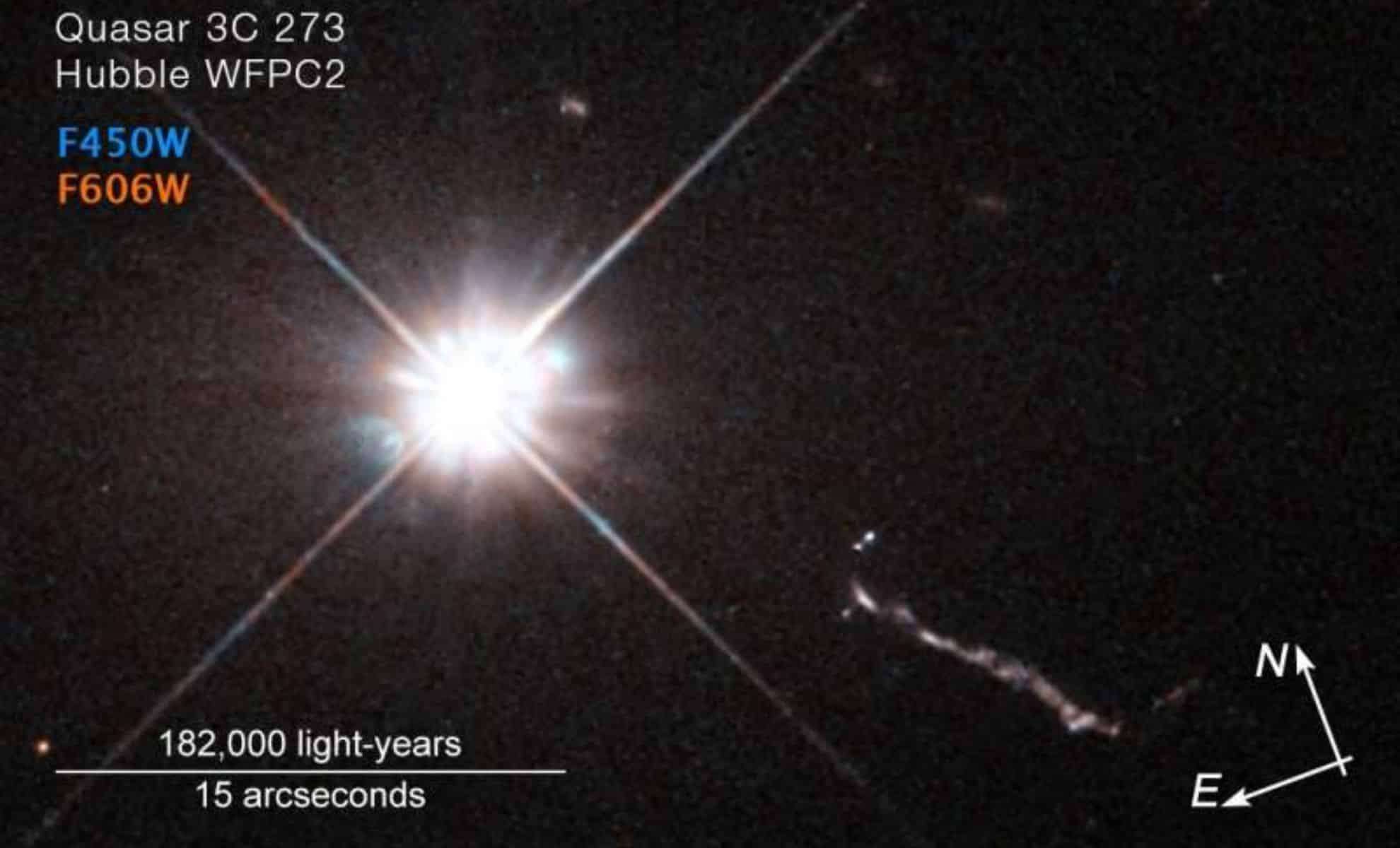
The Hubble Space Telescope has captured an extraordinary new view of the renowned quasar 3C 273, delivering unparalleled insight into its dynamic environment. Situated approximately 2.5 billion light-years from Earth, 3C 273 ranks among the nearest and most luminous quasars observed, making it a key subject for cosmic study. This latest observation signifies a major advancement in our ability to examine quasars—enormous galactic nuclei powered by supermassive black holes—and their complex surroundings.
At the heart of 3C 273 lies a supermassive black hole, encircled by swirling clouds of gas and dust that emit intense energy as they spiral inward. Using the Space Telescope Imaging Spectrograph (STIS) aboard Hubble, astronomers have obtained highly detailed images that reveal phenomena near the quasar with exceptional clarity, shedding new light on the mechanisms driving these powerful cosmic engines.
Historically, quasars appeared as simple points of light due to their vast distances, but Hubble’s advanced resolution allows researchers to explore the quasar's vicinity at an unprecedented scale. This breakthrough is unlocking the mysteries of quasar-galaxy relationships and offering fresh perspectives on the birth and development of these immense astronomical structures.

Peering Deep into 3C 273’s Core
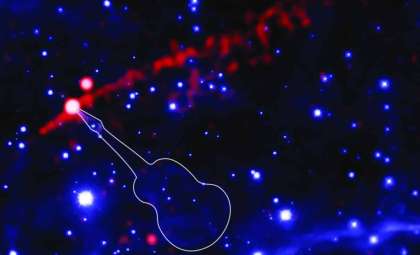
A remarkable discovery reported by the Hubble team includes the identification of unusual L-shaped filaments and a variety of material clumps close to the quasar core. According to Bin Ren from the Côte d’Azur Observatory in France, these distinctive formations lie within roughly 16,000 light-years of the black hole and provide unexpected views into the quasar’s immediate environment. “We’ve got a few blobs of different sizes, and a mysterious L-shaped filamentary structure. This is all within 16,000 light-years of the black hole,” Ren explained.
These newly observed features may indicate the presence of smaller satellite galaxies or inflowing matter toward the black hole. Grasping how such material behaves near a supermassive black hole is vital to understanding how these fascinating giants grow and influence their host galaxies. Furthermore, the findings open new pathways for exploring how galactic collisions and interactions contribute to quasar and black hole development.
“Thanks to Hubble’s extraordinary capabilities, we’re gaining a new gateway into quasar research,” Ren remarked. “My team is thrilled by the level of detail we’ve uncovered.” Indeed, the extraordinary resolution of Hubble’s images of 3C 273 marks a transformative moment in the study of quasars.
Filling Critical Observational Gaps with Hubble
Beyond the discovery of intricate structures, Hubble has also captured the extensive jets of energy emitted by the quasar, which extend more than 300,000 light-years into space at near light speed. These jets are key to understanding not only the quasar’s energy production but also the influence of supermassive black holes on their cosmic surroundings.
“Hubble bridges the observational gap between vast-scale optical data and detailed radio interferometry,” Ren stated. “The fine structures and jet dynamics enable a more thorough understanding of quasar host galaxy morphology.” This means Hubble’s combination of optical imaging and high-precision spectroscopy allows scientists to analyze the quasar’s accretion disk, energetic jets, and nearby environmental features with remarkable detail.
Ren further highlighted Hubble’s role in advancing knowledge of quasar structure and the interactions with their parent galaxies. “Our prior observations were limited, but Hubble reveals the complex nature of quasar morphology and galactic interplay with unprecedented clarity,” he said. Insights like these are essential for comprehending how quasars shape the evolution of the broader universe.
The Future of Quasar Exploration
Looking forward, astronomers anticipate that forthcoming studies, especially with the James Webb Space Telescope, will provide even deeper understanding of 3C 273. Webb’s infrared sensors will enable exploration of the quasar’s core and surrounding matter in greater depth, potentially uncovering additional features and enhancing knowledge about quasar lifecycles.
Ren noted that infrared investigations could offer “more clues” about the quasar and its immediate surroundings. Webb’s ability to examine cooler gas and dust, which affect the quasar’s brightness and jet formation, promises to enhance current models. “In the future, looking further at 3C 273 in infrared light with the James Webb Space Telescope might give us more clues,” he added.
These advancements have broad implications for quasar science, an area central to understanding the early universe, galaxy formation, and the growth of supermassive black holes. As cutting-edge facilities like Hubble and Webb continue pushing boundaries, the frontier of quasar research is set for transformative discoveries.




0 comments
Sign in to Comment