
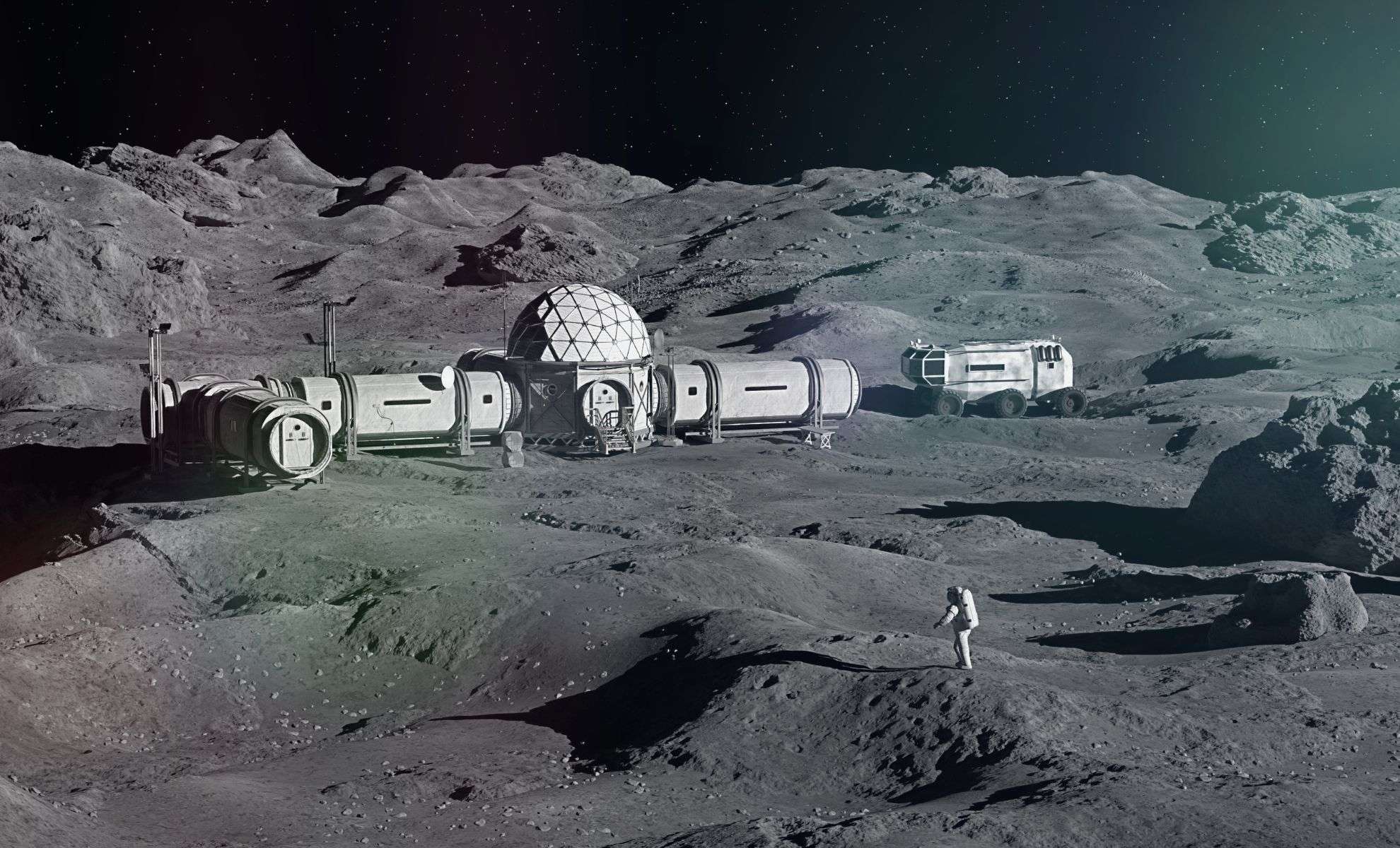
A team of Chinese researchers has introduced a solar-driven 3D printing apparatus that fabricates sturdy bricks from lunar soil, offering a transformative approach to constructing habitats on the Moon. Reported in Acta Astronautica, this method relies entirely on Moon dust without needing materials shipped from Earth.
Operating Principles of the Printer
Engineered at the Deep Space Exploration Laboratory (DSEL) in Hefei, Anhui, the machine functions akin to a 3D printer but uses concentrated solar energy as its thermal source. A parabolic mirror gathers and focuses sunlight into a pinpoint, where fiber optic cables channel the energy to amplify light intensity to more than 3,000 times that of Earth’s surface sunlight.
This concentrated energy creates heat exceeding 1,300°C (2,300°F), sufficient to melt lunar regolith. Using simulated basaltic Moon soil and a xenon lamp simulating sunlight in lab trials, researchers fashioned diverse shapes including flat panels, curves, and intricate designs.

The Importance of Lunar Bricks
Shipping building materials from Earth is one of the biggest cost hurdles in developing lunar habitats. This innovation, based on local Moon materials, could cut expenses significantly and enable sustainable colonization of the lunar surface.
Senior engineer Yang Honglun explained that these bricks can serve as building blocks for roads, equipment foundations, and protective outer layers for living quarters. While unable to contain internal air pressure on their own, they provide critical shielding from micrometeorite impacts and harmful solar radiation.
Testing Under Lunar-Like Conditions
In November 2024, the Tianzhou 8 spacecraft delivered simulated lunar bricks to the Tiangong space station, where they will be exposed to the space environment for three years to evaluate their resistance to temperature extremes, mechanical wear, and radiation.
DSEL engineers have tested multiple simulated regolith types to confirm the method’s compatibility with various lunar soil compositions. Their process is designed to be self-reliant, requiring no additives beyond natural Moon dust.
Expanding the Scope of Lunar Construction
Yang’s team envisions this device as one component in an automated construction network, where robots could mass-produce bricks, assemble them into structures, and verify their performance on the Moon. This strategy could facilitate the creation of fully-fledged lunar settlements without ongoing Earth supply missions.
Furthermore, this technology may have applications beyond our satellite, potentially assisting Mars exploration and other extraterrestrial habitation efforts.
Implications for the Space Race
While NASA’s Artemis program is advancing similar methods for lunar construction, China’s rapid progress offers a competitive edge in establishing a continuous presence on the Moon. Mastering on-site material production could shape future rules for resource utilization and sovereignty in space.
This development is a significant step forward for extraterrestrial building, though challenges like ensuring durability under low gravity, extreme temperature fluctuations, and abrasive lunar dust still need resolution. Upcoming trials will determine if this technology can transition from experimentation to wide-scale use.
- Categories:
- News










0 comments
Sign in to Comment