

Employing the advanced capabilities of NASA’s James Webb Space Telescope, astronomers have made significant strides in understanding sub-Neptunes, a prevalent yet enigmatic type of exoplanet. These small, gas-rich worlds, unlike any found in our solar system, dominate the population of discovered exoplanets. Recent observations focusing on the exoplanet TOI-421 b have given researchers an unprecedented glimpse into the atmospheres of sub-Neptunes, which were previously veiled in a haze. As reported by NASA Science, Webb’s data is offering vital clues about why these planets are so widespread and yet so different from familiar solar system worlds.
Unlocking the Mysteries of Sub-Neptunes
Discovered unexpectedly by NASA's Kepler Space Telescope, sub-Neptunes are planets larger than Earth but smaller than traditional gas giants. Their thick, cloudy atmospheres have long made it difficult for scientists to study their compositions directly. Prior to Webb’s observations, attempts to analyze these planets’ atmospheres resulted in largely featureless or “flat” spectral readings due to obscuring clouds and haze.
“The arrival of Webb has been a turning point in our ability to study these smaller worlds,” explained Eliza Kempton, a lead scientist at the University of Maryland, College Park. “Characterizing their atmospheres is key to unraveling their origins and why such planets don’t exist in our own solar neighborhood.”

TOI-421 b Offers a Clear Atmospheric Window
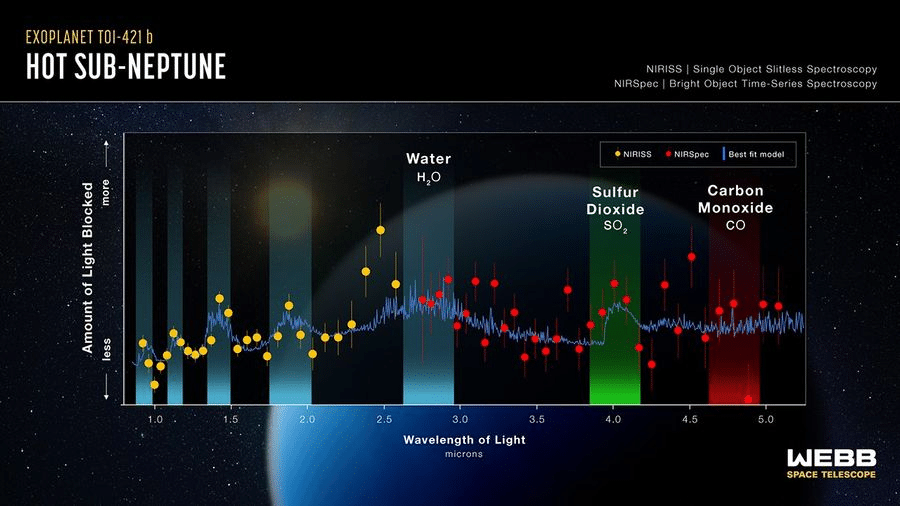
Webb’s observations of TOI-421 b, a warm sub-Neptune with temperatures near 1,340 degrees Fahrenheit, have led to a major breakthrough. Scientists anticipated that planets exceeding about 1,070 degrees Fahrenheit would have less atmospheric haze, revealing clearer chemical signals.
“The spectra we captured displayed distinct molecular signatures that enabled us to identify specific gases in TOI-421 b’s atmosphere,” said Brian Davenport, a doctoral candidate from the University of Maryland. “Previously observed sub-Neptunes had atmospheres shrouded in haze, making it difficult to detect these features.” Detected molecules include water vapor, carbon monoxide, and sulfur dioxide, enriching our understanding of this planet’s atmospheric makeup.
Reevaluating Sub-Neptune Diversity
One unexpected result was identifying hydrogen as the main component in TOI-421 b’s atmosphere, contrasting with the heavier molecular atmospheres found in other Webb-studied sub-Neptunes. This suggests distinct evolutionary paths within this planet group.
“We’ve developed a new lens for viewing sub-Neptunes,” Davenport noted. “Planets with higher temperatures are more amenable to detailed atmosphere characterization, accelerating our insights into these intriguing worlds.”
These findings pave the way for deeper exploration into the origins and development of sub-Neptunes, raising questions about whether TOI-421 b represents a new subclass or an odd exception. Future Webb observations targeting similarly warm sub-Neptunes are expected to further illuminate these cosmic mysteries and advance our knowledge of planetary systems beyond Earth’s neighborhood.
- Categories:
- News










0 comments
Sign in to Comment