
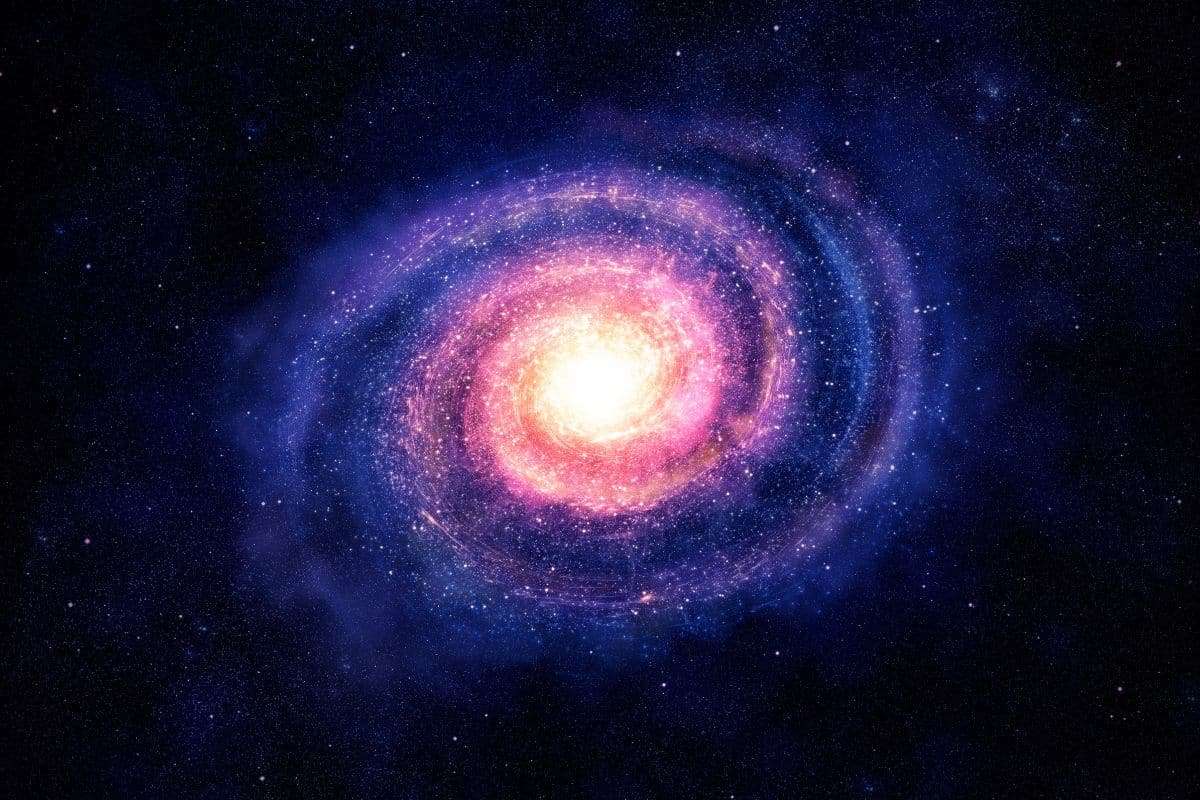
Utilizing the James Webb Space Telescope (JWST), astronomers have pinpointed the farthest known inactive galaxy, showing that some enormous galaxies ceased star formation alarmingly early—only 700 million years post-Big Bang.
A Groundbreaking Cosmic Discovery
The galaxy, designated RUBIES-UDS-QG-z7, came to light through the European-led RUBIES survey during JWST’s second cycle of observations. It contains over 10 billion solar masses packed within a tiny region just 650 light-years across, making it remarkably dense and compact.
What sets RUBIES-UDS-QG-z7 apart is its quiescent nature—indicating star formation had already stopped when the Universe was under a billion years old. This challenges previous assumptions about the timeline for the formation and aging of massive galaxies.

“The identification of RUBIES-UDS-QG-z7 suggests that massive quiescent galaxies existing within the Universe’s first billion years are over 100 times more common than any model has anticipated,” stated Andrea Weibel, lead researcher and doctoral candidate at the University of Geneva’s Astronomy Department.
Star Formation Ceased Far Sooner Than Anticipated
The research published in the Astrophysical Journal indicates that typical galactic growth involves drawing gas from the intergalactic medium, transforming it into stars. This star formation intensifies as galaxies gain mass, ultimately halting in a process called “quenching”. Previously, it was believed this cessation unfolds over extended periods.
Thanks to JWST’s advanced infrared capabilities, astronomers can study distant galaxies’ spectral signatures. The data from NIRSpec/PRISM on RUBIES-UDS-QG-z7 reveal an aged stellar population lacking hot, blue stars, containing only older, redder stars—indicating the galaxy had finished its star-forming phase.
“RUBIES-UDS-QG-z7’s discovery offers significant proof that the cores of some massive elliptical galaxies nearby may have formed within the Universe’s initial few hundred million years,” explained Anna de Graaff, the RUBIES program lead and postdoctoral scientist at the Max Planck Institute for Astronomy.
Challenges to Established Theories
Prior to this, the earliest quiescent galaxies identified appeared about 1.2 billion years after the Big Bang (around redshift 5). RUBIES-UDS-QG-z7 extends this boundary by 500 million years, casting doubt on current early galaxy formation models.
“Discovering primordial massive quiescent galaxies (MQGs) is vital for understanding their origin,” noted Pascal Oesch, co-author and professor at the University of Geneva’s Faculty of Science.
Current simulations cannot explain how such an ultra-dense, massive galaxy could form and halt star production so rapidly. Researchers now consider that stellar winds, black hole feedback, and galactic outflows might play a larger role in stopping star formation than was once assumed.
The Progenitors of Today’s Giant Galaxies
Although distant and ancient, RUBIES-UDS-QG-z7’s compactness and stellar density resemble the dense cores of massive elliptical galaxies observed today. This structure hints that it may represent the primordial nucleus of a present-day large elliptical galaxy.
This discovery suggests that central bulges of massive galaxies could have formed within just a few hundred million years after the Big Bang, reshaping our comprehension of early cosmic evolution.
- Categories:
- News



0 comments
Sign in to Comment