
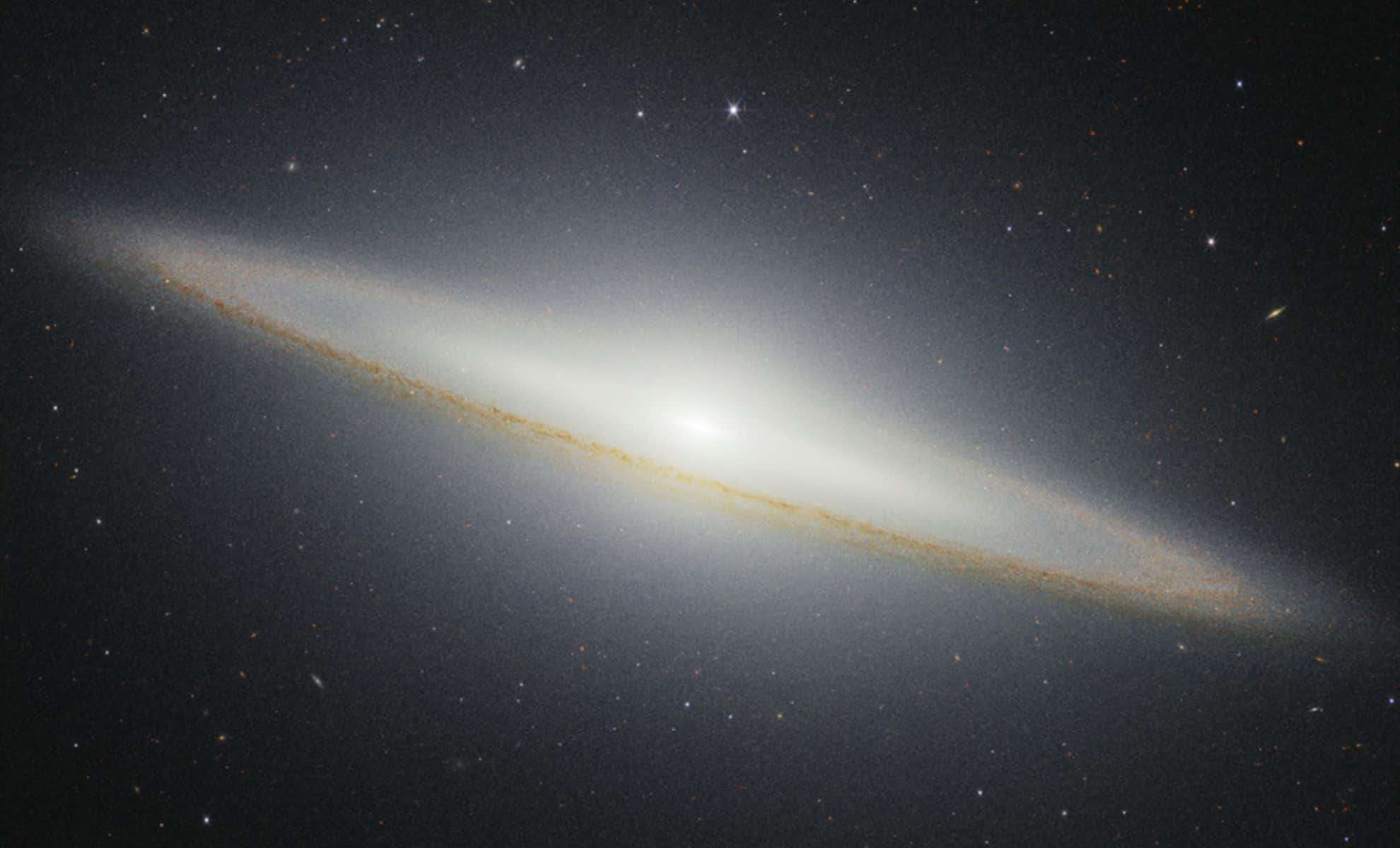
The James Webb Space Telescope has enriched our understanding of the Sombrero Galaxy by capturing a mesmerizing image in the near-infrared spectrum. This fresh view complements earlier mid-infrared observations made toward the end of 2024. Known for its large central stellar bulge and distinctive dust ring, the Sombrero Galaxy continues to intrigue the scientific community.
Exploring the Distinctive Characteristics of the Sombrero Galaxy
Situated roughly 30 million light-years away, at the periphery of the Virgo Cluster, the Sombrero Galaxy has long fascinated both professional and amateur astronomers. Its recognizable disk and marked dust lane are well-known features. Now, NASA’s Webb Space Telescope offers an even more refined and detailed image. By utilizing its NIRCam (Near-Infrared Camera), Webb exposes the dense stellar population concentrated in the galaxy’s core—referred to as the bulge—illuminated in unprecedented detail.
These newest images are particularly important because they allow astronomers to peer beyond the visible spectrum into infrared wavelengths. Unlike images from NASA’s Hubble Space Telescope, where the dust lane appears thick and obscuring, the near-infrared light can penetrate the dust more effectively. This reveals a clearer view of the galaxy’s complex interplay between gas, stars, and dust, enabling a more comprehensive examination of its internal dynamics.

Traces of a Turbulent History
Although the Sombrero Galaxy currently displays a tranquil shape characterized by a smooth dust lane and gentle glow, evidence suggests it experienced a turbulent past. Astronomers have found indications of past violent galactic mergers, with one strong clue being the presence of globular clusters. These dense star groupings, numbering approximately 2,000, show diverse chemical compositions, hinting at their formation through previous galactic collisions.
Normally, stars formed from the same cosmic cloud share similar chemical signatures — elements such as oxygen, neon, and iron. Yet, within the Sombrero Galaxy’s globular clusters, astronomers detect differing chemical profiles. This variation is a sign that the galaxy’s growth involved significant alterations, likely triggered by mergers with other galaxies.
Webb’s Exceptional Capability to Resolve Stars and Galaxies
The newest near-infrared images taken with Webb’s NIRCam do more than reveal the Sombrero Galaxy’s structure. Webb’s impressive resolution can even identify individual stars beyond this galaxy, including red giants—large, relatively cool stars that shine brightly in near-infrared wavelengths. These stars stand out strongly, whereas smaller, hotter stars tend to fade in the longer wavelength light.
Notably, some red giants in these images are part of galaxies at different distances from the Sombrero Galaxy, creating a stunning assortment of shapes and colors within Webb’s field of view. By examining these galaxies' colors, astronomers can estimate their distances and characterize their properties. This capability enhances our knowledge of the universe’s vast variety and scale.
The Enigmatic Warped Disk
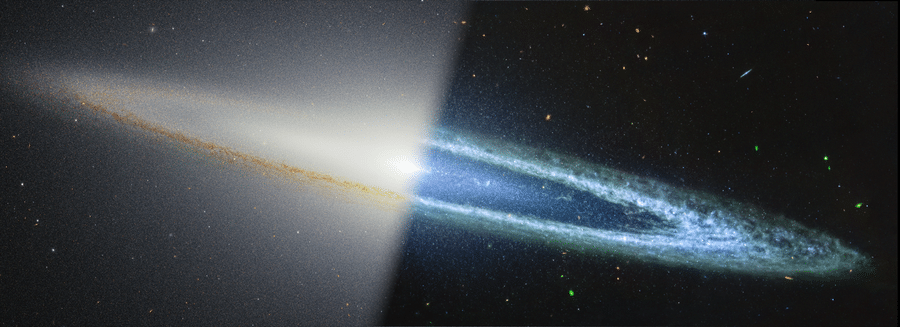
Beyond the discovered globular clusters and red giants, the Sombrero Galaxy exhibits another fascinating feature: its inner disk appears to tilt inward in a subtle funnel shape when observed from Webb’s vantage point. This tilted disk, visible thanks to Webb’s edge-on perspective, suggests ongoing gravitational disturbances.
This warped inner disk further supports the merger theory. Over billions of years, gravitational effects from past galactic collisions may have warped the disk's initially smooth form. Webb’s images from NIRCam and MIRI (Mid-Infrared Instrument) reinforce this scenario, showing the warped disk as a natural consequence of such cosmic interactions.
- Categories:
- News








0 comments
Sign in to Comment