
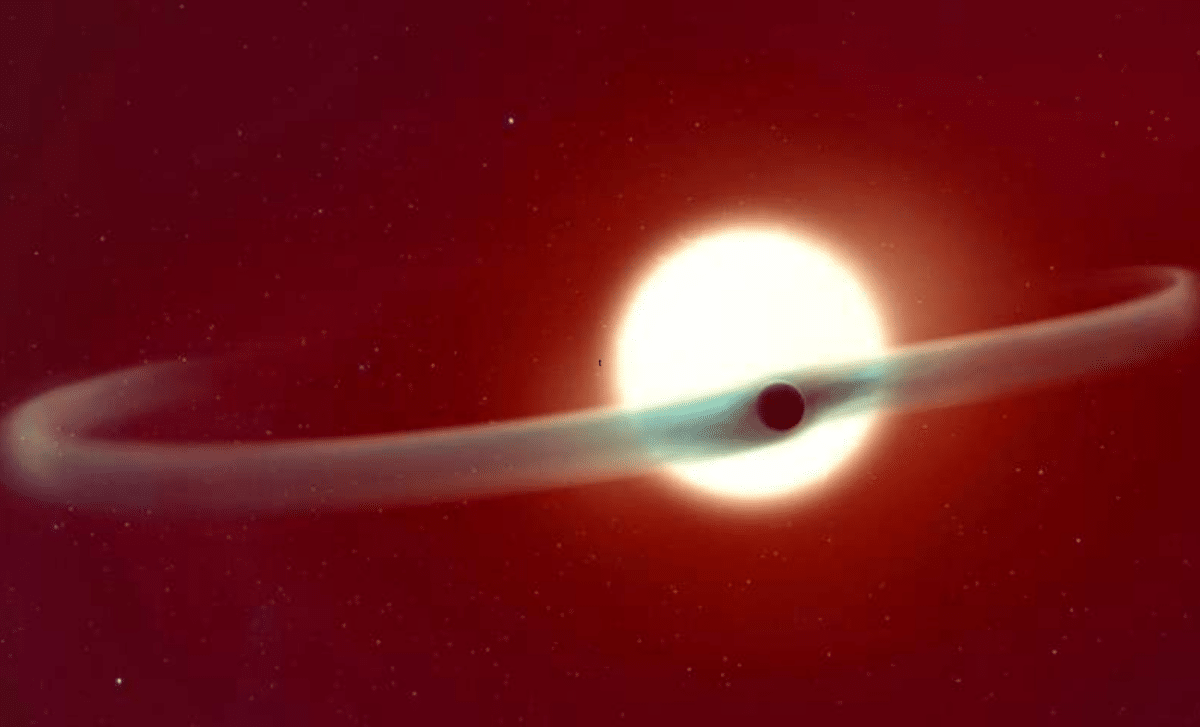
Researchers have made an extraordinary breakthrough regarding the exoplanet WASP-121 b, orbiting a faraway star. Utilizing the advanced capabilities of the James Webb Space Telescope (JWST) paired with its Canadian-built NIRISS instrument, scientists have tracked the planet’s atmospheric escape in unprecedented detail, revealing the presence of two enormous helium tails. This continuous monitoring, spanning a full orbit, offers fresh perspectives on planetary evolution under intense stellar radiation.
Remarkable Discovery of Two Helium Tails
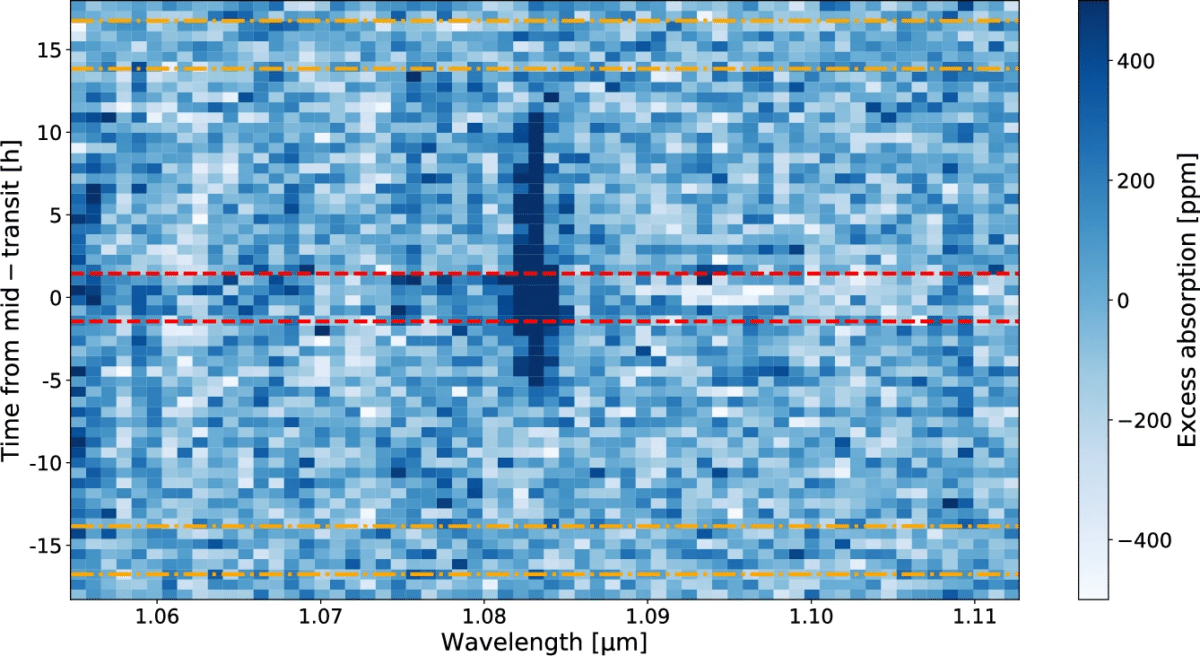
For the first time ever, astronomers have observed an entire orbital cycle of atmospheric loss around an exoplanet. The focus of this groundbreaking study, led by Romain Allart from the Université de Montréal, was WASP-121 b, an ultra-hot Jupiter in close proximity to its star. Unlike prior studies that captured only fleeting moments during transit events, the team employed JWST’s NIRISS instrument to continuously observe the planet’s atmosphere for over 37 hours, covering a bit more than its full orbit. This approach revealed two massive helium tails extending far beyond the planet.
The helium streams detected around WASP-121 b are unprecedented in scale and form. One tail trails behind the planet while the other leads ahead, each stretching over 100 planetary diameters. The front tail appears to be shaped by gravitational interactions with the host star.

“We were incredibly surprised to see how long the helium outflow lasted,” said Allart, the paper’s lead author. “This discovery reveals the complex physical processes sculpting exoplanet atmospheres and how they interact with their stellar environment. We are only starting to uncover the true complexity of these worlds.”
Rethinking How Planets Change Over Time
These observations challenge the current understanding of atmospheric dynamics in exoplanets. Past measurements were often confined to transit events providing limited snapshots. However, the continuous coverage from JWST’s NIRISS exposes more nuanced temporal variations in atmospheric escape. Allart highlights how this data could revolutionize planetary atmosphere modeling.
“This is truly a turning point,” he remarked. “We now have to rethink how we simulate atmospheric mass loss—not just as a simple flow, but with a 3D geometry interacting with its star. This is critical to understand how planets evolve and if gas giant planets can turn into bare rocks.”
The findings illuminate the complex interactions between planets and their parent stars, advancing the knowledge of planetary development processes. By tracking how helium, hydrogen, and other gases are lost from these exoplanets, researchers can enhance predictive models that describe planetary transformations across tremendous timescales.
An Instrumental Milestone in Exoplanet Study
This landmark finding was made possible by the continuous, high-fidelity data collected by JWST’s NIRISS instrument, engineered to analyze distant planetary atmospheres. Louis-Philippe Coulombe, the study’s second lead, emphasized, “The continuous, high-precision data from NIRISS are what made this discovery possible.” By capturing the planet’s entire phase curve, the team obtained rich insights not only into atmospheric escape but also into the planet’s composition, climate patterns, and energy balance. This achievement underscores NIRISS as a vital asset for exoplanet research.
Canada’s pivotal contribution to the JWST project has empowered scientists to extend the frontier of space exploration, enabling groundbreaking discoveries about distant worlds. The new data highlight Canada’s significant role in shaping advancements in exoplanetary science.
Broader Impact on Exoplanet Research
These findings open exciting new paths for studying distant worlds. By mapping the helium escape around WASP-121 b throughout its orbit, researchers are now equipped to investigate whether the presence of two helium tails is a unique feature or a common phenomenon among ultra-hot exoplanets. Such observations provide key insights into planetary atmospheric erosion and evolution.
This research also sheds light on the so-called “Neptune desert”—the observed lack of small, hot gas giants. Many may be the remnants of larger planets stripped of their outer layers by harsh stellar radiation. Understanding atmospheric loss mechanisms can clarify how these planets ultimately evolve.
Nature Communications published this comprehensive study, which emphasizes the complexity of atmospheric escape phenomena and the pressing need for sophisticated simulation models to capture these dynamics.
- Categories:
- Space












0 comments
Sign in to Comment