
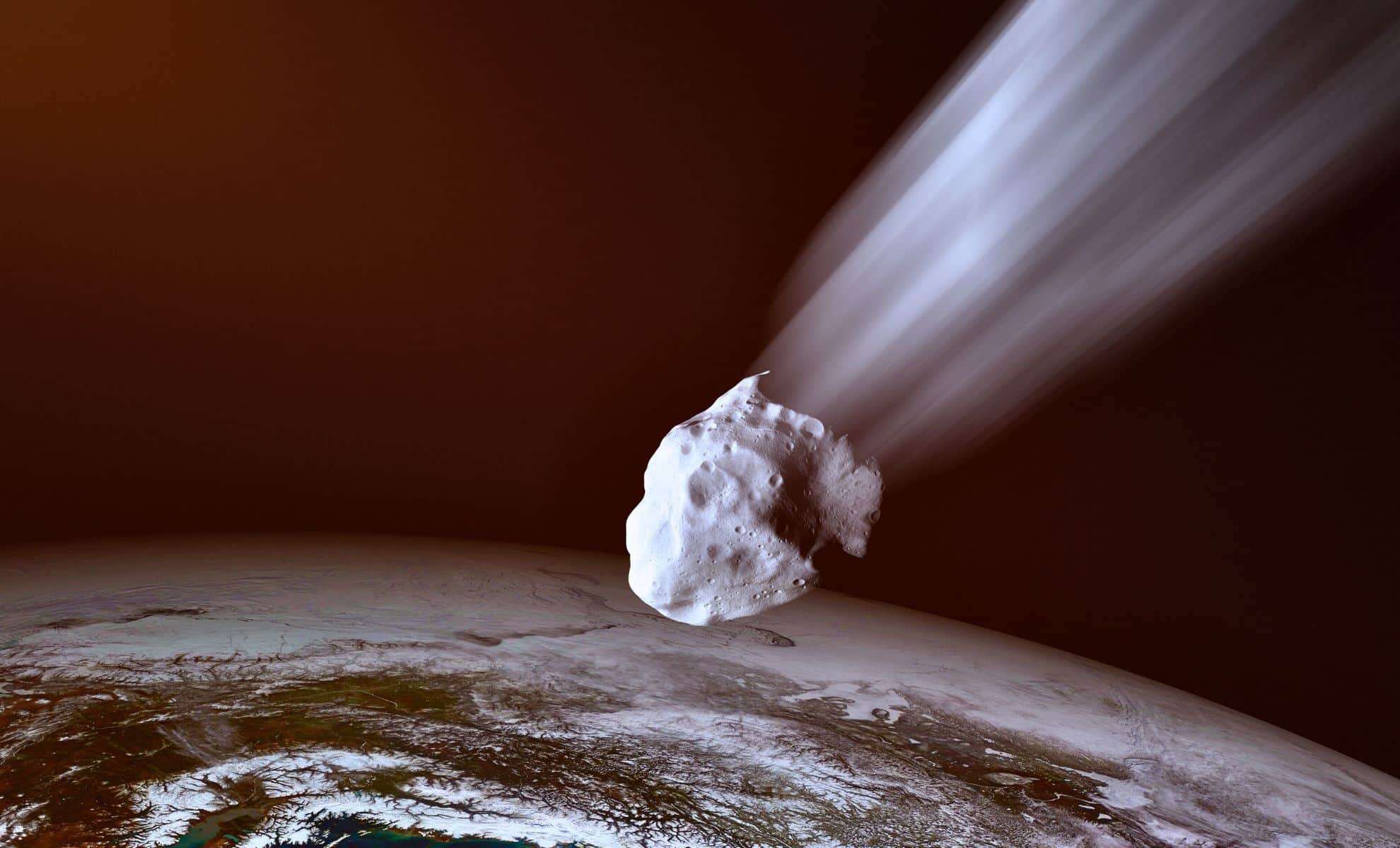
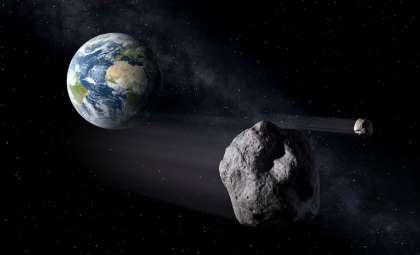
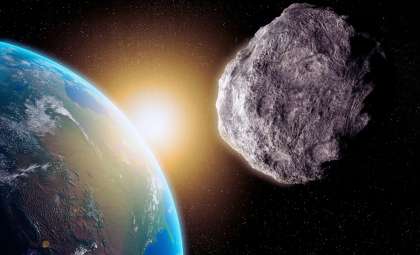
On September 3, 2025, an asteroid roughly the size of a commercial airliner zipped by Earth at a distance closer than that of the Moon, captivating astronomers and sky enthusiasts worldwide. NASA’s Center for Near-Earth Object Studies (CNEOS) reported that asteroid 2025 QD8 was hurtling through space at over 28,000 miles per hour during its closest approach. The event was documented by NASA and broadcast live by Italy’s Virtual Telescope Project.
Details on the Path and Dimensions of Asteroid 2025 QD8
Space.com notes that asteroid 2025 QD8 came within approximately 135,465 miles (218,009 kilometers) of our planet, which is about 57% of the distance separating Earth and the Moon. While this might sound far away, in astronomical language, it’s a remarkably close approach. The asteroid’s estimated diameter ranges between 55 and 124 feet (17 to 38 meters), comparable in size to a typical passenger jet. Despite its high velocity and size, NASA confirmed there was no risk of collision with Earth or the Moon.
Classified as a near-Earth object (NEO), 2025 QD8 orbits within 120 million miles of the Sun, placing it firmly within the region scientists dub Earth’s “cosmic neighborhood.” Unlike many NEOs that often go unnoticed, this asteroid’s proximity and scale commanded widespread interest this week.

Real-Time Observations Before the Close Encounter
The Virtual Telescope Project, spearheaded by astronomer Gianluca Masi, captured snapshots of QD8 employing a 17-inch robotic telescope named “Elena” based in Manciano, Italy. On August 30, they imaged the asteroid from about 2.4 million miles (3.9 million kilometers) away. The photo, taken during a 300-second exposure, revealed QD8 as a tiny speck against a star-filled backdrop.
The project hosted a YouTube livestream starting at 7 p.m. ET on September 2, enabling viewers to follow the asteroid’s swift passage live. The broadcast melded telescope imagery with expert commentary, giving the public a close-up look at one of the solar system’s smaller visitors as it sped past Earth.
NASA’s Monitoring and Safety Evaluations
Asteroids such as QD8 frequently fly near Earth but rarely present danger. NASA actively monitors these bodies, maintaining a comprehensive catalog via its Jet Propulsion Laboratory. In particular, they track thousands of potentially hazardous asteroids (PHAs), defined as objects larger than about 460 feet that come within 4.6 million miles of Earth’s orbital path. The label “potentially hazardous” relates to long-term predictions rather than immediate threats.
NASA stresses that no known PHAs pose a collision risk with Earth over the next hundred years. Paul Chodas, manager of CNEOS, explains these asteroids require long-term observation since gravitational forces can slowly alter their courses over time.
Other Recent Visitors Near Earth
Asteroid 2025 QD8 was just one of several near-Earth objects gliding past in recent days. NASA tracked two additional asteroids, 2025 QH16 and 2025 RB, each about the size of a typical house, measuring between 43 and 53 feet. Both passed Earth safely. A roughly 58-foot asteroid is also being observed, alongside a smaller near-Earth space rock around 35 feet wide, expected to pass within 500,000 miles of our planet.
These frequent close approaches highlight the dynamic activity of our solar system and the importance of ongoing surveillance. They also provide invaluable opportunities for scientists to improve knowledge about asteroid orbits, dimensions, and movement through real-time observations.
- Categories:
- News


0 comments
Sign in to Comment