
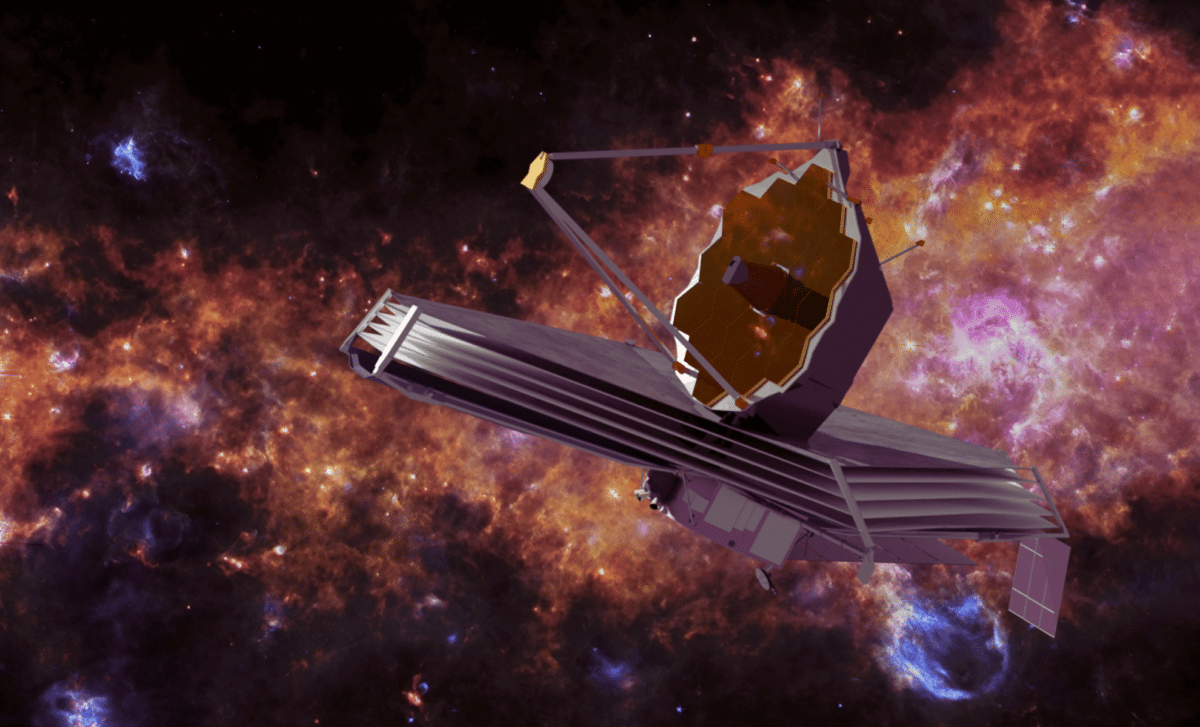
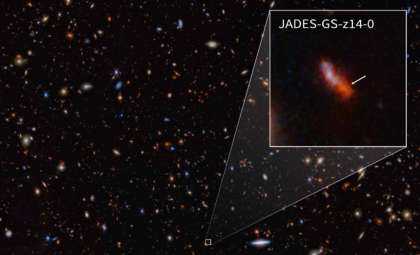
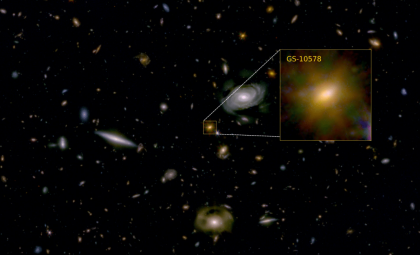
Scientists from the University of Tokyo and collaborating institutes have employed the James Webb Space Telescope (JWST) to explore CEERS2-588, a distant galaxy with intense ultraviolet emission. Featured in a January 29 study on arXiv, this galaxy exists merely 400 million years after the Big Bang. CEERS2-588 stands out for its substantial mass, metal richness, and vigorous star formation, challenging prevailing early galaxy evolution theories.
Investigating the Enigma of CEERS2-588
Discovered through the Cosmic Evolution Early Release Science (CEERS) project in 2022, CEERS2-588 represents a crucial discovery in early cosmic research. With a redshift value of 11.04, this galaxy dates back to only 400 million years following the Big Bang, pinpointing an epoch critical to understanding galaxy formation.
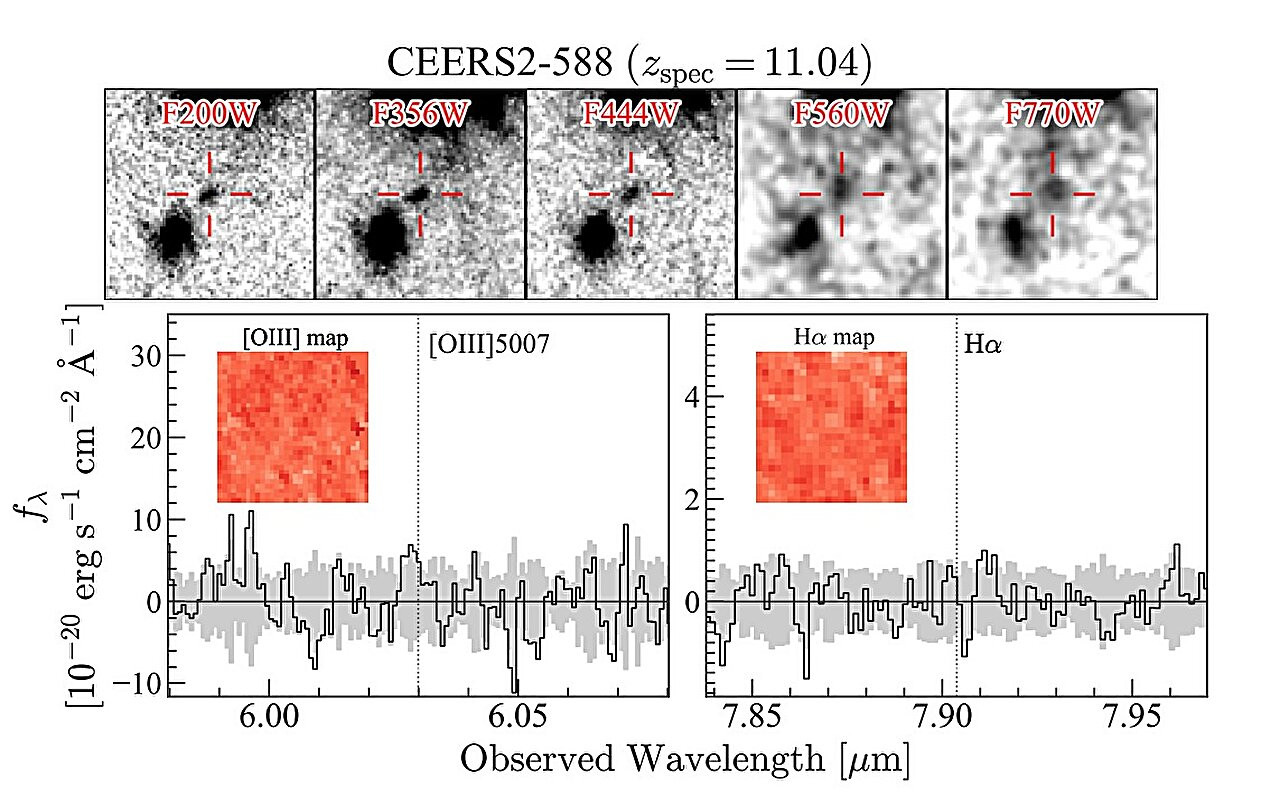
This ultraviolet-bright galaxy’s detection is a landmark in studying nascent galaxies, revealing crucial data on the initial conditions shaping the first cosmic structures. Led by Yuichi Harikane at the University of Tokyo, the research team harnessed JWST’s capabilities to examine the galaxy’s fundamental properties in unprecedented detail.

“Here we present deep JWST/MIRI observations of a UV-luminous galaxy at z = 11.04, CEERS2-588, only 400 million years after the Big Bang,” the researchers write.
These deep analyses unveiled critical insights about the galaxy’s mass distribution and internal formation processes, posing significant challenges to existing early galaxy development frameworks.
An Exceptionally Massive Galaxy
A striking revelation from the arXiv paper available here is that CEERS2-588 boasts a stellar mass estimated at approximately 1.26 billion times that of the Sun. In the context of such a high redshift, it ranks among the heftiest galaxies known from the universe’s infancy, notably without indications of active galactic nucleus (AGN) presence. This contrasts with predictions from current early galaxy formation models that suggest such massive structures should not emerge so rapidly after the Big Bang.
Even more surprising is the near-solar level of gas-phase metallicity detected, an unusual trait for galaxies in such an embryonic stage. The study underscores this anomaly, suggesting that complex and unexpected processes influenced galaxy assembly at redshifts beyond 10.
Intensity and Efficiency of Star Formation
Insights into CEERS2-588’s star-forming activity reveal a remarkable rate: approximately 8.2 solar masses per year. This is notably higher than anticipated for galaxies from this era. Such prolific star production early in cosmic history suggests vigorous and efficient bursts of star creation.
“These results reveal that massive galaxies in the first few hundred million years of cosmic history experienced star formation that was both more efficient and more rapidly quenched than predicted by theoretical models,” the scientists write. These findings significantly enhance our understanding of early stellar production and the origins of galaxies exhibiting intense ultraviolet output.
Rapid Suppression of Star Formation
CEERS2-588 displays a striking plunge in star formation over the past 10 million years, sharper than that seen in other comparable galaxies. This indicates that early galactic star formation may have undergone brief, intense episodes followed by swift shutdowns.
Such rapid cessation might be driven by supernova-driven feedback or the accumulation of dust, pointing to a more irregular and episodic evolution of primordial galaxies. The data suggest early star formation was not gradual but marked by pronounced bursts and interruptions.
Importance of Starburst Events in Early Galaxy Growth
The study highlights that dramatic starburst phases were integral to shaping luminous early galaxies like CEERS2-588. These intense periods of star generation would have made such galaxies substantially brighter and more detectable by instruments like JWST.
Understanding these bursts offers astronomers a clearer picture of how the most massive, ultraviolet-bright galaxies formed in the early universe, forming a key part of cosmic structure’s foundation.
- Categories:
- Space


0 comments
Sign in to Comment