
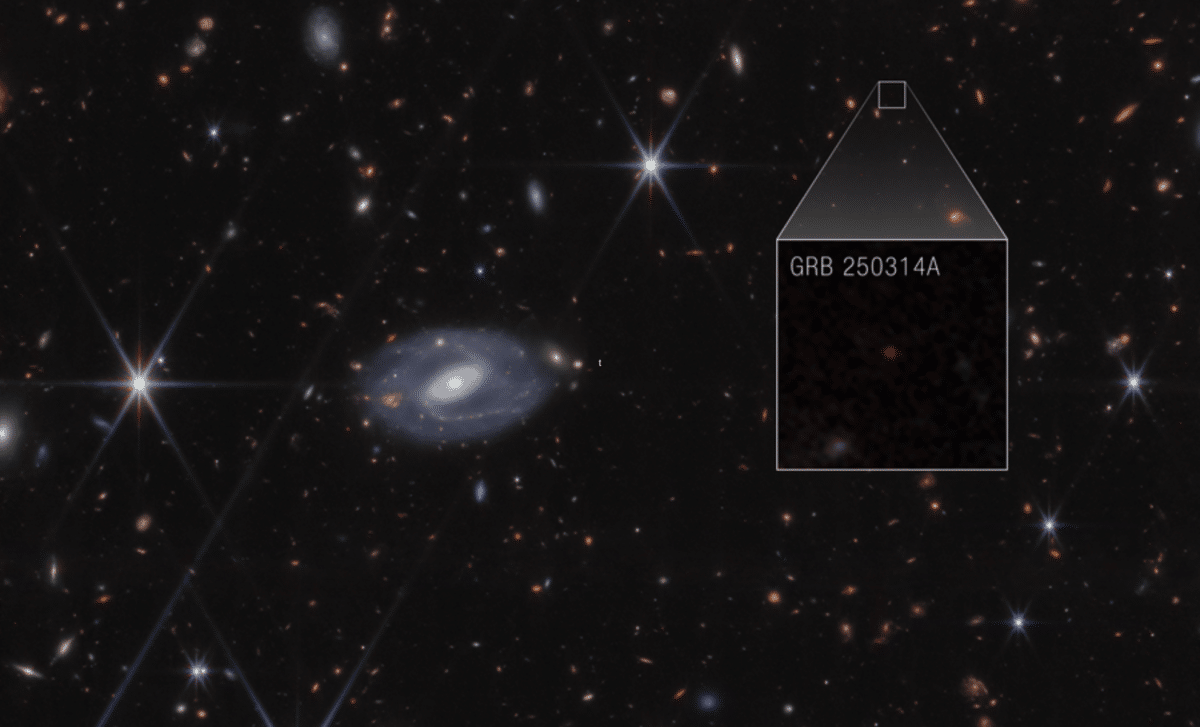
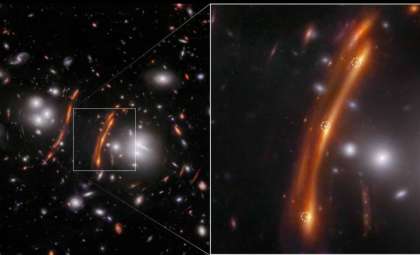
NASA’s James Webb Space Telescope has achieved a milestone by detecting the most ancient supernova on record. Leveraging Webb’s cutting-edge imaging technology, this groundbreaking observation supports two recent reports published in Astronomy and Astrophysics Letters. These studies emphasize Webb’s potential to probe distant cosmic phenomena, including a supernova that ignited when the universe was a mere 730 million years old.
Historic Detection: Webb Captures a Supernova from the Cosmic Dawn
In a landmark discovery, NASA’s James Webb Space Telescope identified a supernova that erupted just 730 million years post-Big Bang, making it the earliest supernova ever recorded. This breakthrough not only establishes a new record but also highlights Webb's exceptional capacity to observe faint, remote cosmic events. The supernova was detected through near-infrared observations, granting astronomers unprecedented access to phenomena that were previously beyond reach.
Thanks to Webb’s superior imaging resolution, scientists were able to accurately locate the supernova and its elusive host galaxy. The light emitted from the supernova has traveled billions of years, offering a rare window into the universe’s formative epochs and the mechanisms driving early star and galaxy formation. Studying this explosion allows researchers to better understand the behavior of primordial stellar events and their influence on cosmic evolution.

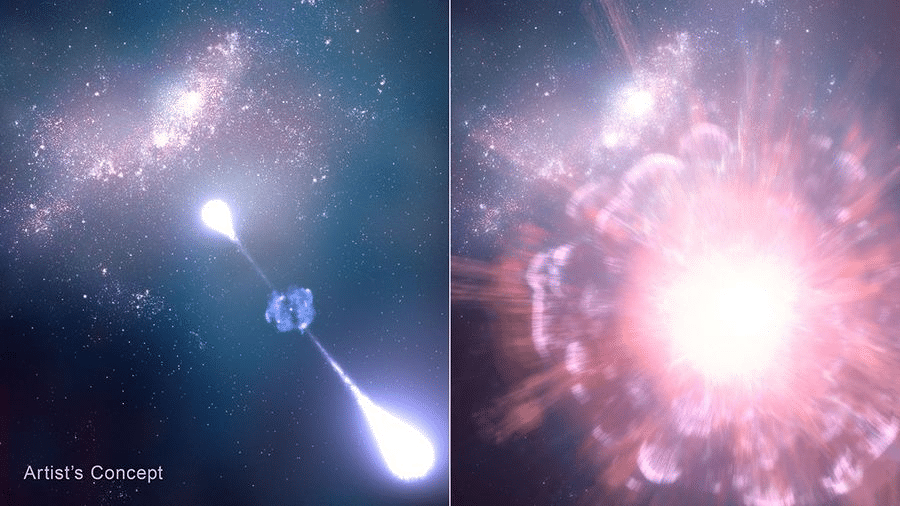
These observations are detailed in two new papers in Astronomy and Astrophysics Letters, underscoring Webb’s outstanding proficiency in capturing remote cosmic phenomena and shedding light on the universe’s earliest stellar and galactic development.
Tracing the Supernova’s Roots Through Gamma-Ray Bursts
This supernova detection is linked to a gamma-ray burst (GRB), a fleeting but intense release of energy produced during the demise of a massive star. Such gamma-ray bursts last only seconds to minutes and are thought to arise from stellar collapses into black holes or neutron star mergers.
The observed gamma-ray burst, occurring over roughly 10 seconds, served as a crucial clue to identifying the supernova. As Andrew Levan, lead author of one study, explained,
“Only Webb could directly show that this light is from a supernova — a collapsing massive star.”
Levan highlighted Webb’s unmatched ability to investigate distant cosmic fireworks, offering vital insights into the universe’s infancy. This observation not only confirms the connection between gamma-ray bursts and supernovae but also unveils details about star deaths that influenced early cosmic structure formation.
An international telescope array, including the recently launched Franco-Chinese Space-based multi-band astronomical Variable Objects Monitor (SVOM), initially detected the gamma-ray burst. Webb’s rapid follow-up observations solidified the event’s classification and pinpointed the supernova’s occurrence nearly 730 million years after the Big Bang.
A Remarkable Rarity in the Early Cosmos
Gamma-ray bursts of such scale are extraordinarily uncommon, especially from the universe’s formative era. Levan noted,
“There are only a handful of gamma-ray bursts in the last 50 years that have been detected in the first billion years of the universe.”
This rarity accentuates the importance of this detection, granting astronomers a valuable portal into a scarcely studied epoch.
The infrequency of these events further solidifies Webb’s crucial role in astronomy. Its capacity to detect and analyze these remote occurrences opens fresh avenues for probing the origins of the earliest stars and galaxies. These studies are transforming our understanding of star formation, supernova phenomena, and galaxy evolution during the universe’s dawn.
Webb’s Swift and Sensitive Follow-Up Observations
A vital element of Webb’s recent achievement was its prompt and delicate follow-up on the gamma-ray burst and corresponding supernova. Co-author Benjamin Schneide emphasized, “Webb provided the rapid and sensitive follow-up we needed.” This quick reaction was essential for capturing the supernova’s peak brightness, facilitating an unprecedented analysis of the explosion.
Since the supernova had already begun fading when Webb commenced observations, the precision of its instruments was key to gathering detailed data. Webb’s unmatched ability to monitor transient astronomical events and observe their temporal development was clearly demonstrated.
Insights Into the Universe’s First Billion Years
Although dim and distant, the supernova’s host galaxy reveals important information about early galactic properties. Webb’s investigations suggest this galaxy resembles others from the same cosmic period. Astronomer and co-author Emeric Le Floc’h remarked,
“Webb’s observations indicate that this distant galaxy is similar to other galaxies that existed at the same time.”
This implies that despite its great distance, the galaxy shares characteristics with other early galaxies found in various areas of the cosmos.
Such findings are pivotal for unraveling galaxy evolution during the Era of Reionization, a transformative phase when the universe transitioned from darkness to the luminous, transparent expanse observed today.
- Categories:
- Space


0 comments
Sign in to Comment