
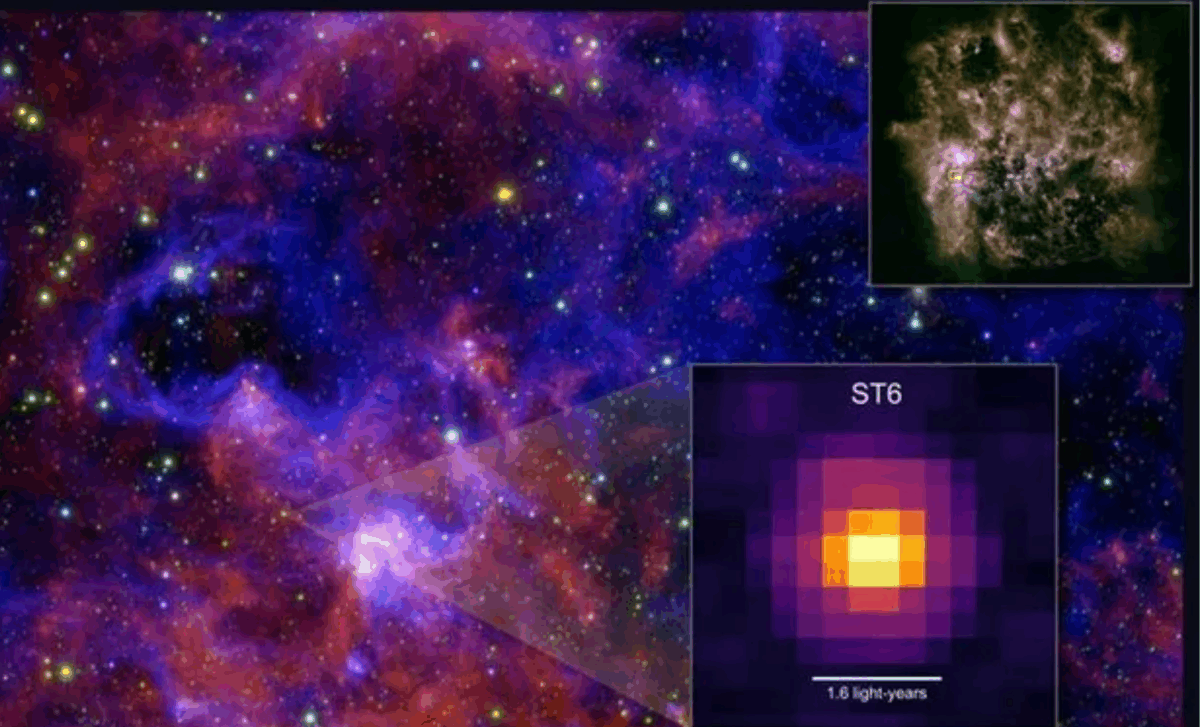
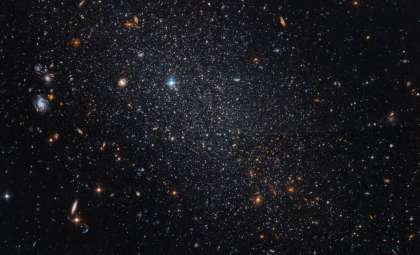
Hidden within the cold depths of a distant galaxy, frozen molecules have unveiled fresh insights into the chemistry of the cosmos. Employing the James Webb Space Telescope (JWST), researchers identified complex organic molecules—the fundamental components that may lead to life—encircling a forming star beyond our own Milky Way. This remarkable find occurred in the Large Magellanic Cloud (LMC), a nearby satellite galaxy, marking a pivotal moment in understanding life’s chemical origins.
JWST’s Landmark Observation Near the Tarantula Nebula
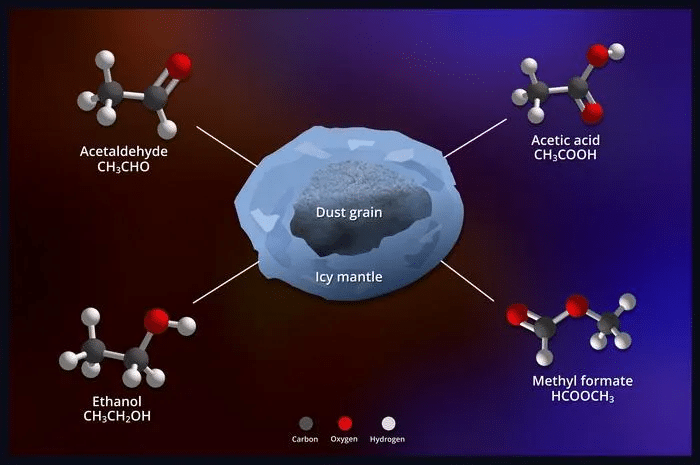
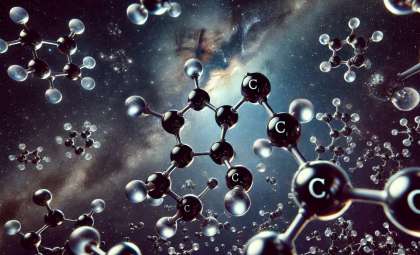
Detailed in a publication within the Astrophysical Journal Letters, Marta Sewiło from the University of Maryland and her collaborators utilized JWST’s Mid-Infrared Instrument (MIRI) to detect complex organic molecules (COMs) embedded as ices on dust grains around a massive protostar named ST6. Situated in the star-forming zone N158 near the renowned Tarantula Nebula, nearly 163,000 light-years away, these carbon-based molecules containing over six atoms serve as key precursors to biologically significant compounds like amino acids and sugars.
The significance of this discovery lies not only in the galactic environment but also in the molecular state—these compounds were identified in their frozen phase, preceding the phase when they warm and transform into gases later during star development.

“JWST has enabled the detection of COM ices, but to date there are only four protostars in the Milky Way where we have detected icy COMs, and only one in the LMC — ST6,” said Sewiło.
This breakthrough highlights JWST’s unprecedented capacity to explore the inner environments of stellar nurseries more deeply than ever before.
Insight into the Universe’s Earliest Molecular Processes
The Large Magellanic Cloud acts as a cosmic archive. Its comparatively lower amounts of heavy elements and intense ultraviolet radiation mirror conditions akin to early-universe galaxies. By examining ST6, astronomers can glean crucial information about how complex organic chemistry evolved in primordial cosmic settings. The relative scarcity of detected COMs, compared to similar Milky Way regions, suggests environmental factors significantly influence organic molecule synthesis.
JWST observations also revealed several unidentified absorption features that may point to even more complex chemistry in progress.
“We have found evidence that several of the unidentified absorption features could be attributed to glycolaldehyde, but the detection remains inconclusive since more laboratory spectra are needed to verify it,” said Sewiło, referring to glycolaldehyde’s role as a precursor to ribose, a building block of RNA.
Should this be confirmed, it would suggest that the cosmic formation of life’s molecular building blocks began earlier and across more environments than previously believed.
Understanding Molecular Formation in Star Nurseries
Observing COMs in their icy state offers a glimpse into molecular assembly before stars fully develop and heat their surroundings. As ST6 warms, these ices will evaporate, releasing complex molecules into the interstellar medium where further chemical reactions may generate even more intricate organic substances. Some of these compounds, including amino acids, have previously been found in comets of our solar system, remnants of similar processes dating back 4.5 billion years.
“It is likely that more COMs are present in the ices around ST6, and our results highlight the need for more laboratory experiments,” added Sewiło. Laboratory data are essential to match observed infrared spectra with specific molecules, confirming their identity and abundance.
The connection between observational astronomy and controlled experiments defines the cutting-edge field of astrochemistry, linking the cosmos to the origin of life.
By charting frozen molecular compositions in the Large Magellanic Cloud, scientists are peeling back the layers of one distant star-forming environment and tracing the initial chemical steps that potentially lead to life throughout the universe.
- Categories:
- Space






0 comments
Sign in to Comment