
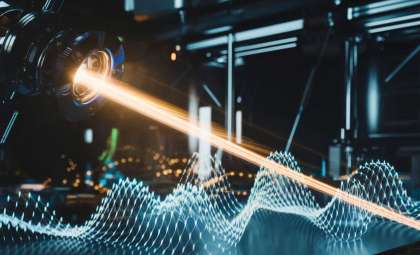
Researchers across Europe have replicated the theoretical phenomenon known as false vacuum decay within a laboratory environment, marking a groundbreaking step toward experimentally understanding an event that might eventually trigger the universe's demise. Utilizing ultracold atoms, the study provides a novel experimental insight into one of theoretical physics’ most dramatic predictions.
Quantum Field Theory’s Alarming Hypothesis
False vacuum decay stems from the hypothesis that the universe may exist in a metastable energy configuration, often called a “false vacuum,” rather than in the lowest possible energy state.
This metastable condition appears stable but could suddenly switch to a more stable state referred to as the true vacuum. Such a transition would unleash a profound upheaval in the fabric of space itself.

The change would start with the emergence of a true vacuum bubble, expanding close to the speed of light and fundamentally rewriting physical laws.
The study, titled “False vacuum decay via bubble formation in ferromagnetic superfluids,” published in Nature Physics and led by G. Ferrari, explains that this decay unfolds through quantum vacuum fluctuations or, occasionally, thermal fluctuations.
Before this breakthrough, the concept remained theoretical, inaccessible to direct tests because of the immense energy levels involved in cosmological processes.
Vacuum Decay Modeled Using Ultracold Atomic Systems
The collaborative research team from Italy and the UK used a collection of sodium-23 (Na-23) atoms confined by optical traps and chilled near absolute zero to form a ferromagnetic superfluid. This setup enabled the laboratory simulation of vacuum decay physics.
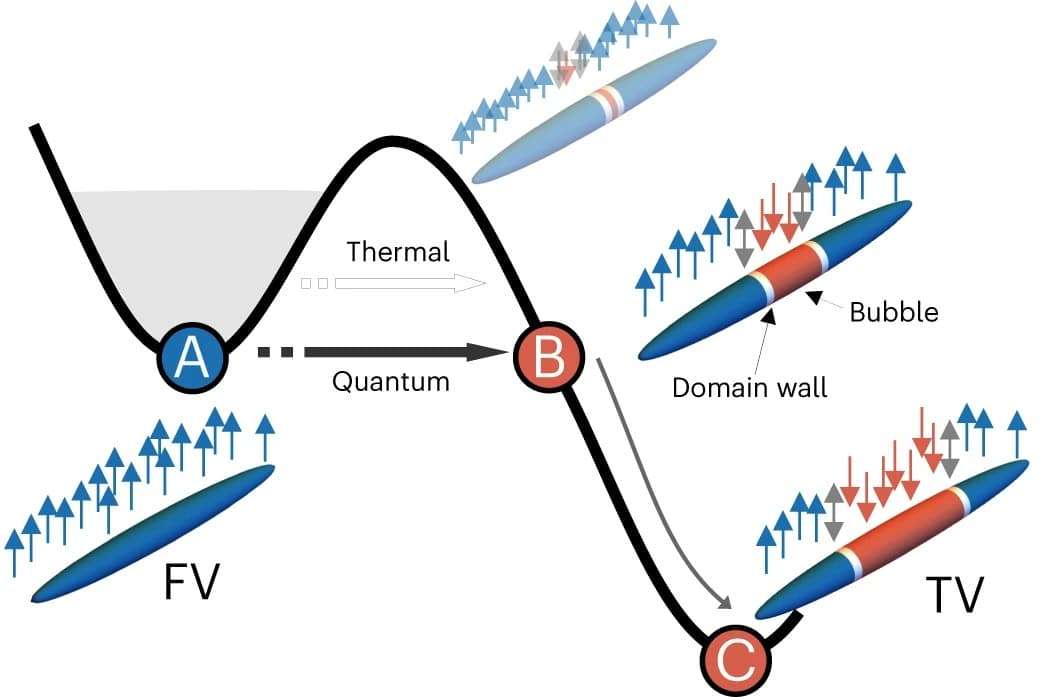
Central to their experiment was crafting a double-well energy structure, permitting the system to exist in a metastable state analogous to a false vacuum.
They employed microwave radiation to trigger transitions between atomic internal states labeled as “up” (|↑⟩) and “down” (|↓⟩).
By adjusting a detuning parameter (δ) alongside a coherent coupling term (Ωₙ), conditions were created for spontaneous “bubble” nucleation in the cloud’s center.
These bubbles act as a laboratory parallel to early universe true vacuum bubbles—localized regions tunneling through an energy barrier into a more stable phase.
Monitoring Bubble Evolution in the Experiment
The scientists tracked changes in the atomic cloud’s spatial magnetization via repeated imaging over time.
When the system remained metastable, a large region in the center flipped to the |↓⟩ state, producing a visible bubble.
The likelihood of bubble formation rose exponentially as time progressed, aligning well with theoretical forecasts.
Measurement of the magnetization distribution Z(x)—the normalized difference between the two spin state densities—enabled precise monitoring of the transition from false to true vacuum states.
They introduced a parameter, Ft, to characterize the bubble’s expansion. This value decayed exponentially with bubble growth, matching Gross–Pitaevskii equation-based simulations.
Strong Agreement Between Experimental Data and Theory
Findings validate the instanton model, a framework describing vacuum tunneling by quantum transitions.
According to this model, bubble formation timing depends on the energy barrier height and an effective temperature parameter β.
Both experiment and simulation revealed bubble creation follows an exponential law tied to proximity to the critical detuning value δc.
Including classical noise in simulations to mimic thermal effects yielded results closely matching the experimental measurements.
Decay times τ vs. coupling strengths Ωₙ conformed to theoretical predictions, highlighting thermal activation’s central role in false vacuum decay.
Researchers achieved precise control over bubble formation timescales, adjustable from milliseconds up to several hundred milliseconds.
This precision was enabled by magnetic field stability better than tens of microgauss, finely tuning the threshold where metastability fails.

Bridging Experimental Cold-Atom Physics and Cosmology
These results represent a major step forward in employing ultracold atomic platforms to probe high-energy physics phenomena previously limited to theoretical or astronomical contexts.
The authors emphasize the setup's potential to deeply analyze bubble nucleation and growth, opening new paths to investigate metastability, phase transitions, and the early universe’s dynamics.
Proposed future work includes engineering deterministic bubble seeding mechanisms and adding controlled noise to study dissipation and quantum entanglement influences.
The team also aims to explore similar dynamics in higher-dimensional systems or at even lower temperatures, moving closer to observing vacuum decay predominantly prompted by pure quantum fluctuations.
- Categories:
- Science








0 comments
Sign in to Comment