
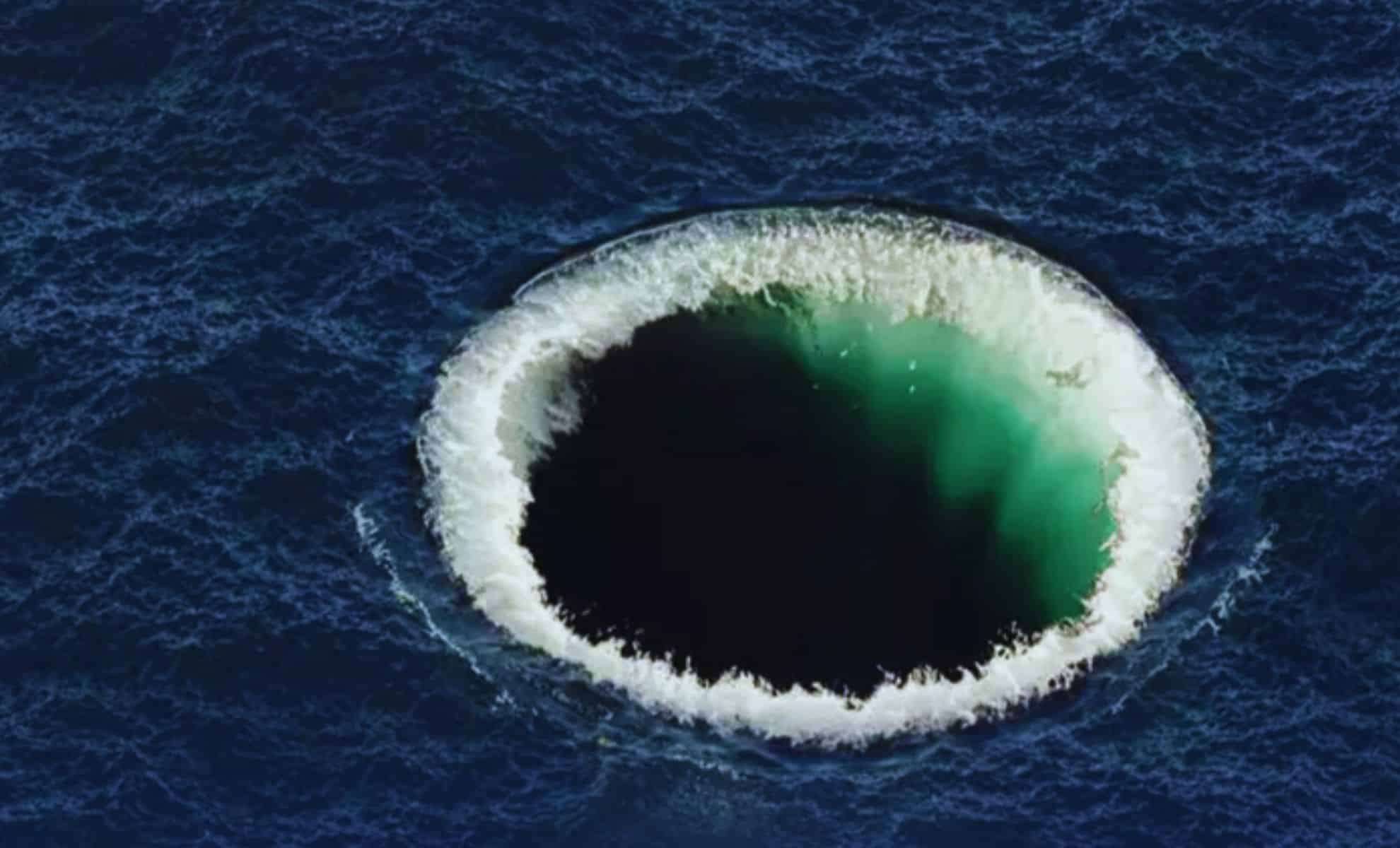
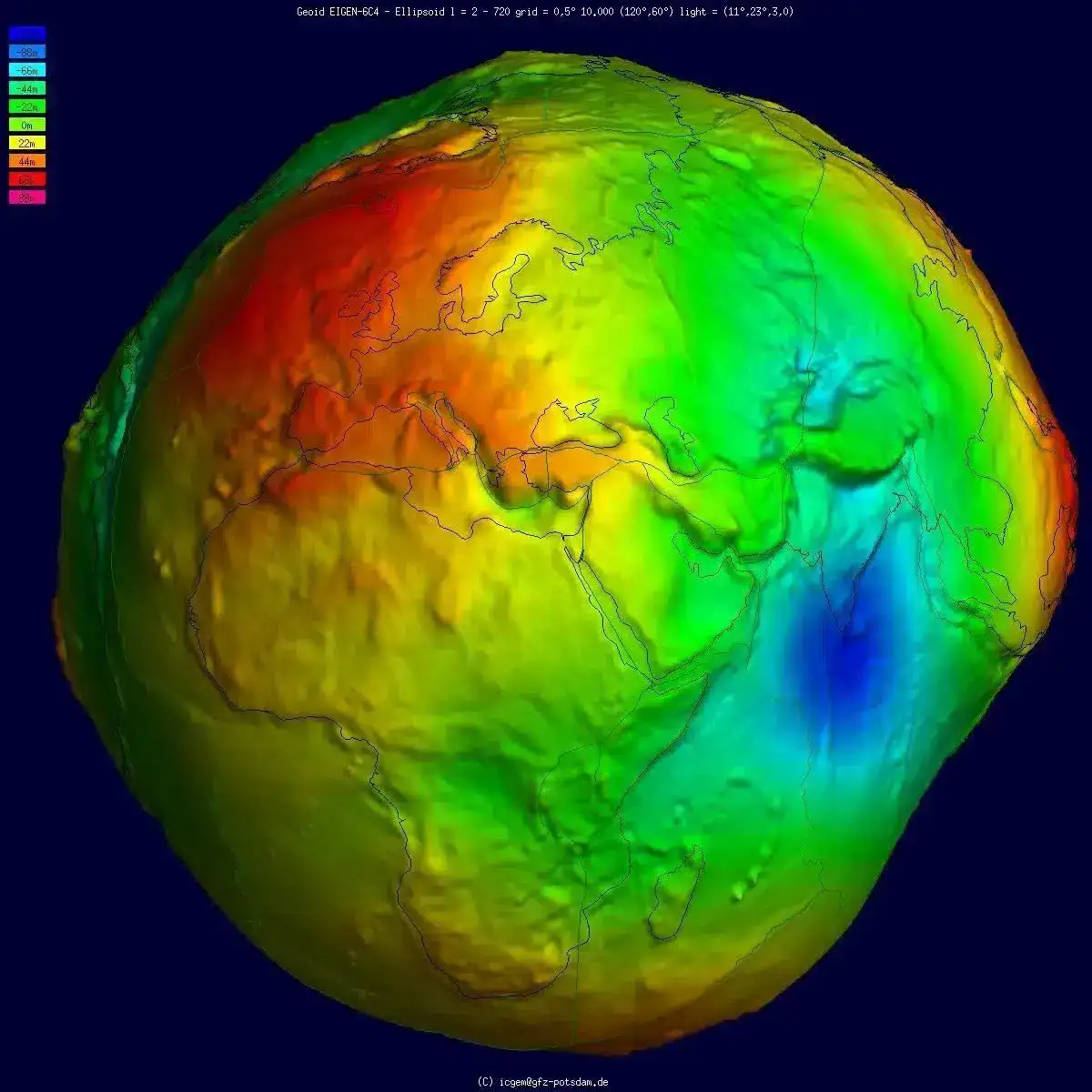
Hidden beneath the Indian Ocean's broad waters lies a remarkable gravitational oddity—a massive depression in the ocean's surface that drops about 106 meters below the adjacent regions. Known as the Indian Ocean Geoid Low (IOGL), this spot exhibits the weakest gravitational pull found on our planet, and until recently, its cause was shrouded in uncertainty.
Breakthrough research, featured in Geophysical Research Letters, indicates that this phenomenon emerges from deep mantle convection processes dating back over 140 million years. Utilizing cutting-edge simulations, the study offers the most compelling explanation to date and calls for a reevaluation of Earth’s internal dynamics over geological timescales.
Earth’s Unequal Gravity: The Reason Behind Its Bumpy Shape
Although Earth looks like a smooth blue sphere from outer space, it is far from uniform. Variations in gravitational pull stem from irregularities in the planet’s internal mass distribution, leading to subtle surface deformations known as geoid anomalies. These cause local alterations in sea level, as gravity predicts where water accumulates or recedes.

“The Indian Ocean geoid low ranks among the most significant enigmas in geosciences,” notes Prof. Attreyee Ghosh from the Centre for Earth Sciences at the Indian Institute of Science. “It represents the lowest gravity anomaly measured on Earth, and until now, its origin was not fully understood.”
Unlike typical geoid lows, which generally correspond to established tectonic or mantle features, the IOGL has defied explanation. Earlier hypotheses suggested a sinking tectonic plate might be responsible, but none adequately accounted for the anomaly’s magnitude—until this new research.
By employing geodynamic modeling techniques, the scientists retraced the region’s geological evolution through simulations spanning 140 million years. The results identified an unexpected source: buoyant, hotter mantle material rising from deep sources possibly related to the extensive African superplume beneath the Indian Ocean.
Unveiling a Deep Mantle Mystery Below the Ocean
The investigation combined seismic tomography and sophisticated computer modeling to explore the Earth’s interior beneath the ocean floor, revealing the mantle’s role in generating the gravitational low.
Researchers found lighter, hotter mantle rock extending from depths of approximately 300 km down to nearly 900 km below the ocean bed. Prof. Ghosh explains, “This geoid low arises from a deficit of mass within the deep mantle. Our findings attribute it to hotter, less dense material stretching through this mantle section, most likely sourced from the African superplume.”
Intriguingly, this mantle activity aligns temporally with the closure of an ancient ocean, as the Indian landmass migrated northward during the last 140 million years.
The Ancient Ocean’s Disappearance and Its Impact on Gravity
India’s tectonic plate was once separated from Asia by a wide ocean. Over millions of years, the Indian plate drifted north, closing that ocean, and forcing the oceanic plate beneath it to subduct deep into the mantle. This process likely activated mantle plumes that brought lighter materials closer to the surface, eventually forming the IOGL.
“The Earth’s shape is more like a lumpy potato than a perfect sphere,” says Ghosh. “It’s better described as an ellipsoid, bulging at the equator due to rotation.” These shape irregularities combined with mantle convection patterns help clarify why gravity varies across the globe.
The team tested their hypothesis through 19 numerical simulations recreating plate movements and mantle dynamics over 140 million years. Six of these produced geoid lows closely resembling the Indian Ocean’s, specifically when mantle plumes were included near the anomaly.
Will the Indian Ocean’s Gravity Anomaly Persist?
One open question is whether the IOGL is a transient feature or a permanent fixture shaped by ongoing tectonic activity.
The study suggests the anomaly began forming roughly 20 million years ago, a relatively young age geologically. “Its longevity depends on how sub-surface mass distributions evolve,” states Prof. Ghosh. “It might endure for millions of years, or tectonic shifts could eventually erase it hundreds of millions of years from now.”
Some experts remain unconvinced by the study’s full explanation. Dr. Alessandro Forte, a geologist at the University of Florida, points out that the models don’t fully incorporate the massive mantle plume linked to Réunion Island’s volcanic activity, which caused the Deccan Traps—one of Earth’s largest volcanic provinces.
Moreover, while the models achieved an approximate 80% match between predicted and actual geoid anomalies, inconsistencies remain, particularly across regions including the Pacific Ocean, Africa, and Eurasia.
- Categories:
- News





0 comments
Sign in to Comment