
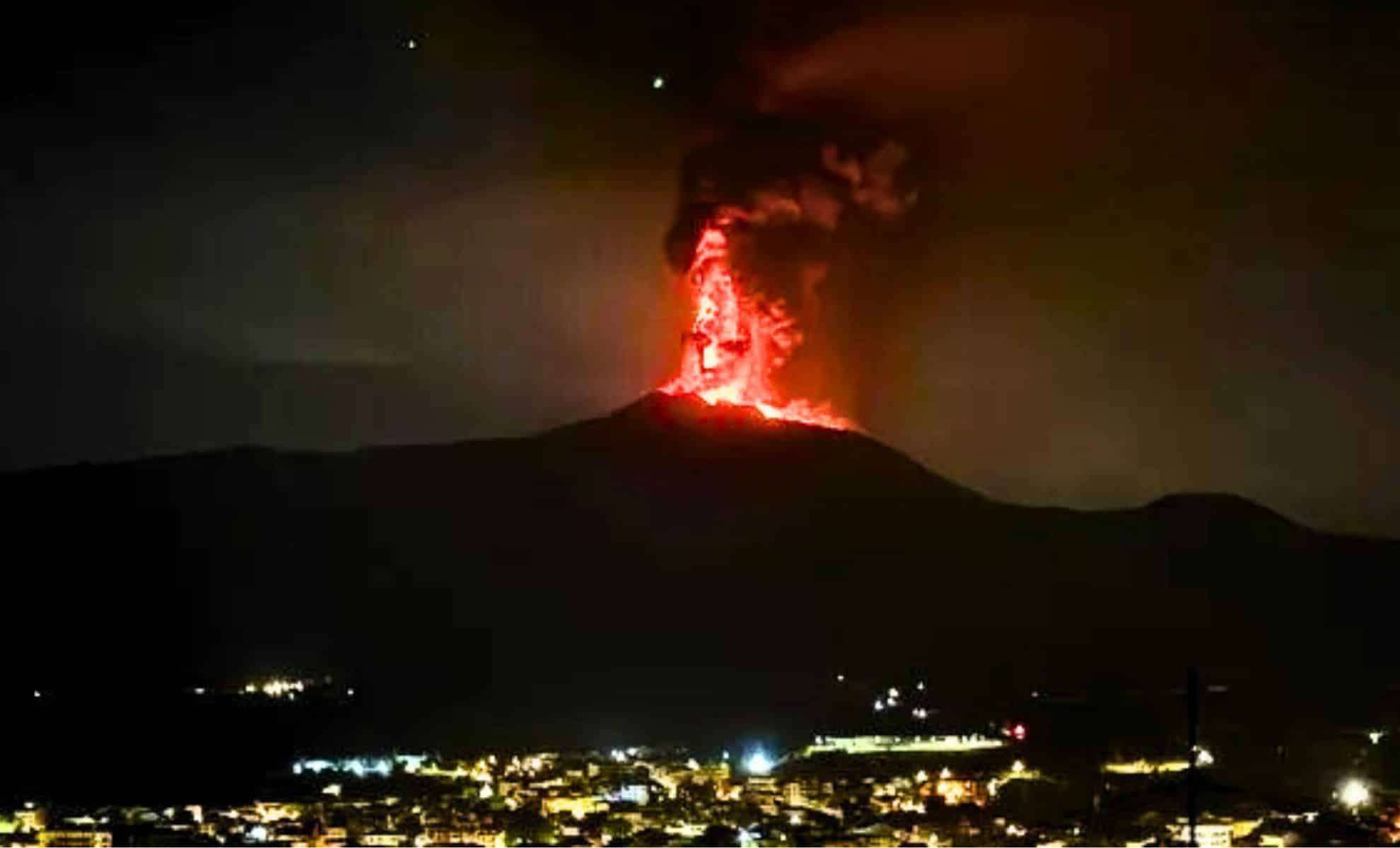
Mount Etna, Europe’s most active volcanic giant, has erupted once more, presenting a striking natural display in early 2025. Since February 8, the formidable volcano has unleashed lava and ash from the Bocca Nuova vent, transforming the skyline of Sicily with vibrant orange hues and thick black smoke.
While the spectacle captivates spectators, it also poses significant challenges for local authorities, disrupting air routes, stretching emergency services, and drawing many thrill-seeking visitors despite evident dangers.
Lava Cascades Through Snow-Covered Slopes Impacting Local Communities
The Italian National Institute of Geophysics and Volcanology (INGV) has indicated that the eruption remains at a medium-high energy level, with lava streams extending nearly three kilometers down Etna’s snowy slopes.

By February 20, molten rock had descended to around 1,950 meters elevation, burning vegetation and cutting off access to the Altamontana ski area at about 1,800 meters.
The explosive activity at the crater has sent dense ash clouds into the sky, causing interruptions at Catania Airport, where 32 flights were diverted within one day earlier in the week.
Though flights have now resumed, the Aviation Color Code remains at Red, the highest threat level, with meteorologists warning that wind shifts could quickly bring new ash plumes over the airport.
Residents of Catania and surrounding communities face the tangible impact of volcanic ash settling on streets, vehicles, and rooftops.
Today, Mount Etna Erupts in Dazzling Display, Sicily, Italy 🇮🇹 (February 12, 2025
A breathtaking eruption at the base of Bocca Nuova crater illuminated the evening sky, juxtaposed against the moon's glow, snow-covered peaks, and Strombolian explosions from the southeast crater.… https://t.co/riE0GJ5N5y pic.twitter.com/33cWjDYD76— Weather Monitor (@WeatherMonitors) February 12, 2025
Tourist Magnet Creates Challenges for Safety Officials
The eruption has attracted numerous adventure enthusiasts, drawn by the surreal contrast of flowing lava alongside snow-covered slopes. Viral videos show skiers navigating close to glowing lava streams and hikers approaching precariously near the flow.
With around 1,000 visitors attempting to witness the eruption daily, managing the crowds has become a serious issue for officials.
On February 16, rescuers aided a hiker who wandered too near the eruption site, underscoring the hazards of “wild tourism.” Salvo Cocina, who leads Sicily's civil protection, has cautioned that visitors are ignoring safety zones and parking dangerously on narrow mountain roads, impeding emergency services.
To mitigate risks, Adrano’s mayor has prohibited access to areas near the lava flow, urging visitors via social media to respect safety protocols. Nonetheless, the eruption remains perilous, especially around 1,800 meters elevation where molten lava is active.
Local protection authorities and forest wardens report ongoing struggles to control hikers trying to approach the volcanic activity.
Scientists Caution Against Steam Explosions Near Lava
While the lava progresses slowly, its behavior is unpredictable. Volcanologist Giovanni advises maintaining a safe distance of 100 to 200 meters from lava flows, warning that contact between magma at roughly 800°C and snow may cause explosive steam bursts. These eruptions can fling molten rock fragments dangerously into the air, threatening anyone too close.
The combination of falling volcanic debris, unstable terrain, and sudden lava surges increases the risks in the eruption zone. Emergency teams continue to monitor conditions, appealing for visitors to heed restrictions and avoid jeopardizing themselves and responders.
Mount Etna: An Ongoing Geological Marvel and Research Focus
Despite the disruptions, Mount Etna remains a vital natural laboratory. Towering at 3,350 meters, its activity extends back to historic records from 425 B.C.. Unlike some destructive volcanoes, Etna’s usually gentle, slow-moving lava rarely endangers settlements, yet its frequent eruptions offer valuable insight for volcanologists.
Researcher Boris Behncke from the Etna Observatory explained that the current eruption exemplifies the volcano’s characteristic sub-terminal eruptions, originating from fissures rather than the summit crater. “It’s Etna exhibiting its typical activity,” he remarked, emphasizing that while visually dramatic, the event follows a well-known pattern to experts.






0 comments
Sign in to Comment