

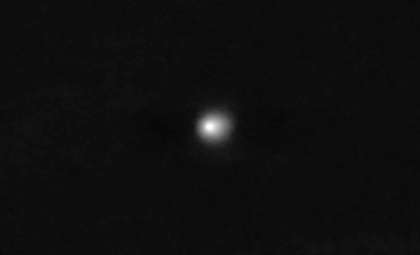
A group of astrophysicists has sounded an alert regarding a newly identified interstellar object designated 3I/ATLAS. Contrary to initial classifications as a comet, some researchers propose it could be a technology-based artifact originating from an extraterrestrial civilization. Detected on July 1, this object is traveling at an astonishing velocity exceeding 130,000 mph, and is forecasted to reach its closest solar approach later this year, with a near-Earth encounter anticipated between late November and early December 2025.
Unusual Characteristics Suggest Possible Alien Origin
The investigation, detailed on arXiv, proposes that if confirmed, the implications for humanity could be severe. The authors argue that 3I/ATLAS’s trajectory and speed are highly atypical, possibly indicating intelligent design. Avi Loeb, a Harvard astrophysicist known for his controversial views on alien life, suggests the object’s flight path might be intentionally calibrated.
In a post on Medium, Loeb notes, “3I/ATLAS reaches perihelion on the far side of the Sun relative to Earth, potentially a deliberate tactic to hinder Earth-based observations during its brightest phase or when instruments might be dispatched towards Earth from its hidden vantage point.”

Loeb, who earlier hypothesized that ʻOumuamua was an alien probe, points out that 3I/ATLAS exhibits several comparable features. He emphasizes its exceptional speed, exceeding even ʻOumuamua’s, and suggests it could offer multiple advantages for extraterrestrial technology.
Moreover, the object’s orbit crosses the paths of Jupiter, Mars, and Venus, hinting at possible navigation rather than random drifting. Co-authors Adam Hibbered and Adam Crowl from London’s Initiative for Interstellar Studies concur with Loeb’s perspective that these factors are unlikely to be accidental.
Scientific Community Offers Alternative Explanations
Despite the object’s peculiar dynamics, many astronomers remain skeptical of alien origin theories. Samantha Lawler, an astronomer at the University of Regina, Canada, dismisses these claims: “All available data strongly indicates this is a typical comet expelled from another star system, much like the vast numbers of such bodies ejected from our own solar system.”
Loeb himself acknowledges the most likely scenario is a natural one, admitting that 3I/ATLAS is probably just a natural interstellar comet.
Nonetheless, the researchers have not ruled out the possibility that the object could represent a hostile reconnaissance device or an advanced alien probe. Loeb further points out that current rocket technology is incapable of matching the object’s velocity, which exceeds one-third the speed of our best spacecraft.
Preparing for a Late-Year Close Encounter
This celestial object, roughly 15 miles wide, much larger than the island of Manhattan, is heading toward the inner reaches of our solar system. Despite its comet-like appearance leading many to assume natural origins, its strange features and approach angle continue to provoke alternative interpretations.
If confirmed as artificial, experts warn Earth might need to consider “defensive strategies” in response. The research team emphasizes the importance of tracking 3I/ATLAS carefully as it draws closer to Earth’s orbital path.
Until more is known, 3I/ATLAS remains a source of both intense scientific inquiry and public curiosity—poised between an extraordinary cosmic visitor and a phenomenon unlike anything previously observed.
- Categories:
- News











0 comments
Sign in to Comment