
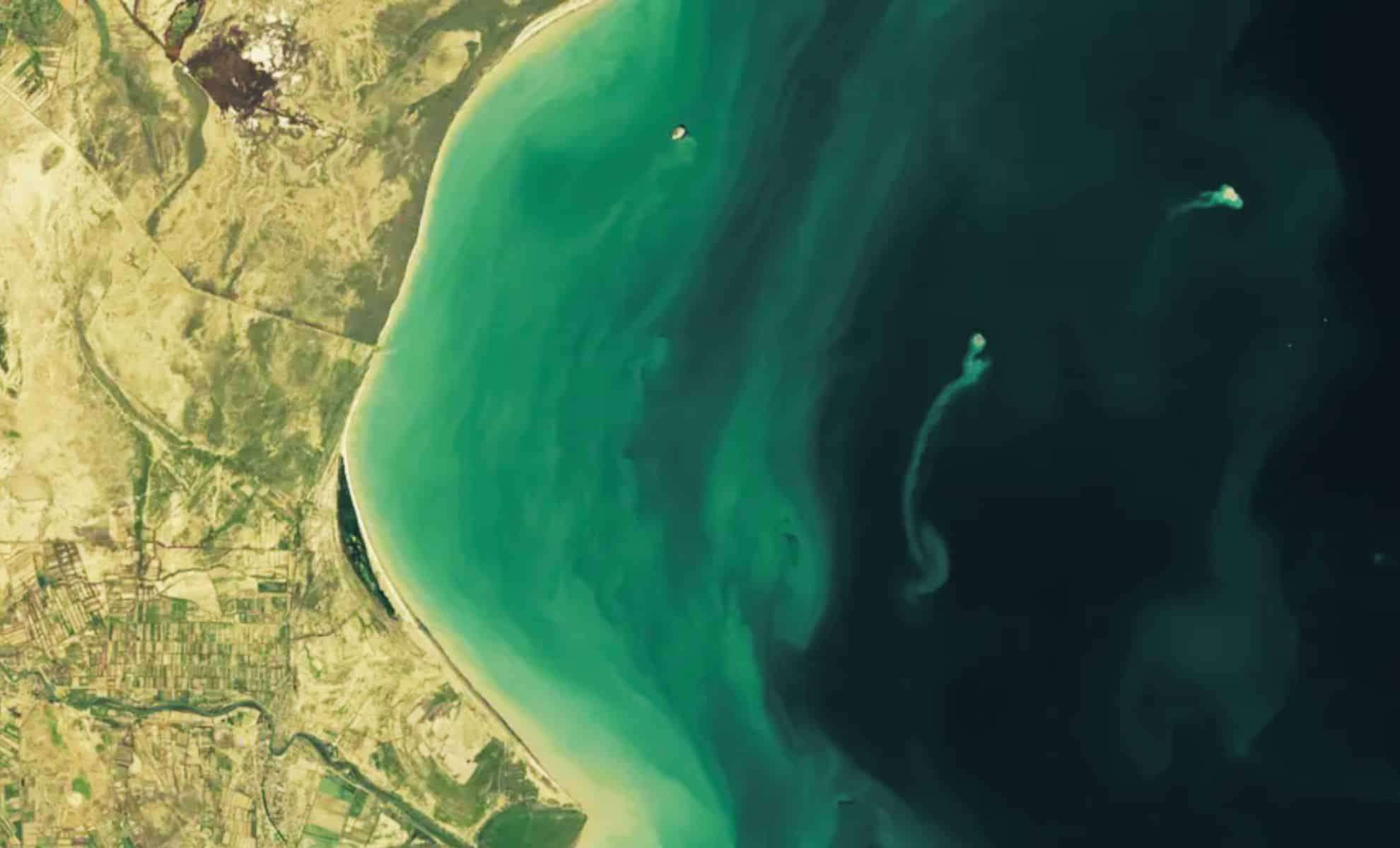
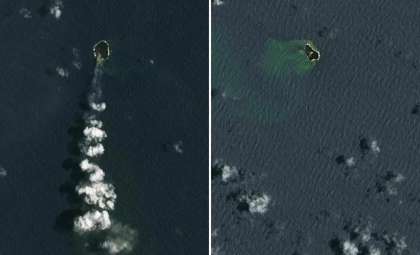
Earlier this year, a transient volcanic island unexpectedly surfaced in the Caspian Sea before disappearing just as swiftly. Observed through NASA’s satellite imagery, this ephemeral landform appeared in early 2023 following an underwater volcanic activity linked to the Kumani Bank mud volcano off Azerbaijan’s shore. Spanning roughly 1,300 feet in diameter at its peak, this island gradually eroded and vanished by late 2024, illustrating the fleeting character of such geological phenomena. NASA’s Earth Observatory documented the sequence of events, shedding light on the volatile nature of submarine volcanoes in tectonically active areas like Azerbaijan.
The Sudden Rise of a Temporary Island
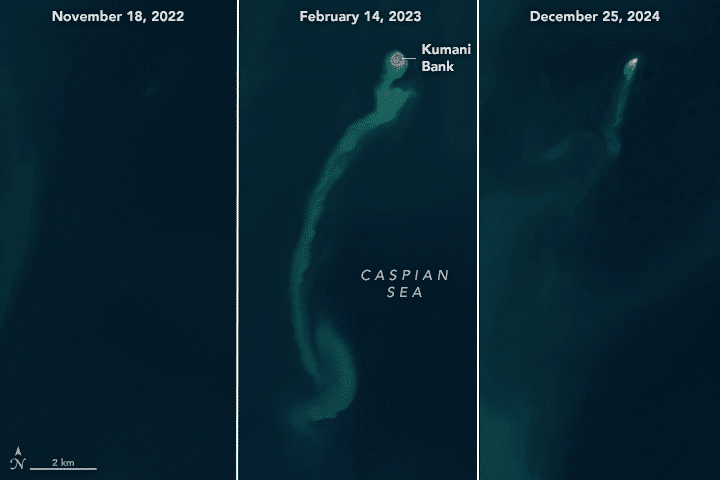
Satellites detected an unexpected new landmass emerging above the surface of the Caspian Sea in late January 2023. This island formed after a mud volcano eruption at Kumani Bank, located about 15 miles east of Azerbaijan’s coastline. The eruption, though not explosive, pushed large quantities of mud, gas, and debris upward, creating a visible island from space. By early February 2023, the island’s width was estimated at 1,300 feet, giving researchers a rare opportunity to study such an ephemeral geological feature. Despite its formation, the island was inherently unstable, with experts anticipating its short lifespan.
Mud volcanoes differ significantly from typical lava volcanoes found around the world. Instead of molten rock, they expel mud, water, and gases, driven by geothermal heat beneath the Earth’s surface. The geothermal pressure forces this slurry mixture upwards, creating temporary landmasses that usually dissolve soon after the eruption fades. By the end of 2024, this island had mostly disappeared, reaffirming its transient nature.

The Role of Mud Volcanoes in Shaping Temporary Islands
Mud volcanoes commonly occur in tectonically active regions, with Azerbaijan hosting over 300 such formations, many beneath the Caspian Sea. The area’s geologic activity stems from the collision between the Arabian and Eurasian plates, fueling geothermal events that sustain these volcanoes. While less disruptive than traditional volcanic eruptions, mud volcanoes can create notable temporary land features.
The Kumani Bank mud volcano is notorious for generating successive short-lived islands since its identification in 1861. These eruptions repeatedly form islands that erode back into the sea within a short timeframe, a pattern typical of mud volcano activity. The most significant eruption on record was in 1950, when an island expanded to about 2,300 feet wide and stood 20 feet above sea level. Although smaller, the 2023 event still attracted attention due to the rapid emergence and disappearance of the island.
The Volatility of Submarine Volcanic Events
Eruptions under the sea are often unpredictable. Some cause gradual alterations to the seabed, while others, like Kumani Bank, can produce transient new islands. These events occur when accumulating tectonic pressures beneath the ocean floor release suddenly, propelling mud, gas, and water upward. The transient island’s rise in the Caspian Sea highlights the intricate dynamics of submarine volcanism and the shifting nature of the Earth’s crust.
Such disappearing landmasses, sometimes called “ghost islands,” are not unique to Azerbaijan. Similar phenomena have occurred globally, including the 2015 Hunga Tonga-Hunga Ha’apai eruption, which created an island later obliterated in 2022. The temporary nature of these features exemplifies the ongoing geological processes continuously reshaping our planet.
What Causes Mud Volcano Eruptions?
Mud volcanoes emit mixtures of mud, water, and gases due to intense geothermal heat and subsurface pressure. Unlike traditional volcanic eruptions that involve molten lava and ash, mud volcano activity results from heated, pressurized mud making its way upward through cracks in the Earth's crust. Upon surfacing, this mud forms mounds or islands that, while visually striking, do not remain stable for long. Eventually, the mud recedes into the sea, dissolving the temporary landform.
These eruptions are generally less violent than lava volcanoes but can still produce dramatic effects. Gas emissions may ignite under specific conditions, leading to fiery displays, as seen in Azerbaijan’s 2021 mud volcano events. This unpredictability adds an element of risk and fascination to these natural occurrences.
The Broader Importance of Mud Volcanoes
Mud volcanoes are found worldwide—in places like Azerbaijan, Indonesia, and the Mediterranean—and serve as natural laboratories for understanding geological and geothermal processes. Though they lack the notoriety of lava volcanoes, mud volcanoes provide crucial insights into tectonic activity and the Earth's subsurface dynamics, especially in regions marked by plate collisions.
Beyond their geological significance, mud volcanoes influence ecosystems by releasing mud and gases that affect marine environments and local climates. Studying their behavior enhances our comprehension of Earth's interior and ongoing surface transformations.
- Categories:
- News





0 comments
Sign in to Comment