
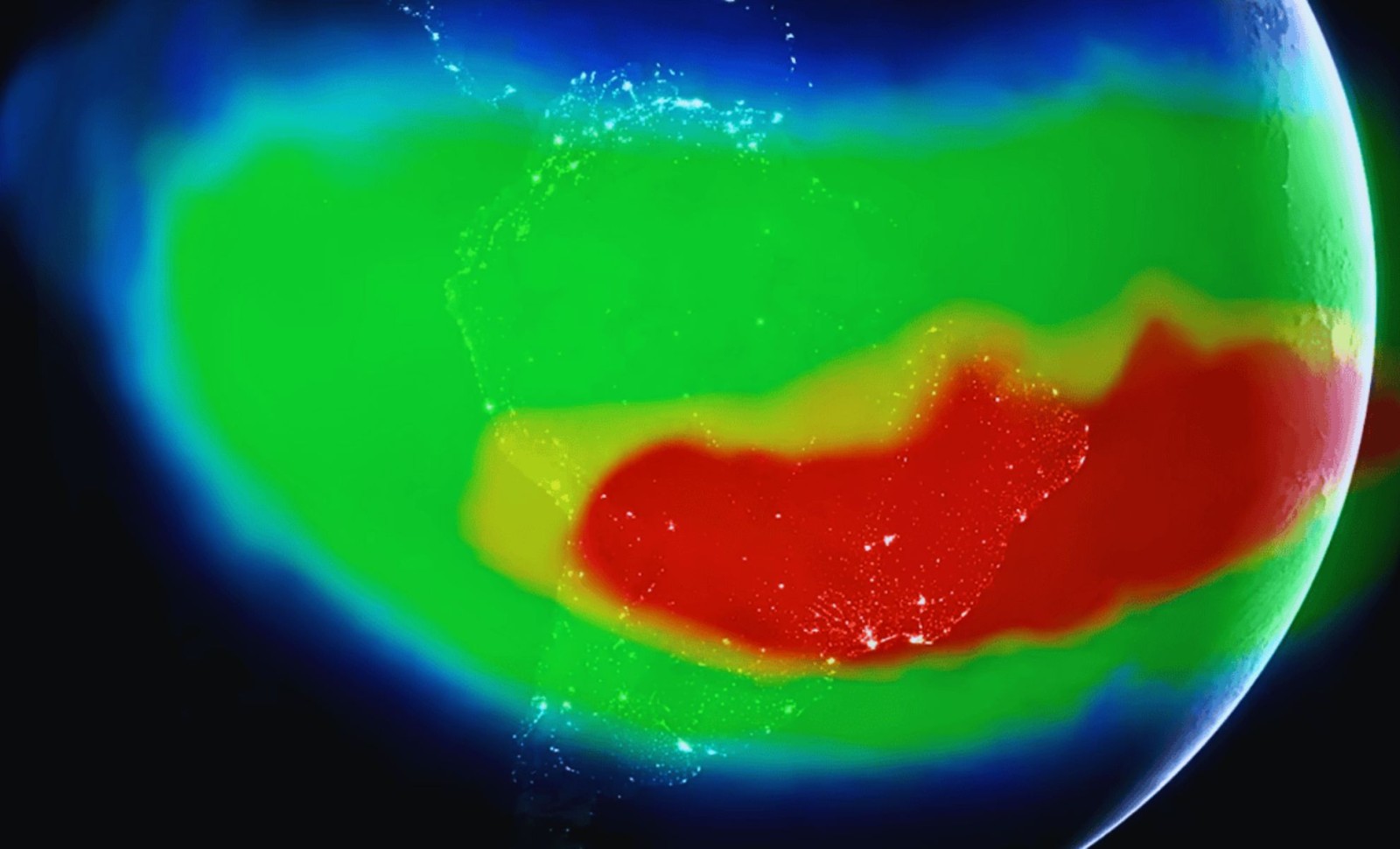
NASA is closely observing an unusual and expanding feature in Earth’s magnetic field located above the South Atlantic region. Known as the South Atlantic Anomaly (SAA), this zone is increasing in size and diminishing the protective magnetic barrier surrounding our planet. Researchers from NASA indicate that this anomaly has steadily enlarged since its initial detection.
This curious occurrence has intrigued scientists for years. While it does not pose a direct threat to life on Earth, the SAA presents substantial challenges for orbiting spacecraft and sensitive electronic equipment in space. Although its root cause remains uncertain, the consequences for space missions are becoming more evident, prompting NASA to prioritize its study.
Understanding the South Atlantic Anomaly
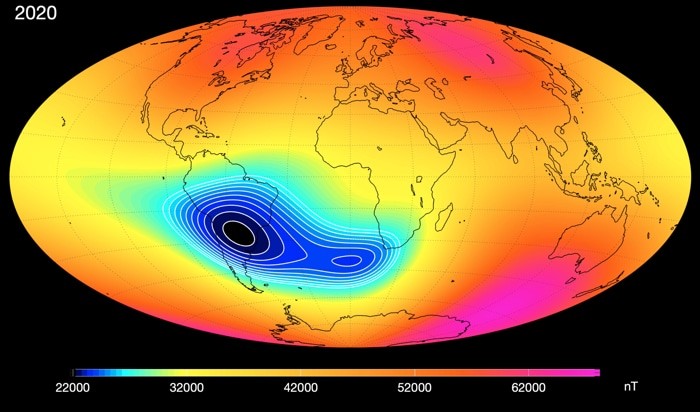
Examining Earth’s magnetic field reveals a distinct weakened zone over the South Atlantic, situated between South America and the southwest coast of Africa. This area, where the magnetic shield is notably less intense, is identified as the South Atlantic Anomaly. Though known for decades, the anomaly has expanded significantly in recent years, nearly reaching an increase equivalent to half the size of continental Europe since 2014.

What raises concerns for NASA is the effect on satellites passing through this weaker magnetic region. These spacecraft encounter energetic solar particles that can interfere with their critical onboard electronics.
Although these disruptions often result in minor errors, the possibility of serious operational failures is a persistent worry. According to the U.S. space agency, operators frequently deactivate sensitive satellite subsystems while navigating the SAA to avoid potential data loss or malfunctions.
Implications for Satellite Operations
Satellites face increased risks while traversing the SAA, entering a zone where Earth's magnetic defenses against solar radiation are reduced. These energetic solar particles, mainly protons, can disrupt satellite hardware, causing intermittent errors or potentially permanent damage. These effects are well documented by NASA.
Though many disturbances are minor, satellite teams remain vigilant, sometimes turning off critical instruments during SAA passages to safeguard technologies. This precaution is part of NASA's broader strategy to protect space assets against the challenges posed by this magnetic weakness.
The Origins of the South Atlantic Anomaly
The reasons behind the SAA’s existence and growth remain under investigation. One leading hypothesis connects the anomaly to disturbances in Earth’s magnetic field generated by the movement of molten iron deep within its core. A dense rock formation beneath Africa, called the African Large Low Shear Velocity Province, may be influencing these irregularities, weakening the magnetic field in the region.
NASA geophysicist Weijia Kuang points out that alterations in Earth’s magnetic dipole contribute significantly to the weakening seen in the SAA.
“The observed SAA can be also interpreted as a consequence of weakening dominance of the dipole field in the region.” She added, “More specifically, a localized field with reversed polarity grows strongly in the SAA region, thus making the field intensity very weak, weaker than that of the surrounding regions.”
The Expanding and Changing Nature of the SAA
Recent studies reveal that the SAA is no longer a single area of magnetic weakness but appears to be splitting into two separate pockets of diminished magnetic strength. This phenomenon, first noted in 2020, continues to evolve, and scientists are carefully monitoring it.
In fact, changes in the anomaly's structure vary by location. As Chris Finlay from the Technical University of Denmark states:
“It’s changing differently towards Africa than it is near South America, There’s something special happening in this region that is causing the field to weaken in a more intense way.”
NASA continues to observe the SAA’s growth patterns to better understand the dynamics of Earth’s magnetic field and its implications for future aerospace endeavors.
“Even though the SAA is slow-moving, it is going through some change in morphology, so it’s also important that we keep observing it by having continued missions,” noted Terry Sabaka, a geophysicist at NASA’s Goddard Space Flight Center.
- Categories:
- Science









0 comments
Sign in to Comment