
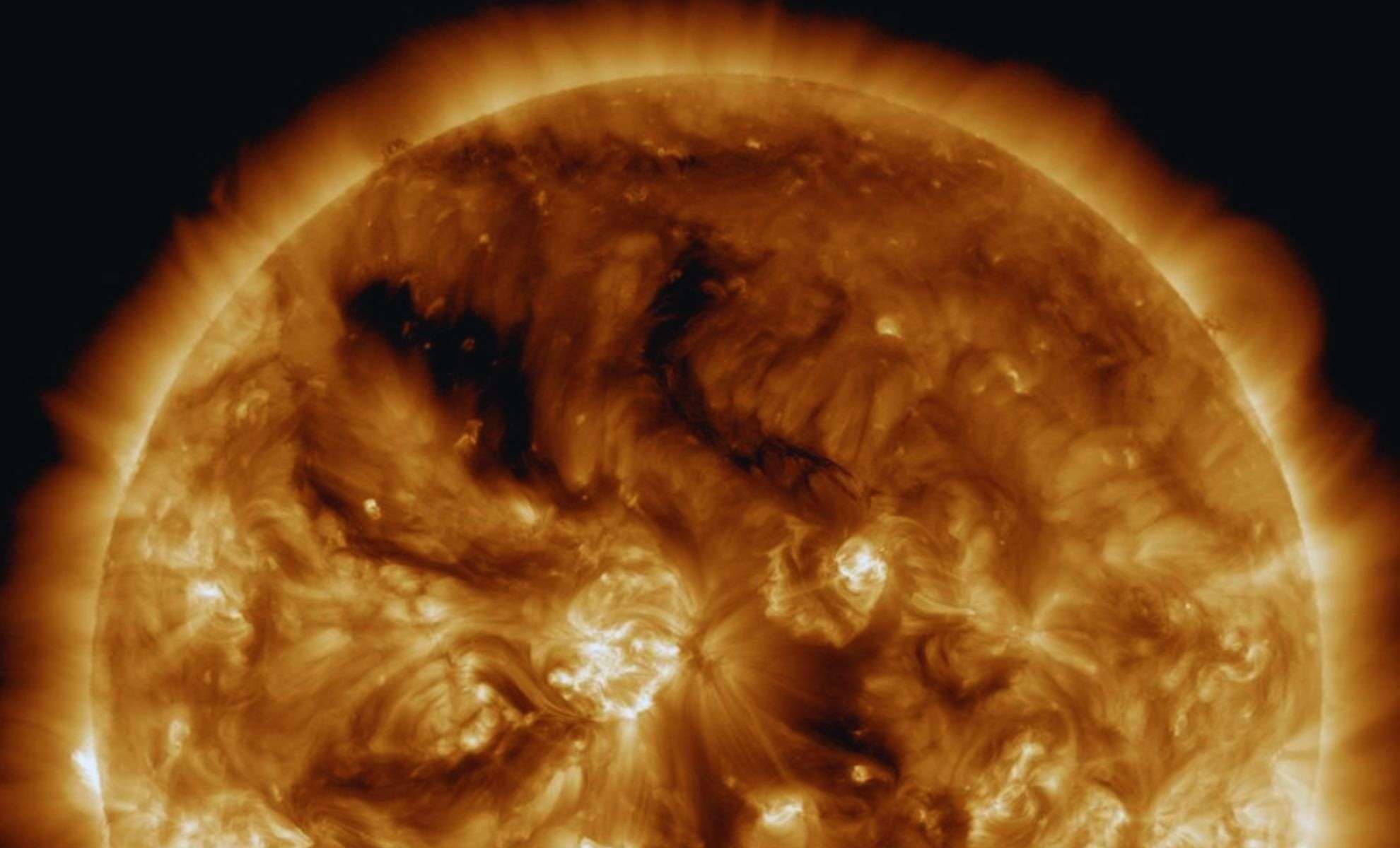
Right before Halloween, NASA’s Solar Dynamics Observatory (SDO) snapped a captivating shot of the Sun that resembles a glowing, cosmic jack-o’-lantern grinning back at Earth. This striking formation, composed of radiant active regions and contrasting dark coronal holes, is both beautiful and meaningful.
Captured on October 28 in the 193-angstrom wavelength, this remarkable image displays what looks like two luminous "eyes," a blazing "nose," and a broad, shadowed "mouth." While such solar faces have appeared before, this specific formation coincides with a solar wind stream heading toward Earth, potentially sparking geomagnetic activity.
Solar Phenomena Create a Haunting Sun Face
Space.com reports that this jack-o’-lantern effect is not just an accidental interplay of light but stems from the Sun’s magnetic field configuration. NASA’s SDO imagery reveals that bright active regions, clusters of intense magnetic activity, form the “eyes” and “nose,” whereas the darker coronal holes make up the eerie grin.

Coronal holes are relatively cooler, less dense zones in the solar corona where magnetic field lines open outward, allowing streams of solar wind to escape. The “mouth” in the October 28 photo represents one such hole facing Earth, releasing fast-moving solar particles that could provoke geomagnetic effects in our planet’s upper atmosphere.
NASA investigators constantly track these patterns to deepen their understanding of how solar magnetism influences Earth. Since its 2010 launch, the Solar Dynamics Observatory supplies ongoing insight into solar emissions and magnetic shifts, enabling scientists to better predict solar weather events.
Potential for Aurora Displays
This captivating event carries scientific importance as well. According to Space.com, experts at the National Oceanic and Atmospheric Administration (NOAA) predict that the incoming solar wind may cause moderate geomagnetic storms rated G1 to G2 between October 28 and 29.
Such geomagnetic disturbances can intensify auroral activity, possibly allowing the Northern Lights to be seen farther south than usual. While the brightest aurora typically form near the poles, these magnetic storms sometimes push them into northern parts of the U.S. or even the UK, depending on the storm strength and timing.
Compared to the intense Halloween Storms of 2003, which unleashed powerful solar eruptions that lit up skies worldwide and disrupted communication networks and power grids, this event is relatively mild. Nevertheless, it highlights the Sun’s ever-changing influence and the need for continued space weather vigilance during dramatic solar episodes.
Repeated Appearances of Spooky Solar Faces
NASA has observed similar jack-o’-lantern solar faces before. A nearly identical glowing grin was seen in October 2014 via the SDO. Both incidents illustrate the Sun’s cyclical magnetic activities, which often create symmetric and sometimes eerie patterns.
These ghostly faces result from the Sun’s 11-year solar cycle, during which magnetic fields shift, twist, and realign. Occasionally, this magnetic dance arranges bright and dark solar regions into shapes that capture public imagination and generate viral attention, as this latest snapshot has.
Although these images spark curiosity and seasonal fun, NASA stresses they reflect genuine physical processes that impact satellites, communications, and other Earth systems, reinforcing the significance of monitoring solar dynamics continuously.
- Categories:
- Space






0 comments
Sign in to Comment