

Scientists at NASA have successfully simulated the enigmatic “spider-like” structures located on Mars, delivering the most definitive explanation yet for these intriguing formations.
Known as araneiforms, these patterns are predominantly found near the Red Planet’s southern polar areas and have fascinated both researchers and space enthusiasts. Contrary to speculation about biological origins, these shapes are formed by purely geological forces unique to Martian conditions. Decoding their formation helps deepen our understanding of Mars’ surface processes.
Deciphering the ‘Spider’ Phenomenon on Mars
The so-called “spiders” observed on Mars are dark, branching channels that emerge seasonally in the southern polar region during Martian spring. First detected in orbital imagery, these intricate networks resemble spider legs extending over Mars’ dusty terrain. Despite their organic appearance, they are geological, stemming from interactions between carbon dioxide ice and the Martian regolith—a sequence not found on Earth. The nickname “spiders” arises from their spider-like visual design, but their origins lie in the unique Martian environment.


The explanation that has gained the most traction stems from the Kieffer model, introduced in 2006 by geophysicist Hugh Kieffer. According to this theory, during the frigid Martian winters, carbon dioxide freezes from the atmosphere, forming a thick ice layer on the surface. When spring sunlight warms the area, the CO2 directly sublimates from solid to gas, building pressure beneath the ice. Eventually, this trapped gas bursts through, ejecting dust and debris and carving out the spider shapes. “These features are not only fascinating but also beautiful natural phenomena,” explains Lauren Mc Keown, planetary scientist at NASA’s Jet Propulsion Laboratory.
Lab Experiments Affirm the Kieffer Model
A NASA team at JPL designed controlled experiments to replicate Martian conditions and validate the Kieffer hypothesis. Using the Dirty Under-vacuum Simulation Testbed for Icy Environments (DUSTIE), they emulated the cold, low-pressure Martian atmosphere. Inside, they placed a simulant of the Martian soil and cooled it with liquid nitrogen. Introducing carbon dioxide resulted in a frozen layer analogous to Martian winter ice.
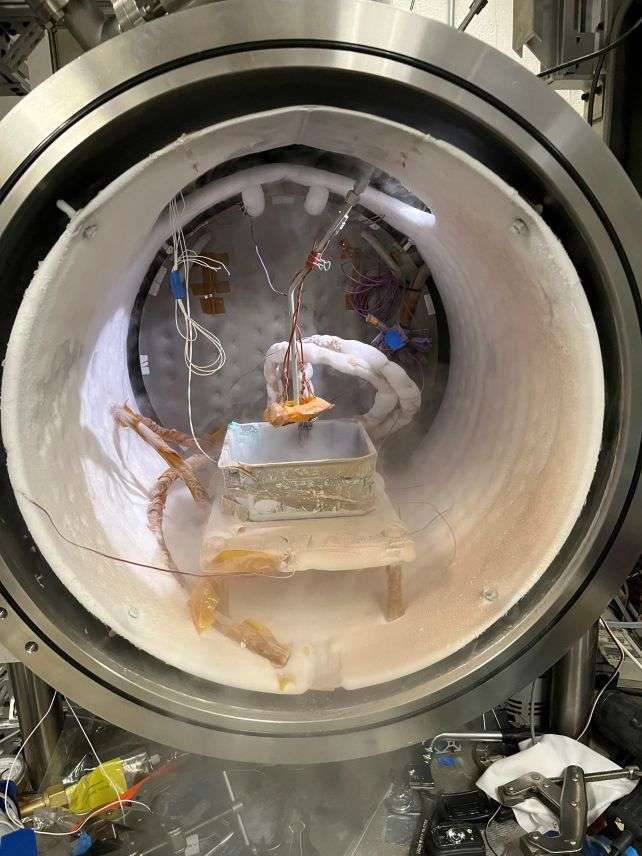
As the chamber was gently warmed to simulate spring, CO2 sublimation began beneath the ice, just as predicted. After refining procedures, the researchers observed gas bursts that forced particles through cracks, forming patterns closely resembling the Martian araneiforms. “It happened late on a Friday evening, and my startled shriek made the lab manager rush in,” recalls Mc Keown. “She thought something went wrong.”
Beyond confirming gas pressure as the cause, the findings revealed that the ice forms within the soil layer, not simply between the regolith and ice as previously assumed. This subtle discovery adds new complexity to the Kieffer model, offering explanations for variety in surface features. The researchers stated, “Our jets appear to be shaped by sublimating ice mixed inside the soil, rather than by gas movement at the interface,” which could clarify other Martian morphologies.
Wider Impacts on Understanding Martian Terrain
Reproducing araneiforms under lab conditions strongly supports the Kieffer model and suggests that similar CO2 sublimation processes could generate other formations such as polygonal terrain and branching troughs. This advances scientific understanding of how seasonal cycles influence Mars’ landscape evolution, especially in polar zones.
The study highlights the crucial role that carbon dioxide plays in shaping the red planet’s surface, differing considerably from Earth where water-driven erosion dominates. Mars’ unique environment relies on cyclical carbon dioxide ice formation and sublimation as key erosive forces that produce the planet's distinct geological features.
The team aims to improve their models and conduct future tests to explore how these CO2 jets influence the formation of other intriguing surface structures. “Our findings indicate that erosion from active carbon dioxide jets involves complexities beyond initial assumptions and may contribute to features like polygonal terrains,” the paper published in The Planetary Science Journal explains. Continued research will shed light on these dynamic processes.
Advancing Our Grasp of Martian Geology
Successfully generating Mars’ “spider-like” geological formations in a laboratory marks a milestone in planetary science. It reveals how intricate natural phenomena arise from Martian environmental conditions and offers insight into the geological forces molding the planet. As missions continue to explore Mars, these discoveries will enhance interpretations of its surface and seasonal changes.
This breakthrough underscores the value of rigorous experimentation and revisiting scientific models. Mc Keown and her colleagues note that, while supporting the Kieffer model, their results also expose unforeseen nuances in how these features form. Deepening knowledge of these mechanisms will provide crucial context for Mars’ geological history and guide future exploration efforts.
- Categories:
- Astronomy ,
- News ,
- Science ,
- Nasa








0 comments
Sign in to Comment