
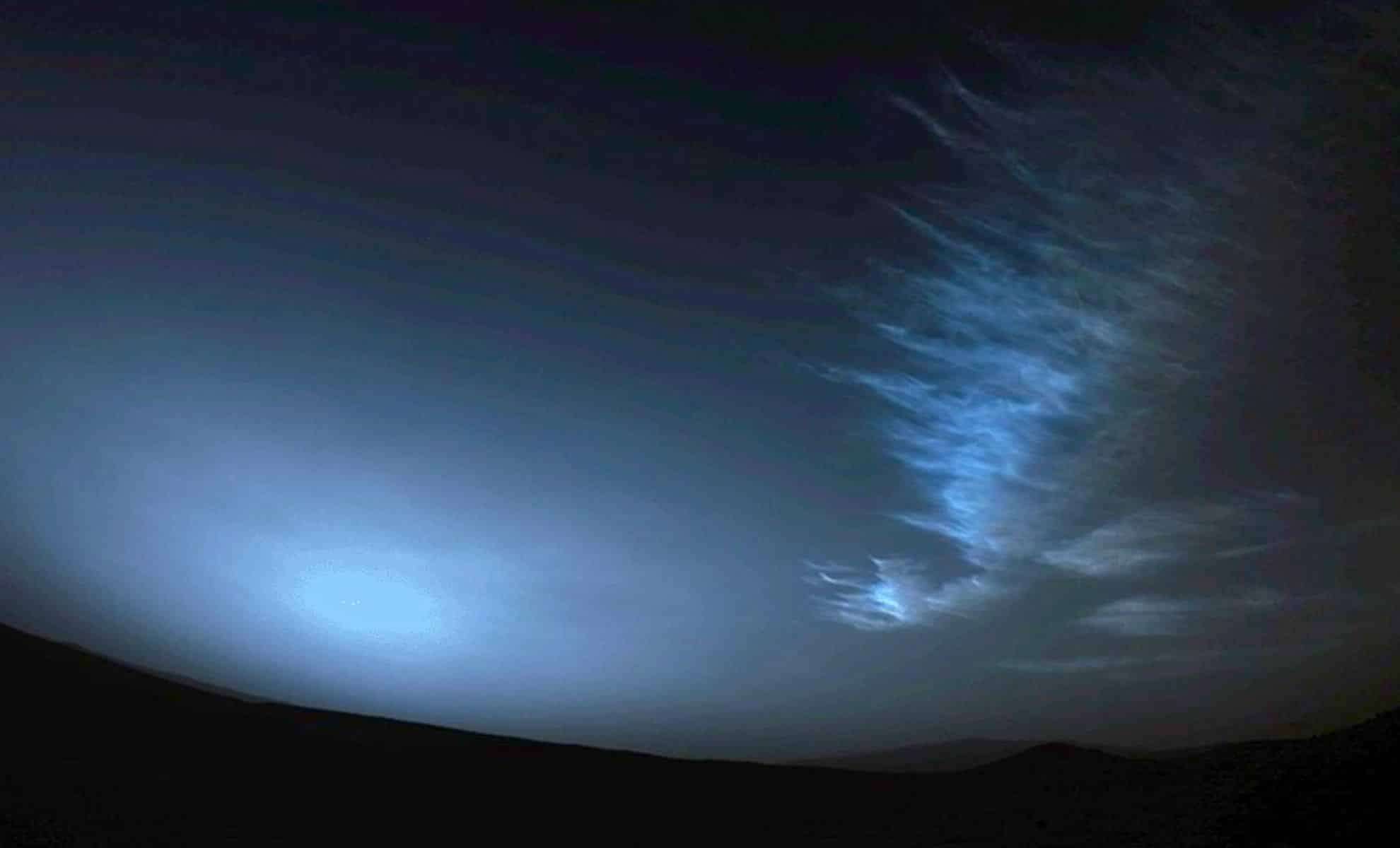
Contrary to the common perception of Mars as a dry, monotonous red planet, NASA’s Curiosity rover has uncovered a vivid display of color in the Martian atmosphere. Recent photos reveal unusual iridescent clouds glowing with hues of red, green, and faint rainbows, elegantly moving across Mars’ sky.
An Extraordinary Atmospheric Display
These captivating photos were snapped on January 17 during a 16-minute span on Curiosity’s 4,426th Martian day (sol). Using its sophisticated Mastcam, the rover captured images of noctilucent clouds—delicate ice clouds visible at twilight when sunlight scatters through high-altitude ice crystals.
This Martian phenomenon echoes Earth’s “mother-of-pearl” clouds, showcasing shimmering colors caused by light diffraction on ice particles. Unlike daytime Martian skies where these clouds are invisible, at dusk they illuminate the horizon with an ethereal light show.

Composition of Martian Iridescent Clouds
Distinct from the water-ice clouds typical on Mars, these iridescent formations likely consist of frozen carbon dioxide (dry ice). They drift at lofty heights between 37 and 50 miles (60 to 80 km), occasionally descending as low as 31 miles (50 km) before warming causes them to dissipate.
Mars’ atmosphere is dominated by 95% carbon dioxide, making clouds of solid CO₂ rare. Atmospheric researcher Mark Lemmon from the Space Science Institute notes these delicate clouds appear during early autumn in the Southern Hemisphere, offering a seasonal celestial spectacle.
The same set of images also revealed water-ice clouds drifting around 31 miles (50 km) over Gale Crater, near Curiosity’s position.
Initial Discovery Dating Back to 1997
NASA’s inaugural observation of these twilight clouds dates to more than 20 years ago, when the Pathfinder mission detected them in 1997. Curiosity first documented the iridescent clouds in 2019, and the current data marks the fourth Martian year of consistent observations.
Lemmon reflected on his initial discovery:
“I’ll always remember the first time I saw those iridescent clouds and was sure at first it was some color artifact. Now it’s become so predictable that we can plan our shots in advance; the clouds show up at exactly the same time of year.”
Each new sighting enables researchers to examine cloud particle size and growth, advancing understanding of the unique Martian atmosphere.
The Enigma of Absent Clouds Elsewhere
One puzzle is why these twilight iridescent clouds appear only in certain Martian locations. Since landing in Gale Crater in 2012, Curiosity has repeatedly recorded them.
In contrast, NASA’s Perseverance rover exploring Jezero Crater since 2021 has yet to capture these clouds. Likewise, Pathfinder’s 1997 sighting took place north of the equator in Ares Vallis, but they remain absent from other Martian regions.
Lemmon proposes that gravity waves—atmospheric ripples that induce cooling—may trigger their formation. However, the behavior of Martian gravity waves remains poorly comprehended, leaving this phenomenon open for further study.
Mastcam’s Role in Illuminating Martian Skies
The most recent cloud images were produced using Curiosity’s left Mastcam, which has a partially stuck filter wheel causing a distinctive circular framing. Despite this issue, both the left and higher-resolution right Mastcams continue delivering crucial color imagery.
Alongside these atmospheric studies, Curiosity recently concluded examination of the Gediz Vallis channel and is traveling toward a location featuring boxwork formations—intricate fracture patterns formed by past groundwater, reminiscent of giant spiderwebs from orbit.
The rover has also explored an impact site dubbed “Rustic Canyon”, analyzing erosion and rock composition there. By investigating such craters, scientists aim to identify ancient materials capable of preserving organic molecules, shedding light on Mars’ past potential for life.
- Categories:
- Space





0 comments
Sign in to Comment