
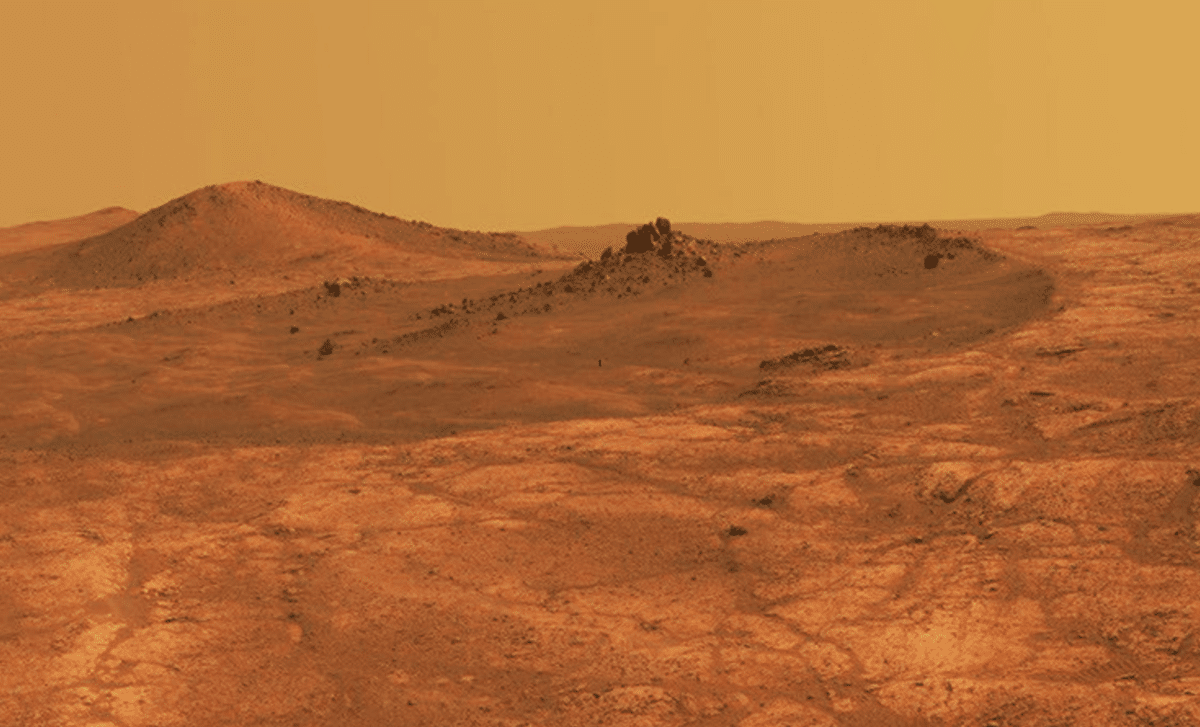
NASA’s upcoming ESCAPADE mission is designed to investigate the causes behind Mars’ atmospheric depletion, shedding light on how the Red Planet shifted from a potentially life-supporting environment to the arid world we observe today. Launching in November 2025, this mission will explore the interaction between solar winds and Mars’ fragile atmosphere to understand their role in the planet’s dramatic transformation.
Unraveling Mars’ Climatic Evolution
There is strong evidence that Mars once harbored liquid water and maintained a thicker atmosphere capable of supporting such conditions. However, over billions of years, this protective layer diminished, leaving Mars cold and desolate. ESCAPADE, a critical component of NASA’s planetary science initiatives, seeks to pinpoint the drivers of this atmospheric loss. Researchers will focus on how solar winds—charged particles streaming from the Sun—gradually stripped away the Martian atmosphere. Mars’ lack of a substantial magnetic shield makes its upper atmosphere especially susceptible to this effect, perhaps explaining its gaseous depletion.
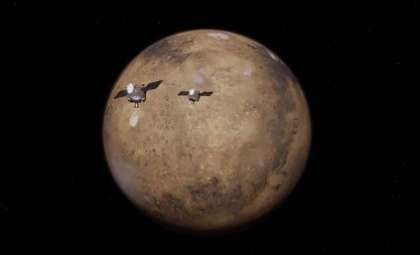
ESCAPADE’s twin spacecraft are equipped with instruments to monitor charged particle flows and measure magnetic fields around Mars. These observations will help scientists understand how solar wind impacts the atmosphere and magnetosphere at various altitudes, offering fresh perspectives on the interplay between the planet and its space environment.

Mission Goals and Scientific Aims
A central goal of ESCAPADE is to generate a detailed three-dimensional map of Mars’ magnetosphere by observing the solar wind’s effects at different altitudes and varying solar conditions. By collecting data during both calm and stormy solar periods, researchers aim to identify the primary mechanisms behind atmospheric erosion and to analyze how charged particles behave in Mars’ upper atmosphere, clarifying the processes that cause atmospheric escape.
ESCAPADE’s findings will enhance and complement ongoing observations from NASA’s MAVEN mission, which has monitored Mars’ atmosphere since 2014. Unlike MAVEN’s single-orbit observation, ESCAPADE’s dual spacecraft will provide multiple perspectives, yielding richer and more precise data to better understand Mars’ atmospheric evolution.
The Role of Solar Wind in Atmospheric Loss
Solar wind is a continuous flow of charged particles emitted by the Sun that can significantly impact planetary atmospheres. Without a protective magnetic field, Mars is directly exposed to this particle stream. ESCAPADE will investigate how this interaction causes atmospheric gases to escape into space, contributing to Mars’ environmental decline.
The mission’s spacecraft will measure the dynamics of Mars’ upper atmospheric gases, track magnetic and electric fields, and assess charged particle densities. By capturing data during different solar activity levels, ESCAPADE will help scientists understand how solar storms accelerate atmospheric loss, providing insights relevant not only to Mars but also to other planets and exoplanets exposed to similar phenomena.
Atmospheres: Key to Planetary Habitability
An atmosphere is crucial for maintaining planetary conditions that can support life, regulating surface temperatures, shielding from detrimental radiation, and enabling liquid water. Mars lost much of its atmosphere over time, leading to frigid surface temperatures that prevent liquid water’s existence and make the planet inhospitable.
Studying Mars’ atmospheric depletion through the ESCAPADE mission is vital to understanding not only Mars’ past but also the vulnerability of planetary atmospheres elsewhere. These discoveries will guide future missions targeting other worlds where atmospheric erosion could be a significant factor in their habitability.
- Categories:
- News





0 comments
Sign in to Comment