
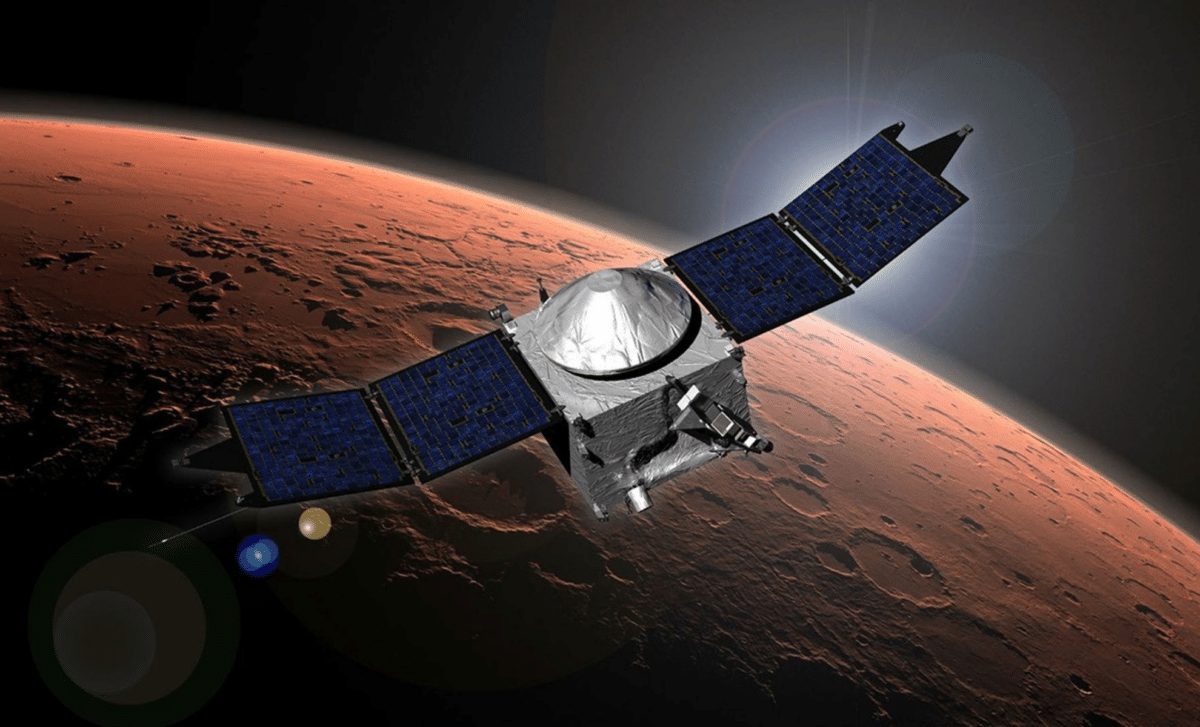
NASA is currently grappling with difficulties in reestablishing contact with the MAVEN spacecraft, which has not transmitted signals for several weeks. Since 2014, MAVEN has been dedicated to studying Mars' atmosphere, but recent troubling signs, including a possible alteration in its orbit, have raised alarms. As the solar conjunction period nears, NASA’s capacity to communicate with the orbiter is on hold, underscoring the delicate nature and intricate challenges of interplanetary exploration.
Unraveling MAVEN’s Communication Blackout
The MAVEN orbiter, operational around Mars since 2014, has been pivotal for atmospheric research. Yet, efforts to hear from the spacecraft have been unsuccessful since December 6, 2025. The final contact suggested that MAVEN may be uncontrollably tumbling, with its orbit deviating from predicted paths. This situation has sparked worries regarding its operational health and mission viability. The timing of MAVEN’s silence coincides with the upcoming solar conjunction, when Earth and Mars are positioned on opposite sides of the Sun, temporarily blocking all communications. This scenario forces NASA to suspend command transmissions until mid-January 2026, complicating recovery efforts.
In an innovative attempt to locate the spacecraft visually, NASA utilized the Curiosity rover’s Mastcam to scan MAVEN’s anticipated orbital path, but these efforts failed to detect the orbiter. The absence of contact restricts information about MAVEN’s current status. NASA suspects the communication loss stems from a malfunction in the spacecraft’s Guidance, Navigation, and Control (GNC) systems, potentially causing it to spin erratically in space.

Questions Surrounding MAVEN’s Orbit and Safe Mode Status
Spacecraft encountering critical issues usually switch to a “safe mode” to conserve energy by shutting down non-essential systems while awaiting commands from Earth. However, NASA has not confirmed that MAVEN has entered this protective state. An industry expert told The Register:
“If it were [in safe mode], they [NASA] would be more successful in communicating with it. So whatever has happened, it hasn’t been able to reach safe mode.”
This suggests MAVEN’s inability to stabilize and activate safe mode might point to a more complicated malfunction than usual.
Understanding the root of MAVEN’s unplanned rotation poses another challenge. The orbiter’s guidance relies on accurate orientation data, and errors here can cause the spacecraft to spin uncontrollably. Potential causes include thrust imbalances or failures in its attitude control system, both of which would dramatically hinder communication efforts. NASA’s team faces a tough endeavor since restoring signal contact likely requires precise spatial positioning of the spacecraft.
Solar Conjunction’s Effects on Mars Communication
Solar conjunction occurs when Earth and Mars lie on opposite sides of the Sun, causing the Sun’s interference to block radio signal transmission between the planets. This event, repeating about every two years, forces space agencies like NASA to temporarily halt Mars mission communications for several weeks. Specifically, MAVEN’s communication blackout window spans December 29, 2025, through January 16, 2026.
This communication gap introduces substantial uncertainty as NASA engineers must rely on pre-conjunction data to diagnose MAVEN’s problems. Once the solar conjunction concludes, NASA plans to renew efforts to reestablish contact with the orbiter. However, if MAVEN’s condition deteriorates during this period, corrective actions could become far more difficult.
- Categories:
- News









0 comments
Sign in to Comment