

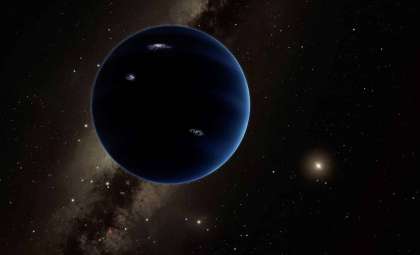
The quest to uncover a giant, hidden world lurking at the edge of our Solar System has long intrigued scientists. A new publication by Terry Long Phan and collaborators, released through Cambridge University Press and available on arXiv, injects fresh energy into this enduring mystery. By analyzing far-infrared data from the IRAS and AKARI all-sky missions, researchers may have pinpointed a candidate that matches the expected features of the elusive Planet Nine.
Uncovering the Invisible Influence Beyond Neptune
Our Solar System comprises a vast array of celestial bodies bound by the Sun’s gravitational pull, and it has long been speculated that undiscovered objects linger beyond Neptune’s orbit. The concept of Planet Nine emerged in 2016 when astronomers Konstantin Batygin and Mike Brown observed an unusual grouping in the orbits of several trans-Neptunian objects (TNOs). These distant bodies appear to be influenced by the gravitational effect of a massive, unseen planet positioned far past Pluto.
Despite rigorous searches using some of the most advanced telescopes available, Planet Nine has remained undetected. The challenge of observing it directly has only intensified as models refine the predicted location and properties of this potential planet.

Leveraging Infrared Data Over Decades
The new study highlights a creative technique, capitalizing on the 23-year interval between the IRAS and AKARI infrared sky surveys. This time span enables the detection of slow-moving objects, anticipated to shift about 3 arcminutes per year—consistent with expectations for a massive planet orbiting in the distant Solar System.
The investigation focused on the AKARI Far-Infrared Monthly Unconfirmed Source List (AKARI-MUSL), a catalog optimized for spotting faint, mobile sources rather than relying solely on bright, static objects. The team predicted Planet Nine’s brightness and motion assuming a mass between 7 and 17 times that of Earth and a distance ranging from 500 to 700 astronomical units (AU) from the Sun.
By meticulously cross-referencing positional and brightness data from both surveys, researchers initially found 13 pairs of sources with angular separations aligned with Planet Nine’s predicted motion. Through a detailed vetting process, including direct image inspections, the list was ultimately narrowed to a single standout candidate.
A Leading Prospect Demanding Further Study
The selected candidate matched all critical factors: angular separations between 42 and 69.6 arcminutes in IRAS and AKARI data, and no repeated detections at identical coordinates across the time span. Additional validation came from AKARI detection probability maps, which aligned with expectations for a slow-moving object observed at the correct intervals, with no detections six months earlier.
Nevertheless, the researchers emphasize caution. Current IRAS and AKARI data alone cannot define an orbit or definitively prove the candidate is Planet Nine. They advocate for follow-up observations utilizing the Dark Energy Camera (DECam), which can quickly capture faint, moving objects and provide critical confirmation.
- Categories:
- News









0 comments
Sign in to Comment