
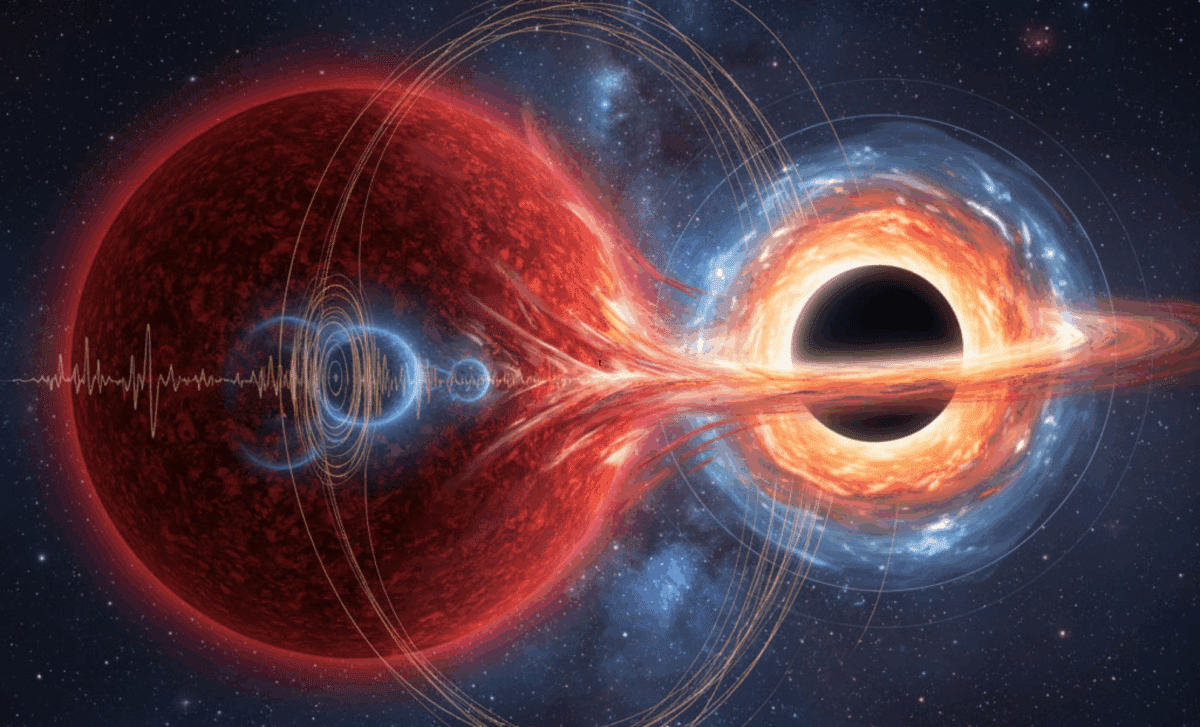
Researchers utilizing NASA’s Transiting Exoplanet Survey Satellite (TESS) have identified a unique oscillating signature from a red giant star in the Gaia BH2 system, situated 3,800 light-years away within the Centaurus constellation. This unprecedented finding, reported by the University of Hawaii, opens a novel avenue for exploring the complex interactions between stars and black holes.
Decoding the Red Giant’s Rhythms through Stellar Oscillations
Much like musical instruments, stars emit vibrations that can reveal their inner characteristics. Although these stellar pulsations are invisible to the naked eye, advanced technology like TESS enables astronomers to detect these subtle oscillations. Often described as a star’s “song,” these vibrations provide crucial insights into the star’s structure, analogous to how seismologists study earthquakes to understand Earth’s interior. As Daniel Hey, lead investigator at the University of Hawaii Institute for Astronomy (IfA) explained: “Just like seismologists use earthquakes to study Earth’s interior, we can use stellar oscillations to understand what’s happening inside distant stars.”
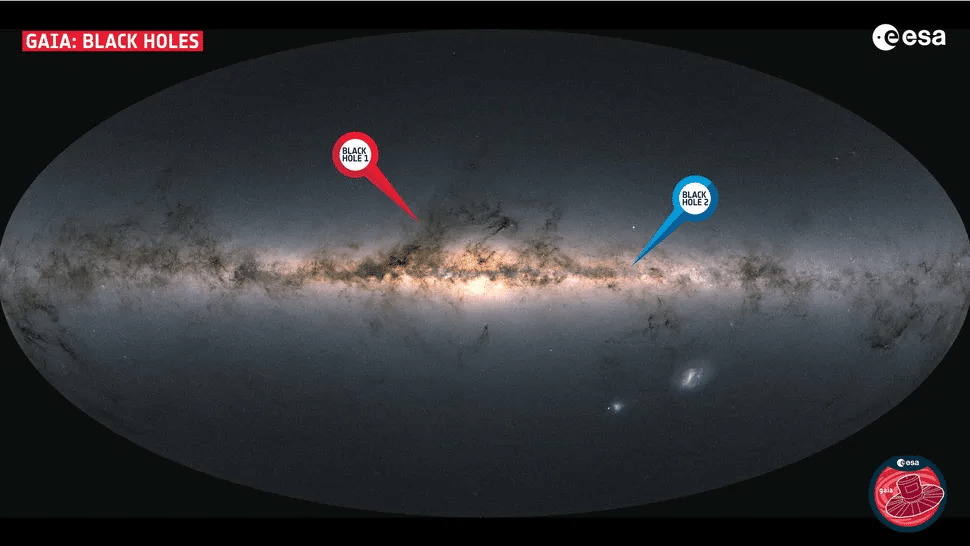
The red giant star in the Gaia BH2 system was a prime candidate for analyzing these stellar pulsations. Observations from TESS have helped reveal the star’s internal constitution and its response to the gravitational influence of its black hole partner. The findings suggest a far more intricate evolutionary background than previously assumed. Hey noted, “These vibrations told us something unexpected about this star’s history,” indicating that the star’s evolutionary journey is more complex than anticipated.

Revealing Gaia BH2’s Red Giant Star's Complex Past
The red giant within the Gaia BH2 system has undergone remarkable transformation. Typically, red giants represent stars in their later stages that have depleted their core fuel. However, this particular star is surprisingly youthful—around 5 billion years old. Coupled with its rare chemical composition, this discovery raises compelling questions. The star exhibits a high concentration of heavy, "alpha-rich" elements, a trait commonly found in much older stars. Despite this, the star remains in its relatively early phase, contrasting with isolated stars of similar makeup.
Hey observed, “Young, alpha-rich stars are quite rare and puzzling,” noting that the combination of young age and aged chemical signature points to an unusual development. The star’s evolution was likely influenced by interactions with a binary companion, possibly gaining additional mass during a merger or by absorbing material when the black hole emerged. This interaction would explain the star's atypical chemical profile and evolutionary path.
Rapid Spin Offers Insight into the Star’s Turbulent History
Another remarkable aspect of this red giant is its swift rotation, completing one full turn every 398 Earth days, which is unusually fast for stars in this category. This rapid spinning is uncommon for solitary stars. NASA Hubble Fellow Joel Ong, a project team member, stated,
“If this rotation is real, it can’t be explained by the star’s birth spin alone. The star must have been spun up through tidal interactions with its companion, which further supports the idea that this system has a complex history.”
Such accelerated rotation generally arises from tidal forces exerted by a close companion, in this case, the black hole, which intensifies the star’s spin. This interaction is also responsible for starquakes—vibrations within the star’s interior caused by the gravitational pull of its companion. The faster rotation amplifies these effects, reinforcing the notion that Gaia BH2’s red giant star has been significantly influenced by its proximity to the black hole or previous stellar encounters in the system.
Unraveling the Black Hole’s Origin and Its Role
The black hole in the Gaia BH2 system adds an intriguing element to this cosmic narrative. Direct observations of black holes remain challenging, but their gravitational effects on neighboring stars provide indirect evidence of their formation and evolution. The discovery of Gaia BH2 alongside its red giant companion has enriched our understanding of the interplay between black holes and stellar development.
This black hole likely originated from the collapse of a massive star within the binary system, creating the intense gravitational field now influencing the red giant. The star’s unusual traits may stem from mass transfer that happened during the black hole's formation. Hey emphasized,
“The combination of youth and ancient chemistry suggests this star didn’t evolve in isolation. It likely acquired extra mass from a companion, either through a merger or by absorbing material when the black hole formed.”
- Categories:
- Physics




0 comments
Sign in to Comment