
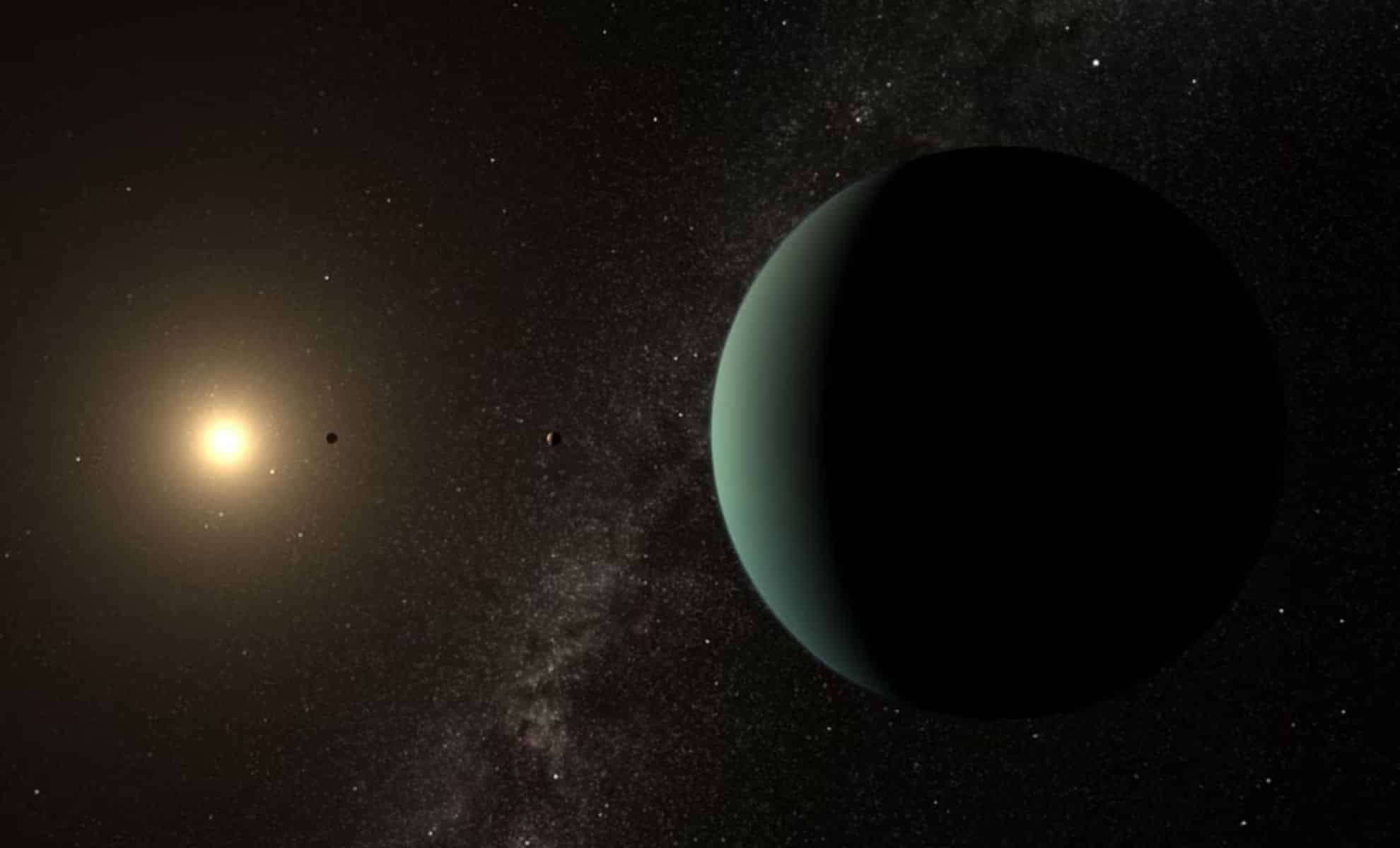
Astronomers have validated the presence of HD 20794 d, a super-Earth situated roughly 20 light-years from Earth, showing compelling signs that it could harbor conditions suitable for life. Unlike many exoplanets previously identified, this planet orbits squarely within its star’s habitable zone, where liquid water could potentially exist—an essential factor for life as we understand it.
The official detection of HD 20794 d represents a significant leap forward in the field of exoplanet exploration. Scientists have long suspected the existence of this planet in the HD 20794 system, also referred to as 82 G Eridani, located in the Fornax constellation. Early signals hinted at the planet’s presence, but the data was initially too faint to confirm. After thorough and prolonged analysis, researchers have now unequivocally proven the planet’s reality. “We devoted years to refining the data, systematically excluding any sources of error,” noted Dr. Michael Cretignier, a postdoctoral fellow at Oxford University and study co-author.
While experts are cautious about declaring HD 20794 d habitable outright, it meets many criteria sought in an Earth-like exoplanet. It lies at a favorable orbit from its star, possesses a mass at least 5.8 times greater than Earth’s, and orbits a comparatively stable star, making it an exciting subject for upcoming investigations.

Confirming HD 20794 d’s Existence
Detecting HD 20794 d required overcoming numerous challenges. Planets beyond our solar system are commonly found using either the transit technique, which measures a star’s brightness dip as a planet crosses in front, or the radial velocity method, observing minute stellar motions prompted by a planet’s gravitational tug.
Since HD 20794 d doesn’t transit its star from Earth's viewpoint, the transit method wasn’t applicable. Instead, astronomers utilized the High Accuracy Radial Velocity Planet Searcher (HARPS) spectrograph at La Silla Observatory in Chile and its upgraded counterpart, ESPRESSO, to detect subtle shifts in the host star’s velocity caused by the planet.
By combining extensive datasets accumulated over several years, the research team confirmed HD 20794 d’s presence. “Confirming this planet brought me immense satisfaction,” explained Cretignier. “Given the signal was barely above the detection threshold, there was always some uncertainty, so verifying its presence was a major relief.”
This success highlights how advanced instrumentation and persistent data refinement can push exoplanetary science forward. Promising new tools like the Extremely Large Telescope (ELT) and the Large Interferometer for Exoplanets (LIFE) are slated to enable detailed atmospheric studies of HD 20794 d, a fundamental step in assessing its potential for life.
HD 20794 d At a Glance
Why HD 20794 d Stands Out
Among the thousands of exoplanets discovered, only a few are promising in terms of habitability. Many are either too close to their stars, resulting in extreme heat, or too distant, leading to frozen, inhospitable surfaces.
HD 20794 d is noteworthy because its star is unusually stable compared to many other exoplanet hosts, especially the flare-prone red dwarf stars known for their volatile eruptions. Stellar flares can erode planetary atmospheres, diminishing the chances for life. The star hosting HD 20794 d has relatively mild activity, which increases the likelihood that any atmosphere on the planet could persist over time.
However, the planet’s eccentric orbit poses potential challenges. Unlike Earth’s nearly circular revolution, HD 20794 d’s orbit swings it closer and farther from its star during its year, likely causing significant seasonal temperature changes. This could result in scorching heat during closer approaches and deep freezes when farther away. Whether life could withstand such variability remains an intriguing question for future research.
Future Research Directions for HD 20794 d
Studying exoplanet atmospheres directly remains a major observational challenge. The James Webb Space Telescope (JWST) has transformed this field by revealing atmospheric details for many planets, but since HD 20794 d does not transit its star, JWST’s transit spectroscopy methods cannot be used.
Astronomers are hopeful that upcoming observatories, such as the Extremely Large Telescope (ELT) and the Large Interferometer for Exoplanets (LIFE), will employ alternative techniques to study HD 20794 d’s atmosphere. These next-gen facilities aim to detect crucial gases like water vapor, oxygen, and methane, which are important signs when assessing habitability.
Discovering biosignatures or similar atmospheric clues on HD 20794 d could position it among the top targets in the quest to find life beyond Earth, bringing humanity closer to answering the profound question of whether life exists elsewhere in the cosmos.
- Categories:
- News










0 comments
Sign in to Comment