
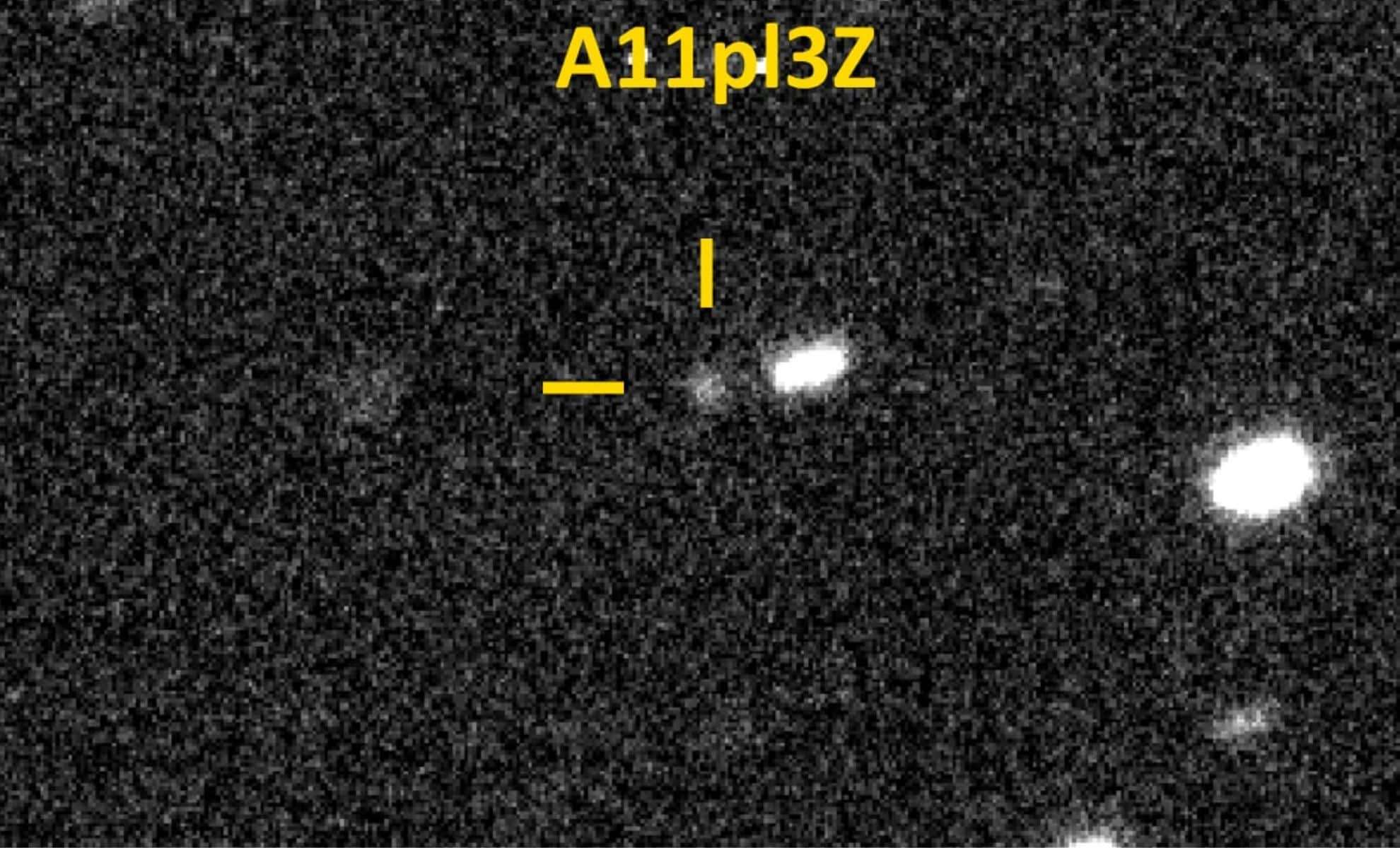
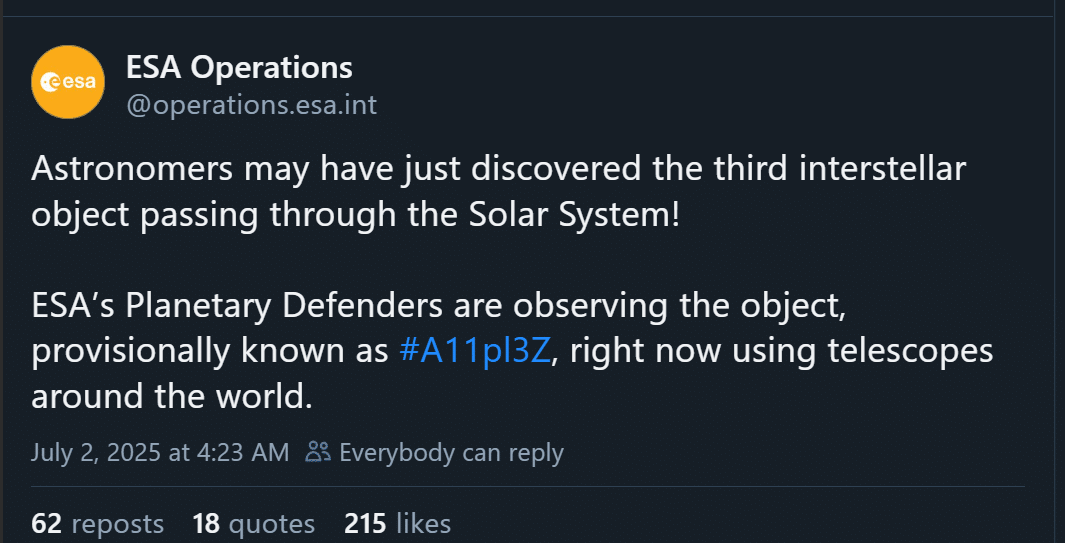
Scientists have detected a fresh interstellar visitor speeding through our solar system, following a path that brings it closer to our star than any previously observed interstellar entity. This object, designated A11pl3Z, has captured significant attention in the astronomy community, with the European Space Agency (ESA) participating in a coordinated observational campaign. ESA’s Operations team recently announced on Bluesky: “Astronomers may have just discovered the third interstellar object passing through the Solar System! ESA’s Planetary Defenders are observing the object, provisionally known as #A11pl3Z, right now using telescopes around the world.”
As A11pl3Z approaches its closest passage to the Sun, it offers a rare chance to explore the origins and nature of interstellar bodies—a rapidly growing area of study. This discovery represents just the third confirmed interstellar visitor, following ‘Oumuamua in 2017 and Comet 2I/Borisov in 2019. Researchers are actively monitoring A11pl3Z to analyze its structure and activity, potentially unlocking secrets about the formation and evolution of distant star systems.
Spotlight on A11pl3Z: An Interstellar Traveler like No Other
The object labeled A11pl3Z stands out not only due to its extra-solar origin but also because of its trajectory, which hints at its roots. Observations reveal that A11pl3Z is zooming through the Milky Way’s thin galactic disk, suggesting an origin far beyond our stellar neighborhood. Traveling at a swift pace of approximately 68 km/s, the object accelerates as it closes in on the Sun, expected to reach velocities near 152,000 mph (68 km/s).

Though still distant, astronomers estimate A11pl3Z to be about 20 kilometers (12 miles) across, making it substantial for an interstellar visitor. Its classification remains uncertain—potentially a comet or asteroid. Importantly, there is no risk to Earth; it will pass safely beyond Mars, at roughly 0.4 AU, just within the observational reach of spacecraft like the Mars Reconnaissance Orbiter. As data accumulates, experts anticipate learning more about its composition and structure.
Detecting Interstellar Visitors: The Case of A11pl3Z
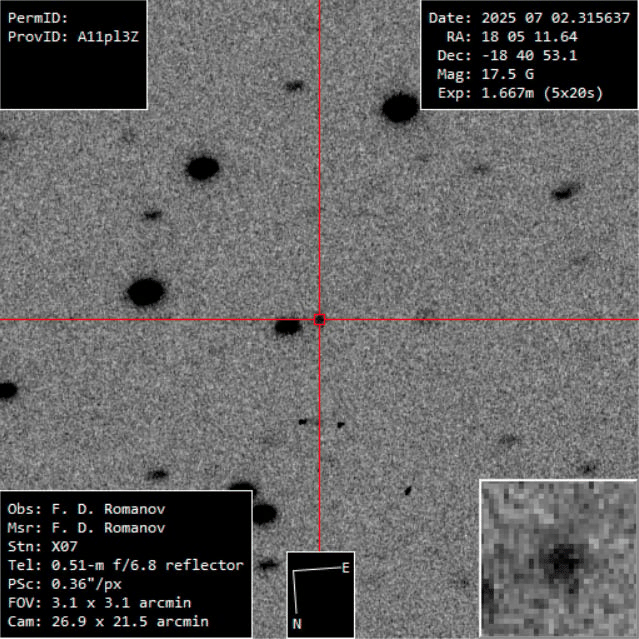
Confirming A11pl3Z as an interstellar object depends on analyzing its unique orbital path, velocity, and multisite observations. Its unexpected approach trajectory sparked initial suspicions, as interstellar objects do not follow closed orbits around the Sun but rather hyperbolic courses.
Currently listed on the NASA/JPL Near-Earth Object Confirmation Page, A11pl3Z is notable as the third recorded visitor from beyond our solar system. The discovery has spurred international astronomical collaboration. As ESA’s Operations account noted on Bluesky, “ESA’s Planetary Defenders are observing the object, provisionally known as #A11pl3Z, right now using telescopes around the world.” This collective effort will deepen understanding of the object’s material make-up, geometry, and potential origin, informing models of star and planet formation.
Why A11pl3Z Matters to Science
Investigating interstellar visitors like A11pl3Z provides crucial insights into the wider universe. As this object speeds toward the Sun, it offers a glimpse into the interstellar environment and the mechanisms shaping entities far beyond our celestial neighborhood. VLBI radio astronomer Marshall Eubanks noted on the Minor Planet Mailing List that “This object appears to be coming from the thin galactic disk.” Studying it could enhance our knowledge of star and planetary system formation, along with how such objects traverse vast cosmic distances.
A11pl3Z will continue accelerating as it reaches perihelion, expected in October 2025. At this point, it may achieve record-setting speeds for interstellar objects, aiding astronomers in refining models of cosmic travel and interactions with solar gravitational fields. This knowledge expands our understanding of the physical properties and behavior of these rare visitors.
- Categories:
- News










0 comments
Sign in to Comment