
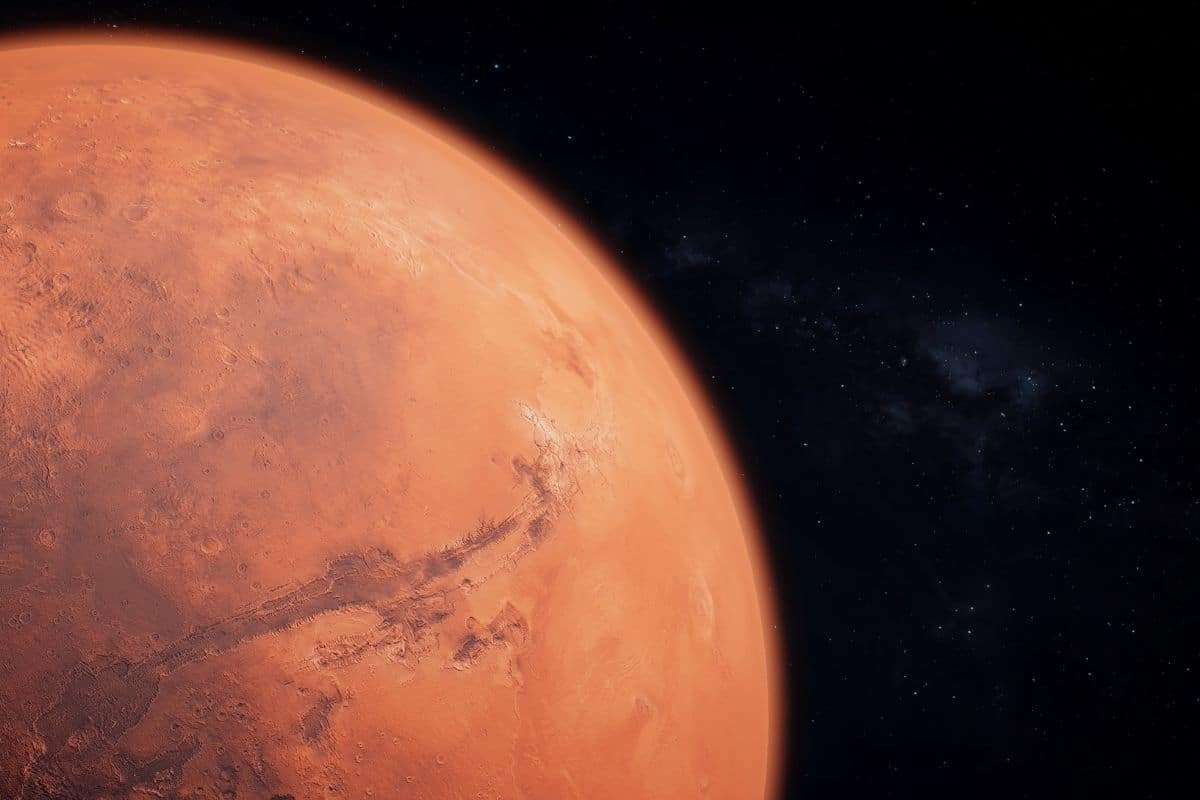
The concept of making Mars more Earth-like, allowing humans to thrive without bulky spacesuits, continues to inspire scientists, authors, and space enthusiasts worldwide.
At the 56th Lunar and Planetary Science Conference, Dr. Leszek Czechowski of the Polish Academy of Sciences unveiled a study that offers new insight into the challenges and possibilities of terraforming the Red Planet.
Understanding Mars’ Harsh Environment
Mars remains a planet marked by extreme cold and severe conditions. Due to its low atmospheric pressure, water boils at far lower temperatures than on Earth, presenting major obstacles for sustaining life.
“On Mars, a human’s bodily fluids would start boiling almost immediately under the planet’s current atmospheric pressure,” explained Dr. Czechowski. His paper, Energy Problems of Terraforming Mars, details the enormous amount of energy and resources required to transform the Martian environment.

Czechowski proposes that raising Mars’ atmospheric pressure to roughly one-tenth of Earth’s could be achievable. At this pressure, water would boil at 50°C, which is just above normal human body temperature. Although still not optimal, this shift would significantly enhance Mars’ potential for habitability.
Targeting Hellas Planitia for Terraforming
Increasing atmospheric pressure across the entire planet represents a huge challenge, but certain areas offer promising initial opportunities. One such region is Hellas Planitia, a massive Martian basin.
Here, atmospheric pressure averages approximately one-hundredth that of Earth at sea level, making it the most favorable location to initiate terraforming efforts by gradually boosting pressure to sustainable levels.
Securing the Right Materials
A major hurdle in terraforming is sourcing sufficient elements to assemble a breathable atmosphere. Dr. Czechowski examines whether asteroids in the nearby asteroid belt could supply needed resources like water and nitrogen.
Unfortunately, the asteroid belt’s composition lacks adequate amounts of these vital materials. Instead, he turns his attention toward the Oort Cloud, a distant, icy reservoir surrounding our Solar System.
This area holds large quantities of water ice and other compounds essential for atmospheric creation. However, hauling material from the Oort Cloud is an immense logistical challenge.
Science Alert reports that transporting a suitably sized Oort Cloud object close enough to Mars might take around 15,000 years.
Kuiper Belt: A More Practical Resource
The Kuiper Belt, a region beyond Neptune, offers a more manageable alternative. Rich in icy bodies, the Kuiper Belt could potentially supply Mars with water over a few decades rather than centuries or millennia.
However, bringing these bodies inward is complicated because their fragile structures risk breaking apart when warmed by the Sun’s heat.
- Categories:
- Space



0 comments
Sign in to Comment