
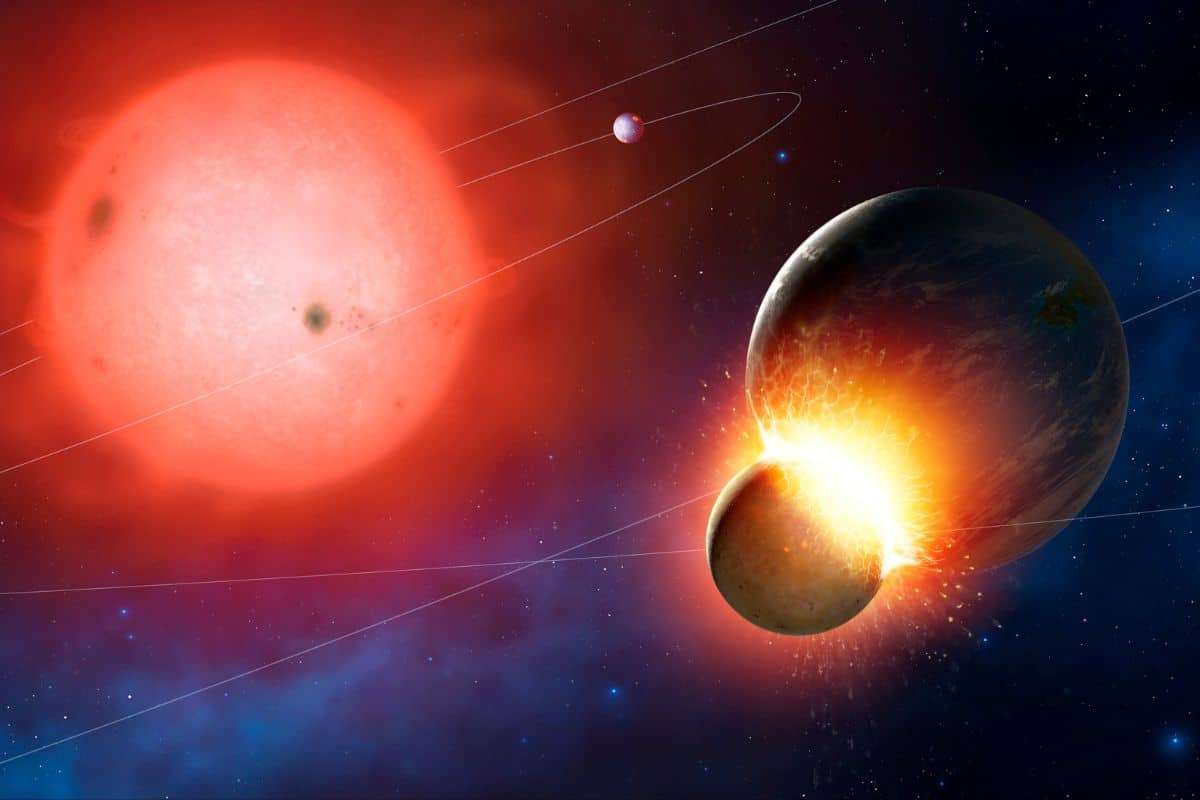
Recent research from Ohio State University indicates that gas giant exoplanets resembling Jupiter may form significantly earlier than previously assumed. Contrary to the earlier estimates of 3 to 5 million years, these massive worlds could emerge within just 1 to 2 million years, prompting a major shift in planet formation theories for fledgling star systems.
Reevaluating How Planets Take Shape
The birth of planets occurs within protoplanetary disks, which are rotating clouds of gas and dust enveloping young stars. These disks supply essential materials that accumulate through a process known as accretion, where gas and solid particles gradually coalesce.
This new study, featured in The Astrophysical Journal, proposes that giant gas planets must form rapidly while their protoplanetary disks are still dense and active.

Examining the chemical properties of seven exoplanets and comparing them with Jupiter and Saturn, scientists discovered these planets incorporated significant amounts of solid matter surprisingly early.
This implies that gas giants need to start forming sooner than traditionally believed; otherwise, they wouldn’t have access to sufficient materials needed for their massive growth.
Challenges to Established Planet Formation Theories
The prevailing model, known as core accretion, describes a "bottom-up" process where small particles gradually combine to form a solid planetary core before attracting gas.
This mechanism, however, generally assumes a timeline of several million years for gas giants like Jupiter to fully develop.
The new insights question this timeframe. If Jupiter-sized exoplanets form within 1 to 2 million years, either the accretion process is far quicker than predicted or another phenomenon is responsible.
One competing theory is gravitational instability, where parts of a protoplanetary disk rapidly collapse under gravity, leading to near-instant planet formation.
Implications for Our Own Solar Neighborhood
Although focusing on distant worlds, this research also offers new viewpoints about the origins of Jupiter and Saturn. If distant gas giants emerge swiftly, it suggests our own Jupiter might have formed earlier than previously thought.
There’s long been speculation that Jupiter influenced the early solar system's architecture, affecting how terrestrial planets like Earth and Mars developed.
In particular, the movements of Jupiter and Saturn might explain why Mars is much smaller than Earth and Venus—these giants could have disrupted the flow of material crucial to forming smaller rocky planets. This study bolsters the idea that gas giants play shaping roles in planetary systems far earlier than once thought.
Updating Planet Formation Models
Ji Wang, an astronomy assistant professor leading the study, stresses that these findings demand a fresh look at planetary origins.
“These exoplanets formed while plenty of metals were still abundant,”Wang explained. “This is something the research community wasn’t anticipating, so new explanations must be developed quickly.”
The team also introduced a novel statistical method to approximate the solid accretion mass of exoplanets, offering a promising way to deepen our understanding of how planets form across various stellar environments.
- Categories:
- Space




0 comments
Sign in to Comment