

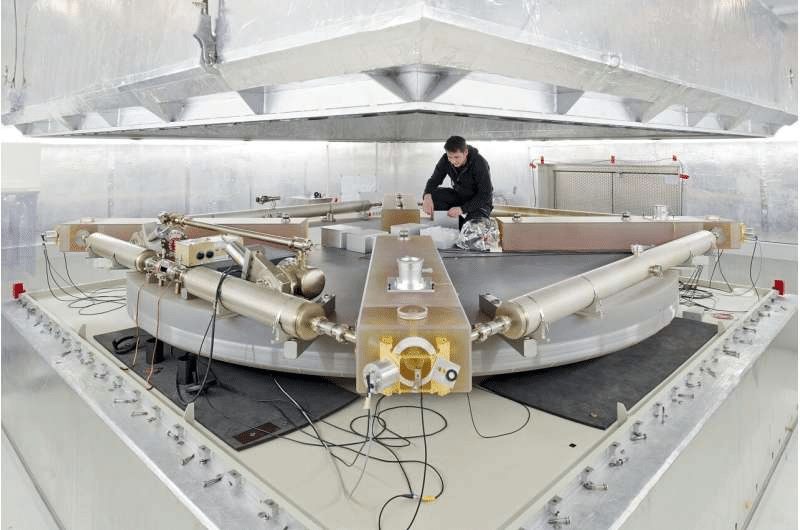
Researchers from the Technical University of Munich and University of Bonn have unveiled an innovative approach for capturing the delicate wobble of Earth's rotational axis without relying on complex global radio telescope arrays. Detailed in Science Advances, their work utilizes a cutting-edge ring laser stationed at TUM’s Geodetic Observatory in Wettzell, Bavaria, offering unmatched precision and time resolution that may revolutionize our understanding of planetary dynamics and enhance tests of Einstein’s theory of relativity.
Resolving a Century-Old Challenge With Advanced Technology
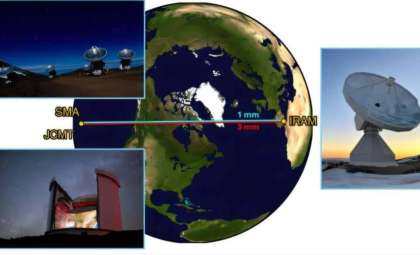
Earth’s rotation is inherently imperfect, marked by gentle but intricate tilts influenced by gravitational forces and its uneven geometry. Traditionally, capturing these subtle changes involved Very Long Baseline Interferometry (VLBI), which depends on vast networks of radio telescopes spread across continents and requires days or weeks to analyze the data.
The TUM team has now developed a compact, ground-based alternative: a sophisticated ring laser gyroscope installed beneath Bavarian soil. Operating continuously for 250 days, the setup monitored the minute shifts in Earth’s axis with under one-hour resolution — a time scale significantly finer than the daily updates typical of VLBI methods.

“Our advancements in observing Earth are unparalleled,” explained lead researcher Prof. K. Ulrich Schreiber from the TUM Institute of Engineering for Astronomical and Physical Geodesy. “This ring laser’s precision outperforms previous gyroscopes and ring lasers by a factor of 100, enabling far more accurate Earth system modeling.”
The Complex Dance of Precession and Nutation
Although Earth seems to spin steadily, its axis instead follows a complex dance, tracing intricate paths across the sky due to multiple interacting forces. The dominant motion, called precession, stems from Earth’s equatorial bulge, which makes the planet more oblate than perfectly spherical. This causes the spin axis to slowly describe a conical shape over roughly 26,000 years.
Superimposed on precession is the finer wobble known as nutation. This oscillation arises due to the gravitational pulls from the Moon and Sun, whose alignments cause time-variable effects ranging from 18.6-year cycles down to daily and even hourly fluctuations. The result is a richly layered pattern of axial shifts, now measurable with exceptional temporal detail.
Mechanics and Significance of the Ring Laser Approach
Unlike methods that depend on external signals, the ring laser functions as a fully inertial sensor. It splits laser beams to travel clockwise and counterclockwise through a loop. Rotation alters their interference pattern, sensitively indicating even the tiniest movements. The Wettzell instrument's structural and optical excellence permits detection of axial fluctuations at a precision level unmatched by any other ground-based gyroscope.
The true breakthrough lies in its autonomous ability to capture all crucial components of Earth's axial motion — precession, nutation, and subtle, smaller-scale variations — eliminating reliance on global radio telescope arrays. This paves the way for more accessible, frequent, and cost-effective monitoring of Earth's rotational dynamics.
Looking ahead, the researchers anticipate enhancing the device’s sensitivity tenfold, potentially enabling direct detection of relativistic frame-dragging phenomena such as the Lense-Thirring effect, where Earth's rotation slightly warps spacetime. Achieving this would represent a landmark test of Einstein's general relativity from a terrestrial platform.
Broader Impact on Earth Science, Navigation, and Physics
This technological leap offers benefits far beyond academic curiosity. Geodesy experts gain a powerful tool for tracking tectonic shifts, sea level changes, and the dynamic behavior of Earth's interior layers. Navigation systems could leverage real-time, ultra-precise Earth orientation data to improve missile guidance, satellite positioning, and spacecraft trajectory planning.
Most compellingly, this advancement bridges the gap between quantum sensing innovations and planetary-scale models. As humanity faces pressing climate challenges and expands interplanetary exploration, precise inertial data will be vital to advancing prediction accuracy and scientific understanding.
- Categories:
- News









0 comments
Sign in to Comment