

Recent research reveals that Pluto’s biggest moon, Charon, retains evidence of a long-ago mechanism that progressively reduced its rotational speed. By analyzing the mountain formations on Charon, scientists uncovered clues about its development over billions of years.
Charon appears as one of the most ancient terrains in our Solar System, with a surface estimated to be roughly 4 billion years old. Unlike many other icy satellites, it has seen relatively little surface alteration, making it an excellent candidate for detecting ancient geological phenomena that might be erased on other moons.
This study specifically examines the process known as tidal despinning, where gravitational interactions cause a gradual deceleration of a celestial body’s spin rate. The research indicates that remnants of this slowdown remain visible on Charon’s landscape, providing insights into its primordial stages.

Mountain Ranges Reveal Clues of Compression
Led by Dr. Hanzhang Chen from UCLA and ETH Zurich, the team focused on Oz Terra, an area in the northern hemisphere of Charon.
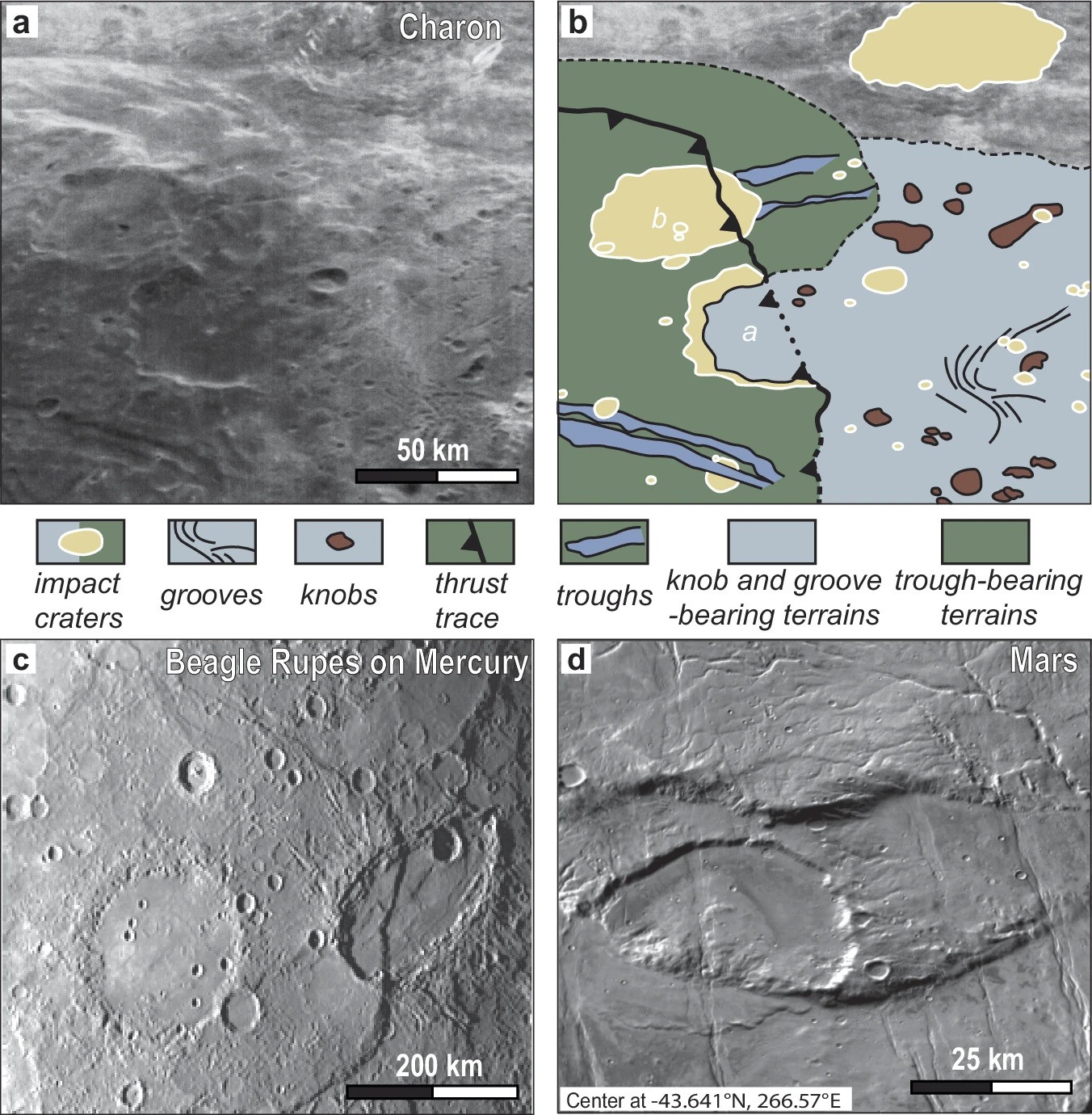
In this region, they studied mountain ranges extending over 200 kilometers. Instead of the expected signs of crustal stretching, the features exhibited uneven slopes indicating compressive forces.
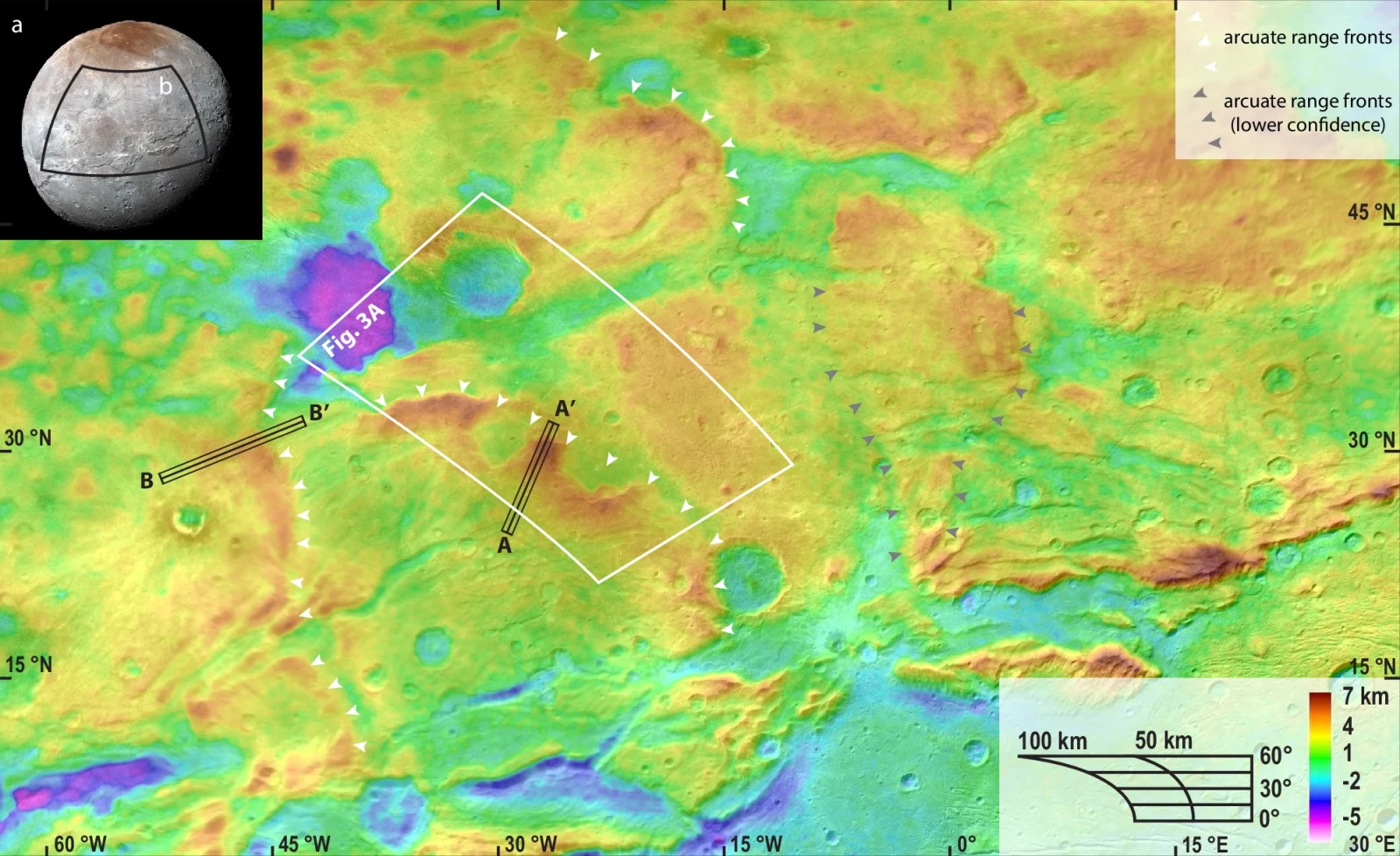
Published on July 14, 2026, in Nature Communications, the results suggest that sections of Charon's crust contracted, with existing faults accommodating the stress. This scenario contrasts with earlier ideas proposing extensive crustal expansion related to cryovolcanic activity.
“Charon exhibits a topographic dichotomy of rugged northern highlands and smoother southern plains,” Dr. Chen said. He added that “Previous studies proposed that Charon has undergone global extension accompanied by cryovolcanism.”
Charon Once Spun Much More Rapidly
Combining observational data with advanced modeling, the researchers investigated how these geological features might have formed.
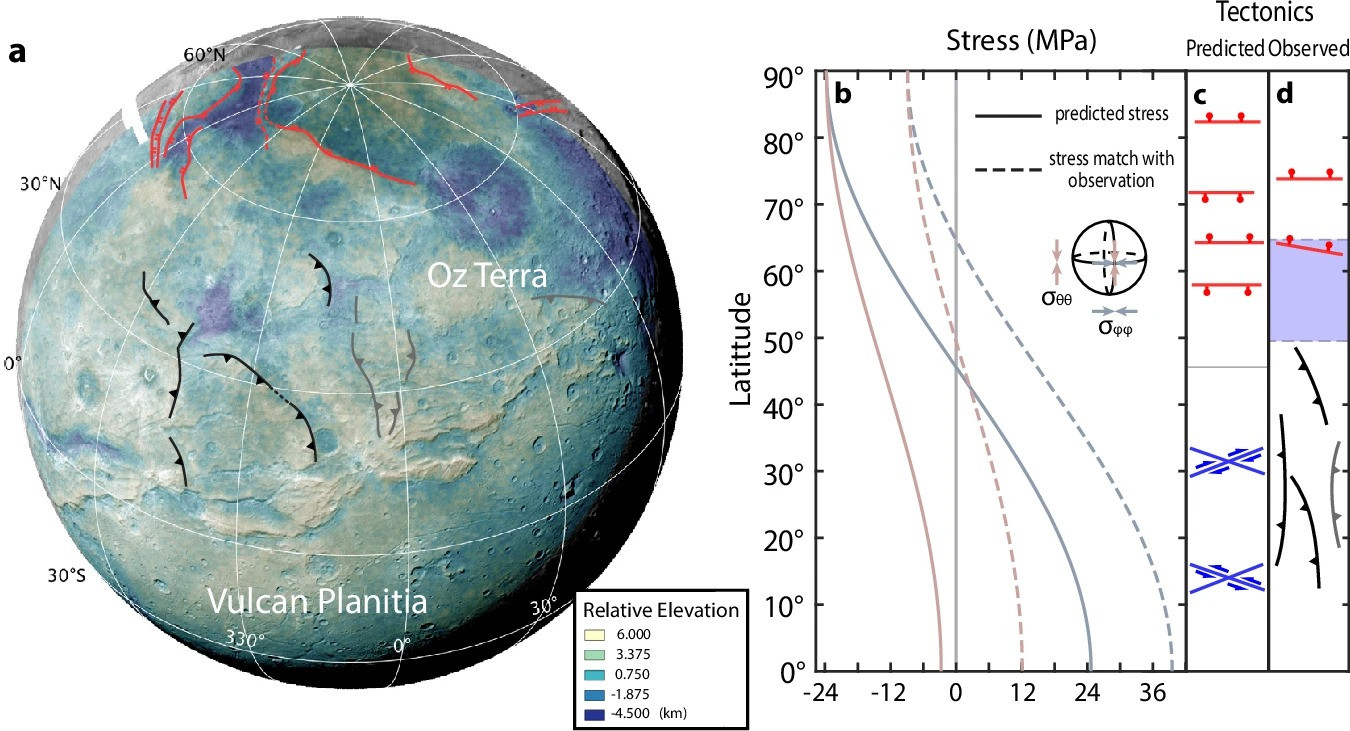
Their analysis indicates that Charon possessed an ice shell approximately 30 to 36 kilometers thick when these compressional ridges developed. Modeling also reveals that the equatorial crust shrank by about 1%, concentrating compressive forces along pre-existing fault lines.
According to the models, early in its history Charon completed a rotation in roughly 14.3 hours. In stark contrast, its current rotation period is about 153.3 hours, matching the time it takes to orbit Pluto due to tidal locking.
This significant slowdown supports the hypothesis that Charon’s spin rate declined gradually through the process of tidal despinning over an extensive timeframe.
Indications of a Cooler Early History
The study also provides insights into Charon’s formative environment. The contraction combined with rotational deceleration aligns with a model where Charon began its life relatively cold, allowing a thick and sturdy ice shell to develop early on.
“Our work suggests that Charon’s surface presents an example that records the planetary despinning history, which predates the proposed global extension and cryovolcanism on Charon,” the authors write in the paper.
In conclusion, the interplay of these two processes suggests a distinctly cooler origin for this icy moon and enhances our comprehension of the evolution of icy bodies residing in the outer regions of the Solar System.
- Categories:
- Science












0 comments
Sign in to Comment