

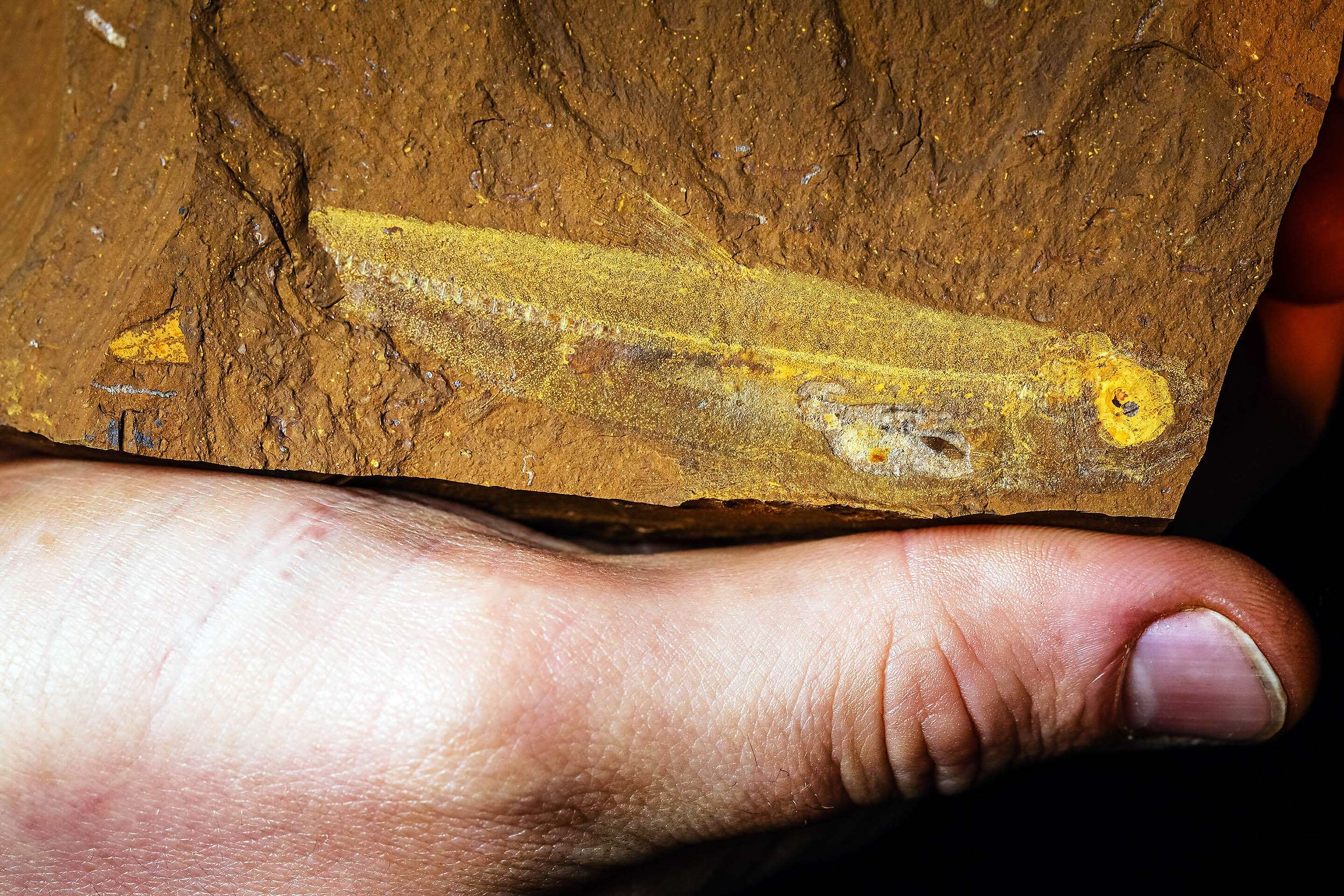
Scientists have unveiled a remarkable fossil near Gulgong in New South Wales, Australia, shedding light on the life of a freshwater fish from 15 million years ago. This species, named Ferruaspis brocksi, astonishingly retains evidence of its last meal along with traces of a parasite and distinctive color markings, providing an extraordinary glimpse into Miocene aquatic ecosystems of Australia.
Groundbreaking Discovery in Freshwater Fish Evolution
The research, spearheaded by Dr. Matthew McCurry from the Australian Museum and UNSW Sydney, documents the first fossil of a freshwater smelt species in Australia. Part of the Osmeriformes order—which includes species such as the Australian Grayling and Australian Smelt—this find offers valuable evolutionary insights into this group during the Miocene period.
“This 15 million-year-old fish fossil unlocks new understanding of ancient Australian ecosystems and charts the evolutionary path of the Osmeriformes group during the Miocene, between 11 and 15 million years ago,” McCurry noted.

The Fossil’s Preserved Meal and Parasite
Notably, the fossil exhibits remnants of the fish’s final meal, predominantly consisting of tiny phantom midge larvae, highlighting the diet of Ferruaspis brocksi. Adding to this rare finding, a juvenile freshwater mussel parasite called a glochidium was discovered affixed to the fish’s tail.
“One specimen clearly shows a glochidium, a juvenile mussel that latches onto the gills or tail of fish for transportation within streams,” Dr. McCurry explained.
Discovering Ancient Color Patterns via Melanosomes
The fossil also provides fresh evidence of the fish’s external coloration. Advanced microscopy revealed the presence of melanosomes, pigment-bearing cellular structures that enabled scientists to reconstruct the fish’s original color pattern.
“The fish exhibited a darker tone on its upper body, a lighter belly, and two distinct side stripes,” stated Dr. Michael Frese from the University of Canberra and CSIRO.
This represents the first instance of melanosomes being used to estimate coloration in a fossilized fish, a method primarily applied before to study feathered dinosaurs.
Honoring Legacy Within a Species Name
The genus name Ferruaspis brocksi combines a nod to the iron-rich geological context with a dedication to a prominent contributor: “Ferru” derives from Latin for iron, reflecting the iron minerals found at the fossil site.
The species name, brocksi, pays tribute to Professor Jochen J. Brocks of the Australian National University, known for his vital fossil work at McGraths Flat.
“Fossil hunting at McGraths Flat is always a thrill, revealing snapshots of life in an Australian oxbow lake from some 15 million years ago,” said Brocks.
McGraths Flat: Exceptional Record of Australia’s Past
McGraths Flat, situated in New South Wales’ Central Tablelands, is a celebrated Lagerstätte—a fossil deposit known for extraordinary preservation. Specimens from this location span 11 to 16 million years ago, revealing a once lush temperate rainforest teeming with diverse life.
Research here, initially supported in 2017 by a descendant of palaeontologist Robert Etheridge, continues to deepen our understanding of Australia's ancient biodiversity.
- Categories:
- Science





0 comments
Sign in to Comment