
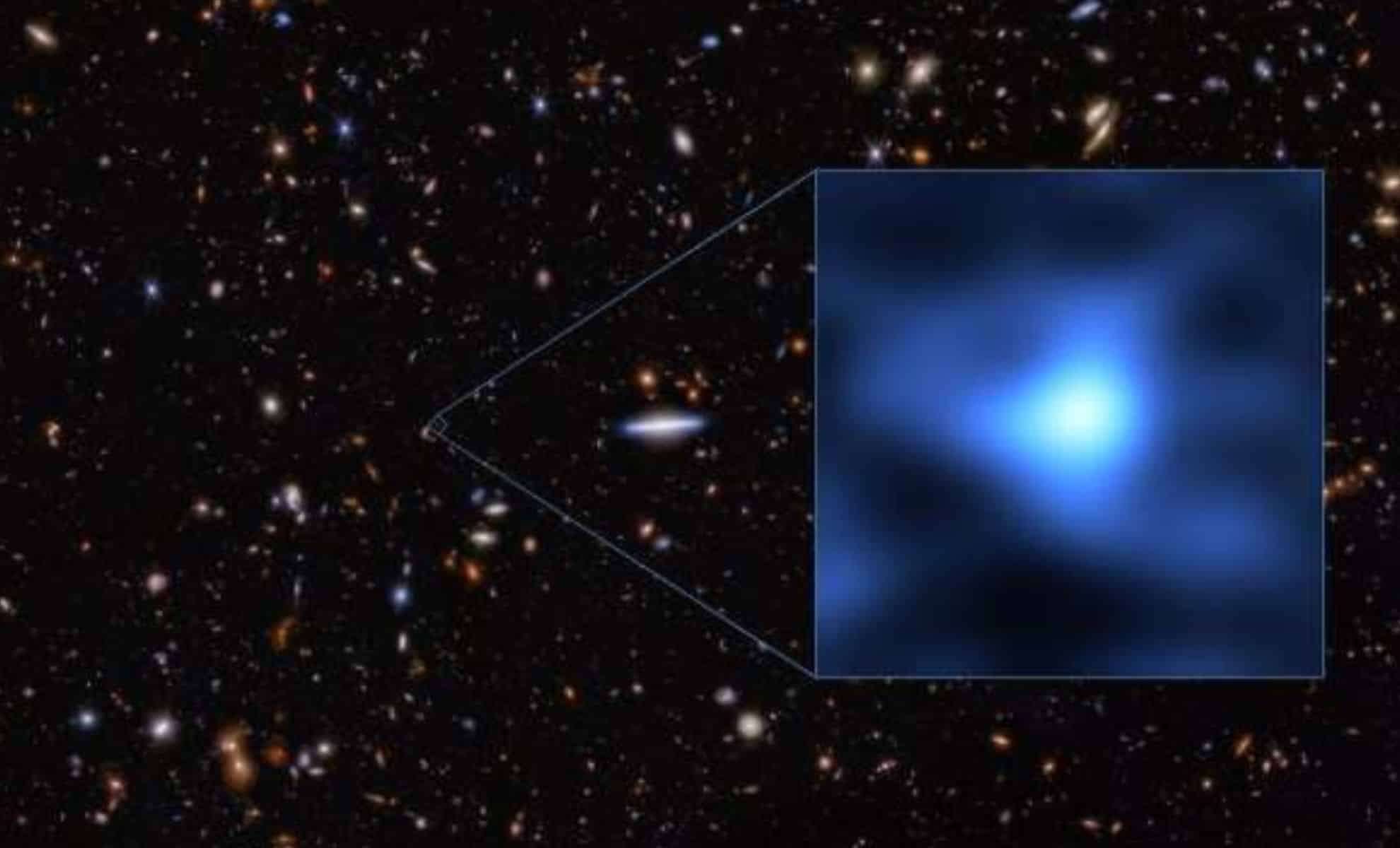
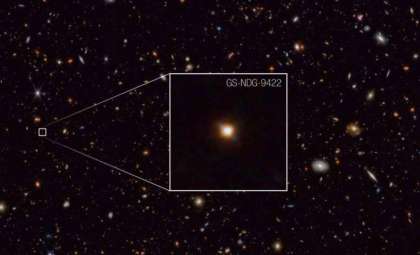
Astronomers have identified oxygen in the farthest galaxy ever observed, prompting a reevaluation of how quickly the early cosmos developed. The galaxy, designated JADES-GS-z14-0, is located an incredible 13.4 billion light-years away, showing us a glimpse from only 300 million years post-Big Bang. Observations with the Atacama Large Millimeter/submillimeter Array (ALMA) by two separate teams verified oxygen’s presence—an element thought unlikely to be abundant at such an early stage of the universe. These findings were published in Nature and other papers accepted by The Astrophysical Journal and Astronomy & Astrophysics.
The detection of oxygen indicates JADES-GS-z14-0 is significantly more chemically mature than anticipated for such a young cosmic structure. “Discovering an adolescent where we expected only newborns,” described Sander Schouws, the principal investigator of one study. Previously, it was assumed that galaxies from this epoch mainly contained primordial elements like hydrogen and helium, with very few heavier atoms like oxygen.
A Developed Galaxy in the Universe’s Early Days
This evidence implies that stellar generations had already formed and expired within this galaxy, synthesizing oxygen and distributing it across the system in a relatively short interval. Known as chemical enrichment, this process usually spans billions of years. Yet, in JADES-GS-z14-0’s case, it unfolded in only several hundred million years.

“The surprising results unveiled a new perspective on initial galaxy evolution,” said Stefano Carniani from Scuola Normale Superiore in Pisa, who led the second research group. Their analysis suggests the galaxy harbors ten times the heavy element content predicted for this early period, indicating a far brisker and more intricate galaxy formation than previously understood.
JWST and ALMA’s Crucial Roles in the Breakthrough
Although the James Webb Space Telescope (JWST) first discovered JADES-GS-z14-0, it was ALMA’s detection of [OIII] 88μm emission lines that unequivocally revealed the oxygen signature. This not only affirmed the galaxy’s extreme remoteness but also provided a remarkably precise redshift value with an error margin as narrow as 0.005%.
Eleonora Parlanti, a co-author and Ph.D. candidate in Pisa, noted, “Such precision—the equivalent of measuring 5 cm over a kilometer—enhances our insight into the features of distant galaxies.” The collaboration between JWST’s unparalleled deep-space imaging and ALMA’s spectral accuracy was pivotal in capturing this ancient galaxy’s chemical makeup.
Revisiting Cosmology and Early Star Formation Theories
This discovery carries major consequences for our understanding of cosmic history. It implies that both galaxy assembly and chemical maturation advanced at a much faster pace than current models suggest, necessitating a reexamination of the timeline for the universe’s formative stages. Moreover, if oxygen was prevalent in these primordial galaxies, the prerequisites for planet formation—and possibly life—might have been established earlier than once believed.
ESO astronomer Gergö Popping, unrelated to these studies, remarked, “This finding highlights ALMA’s vital contribution to probing how the first galaxies shaped the early universe.”
- Categories:
- News



0 comments
Sign in to Comment