
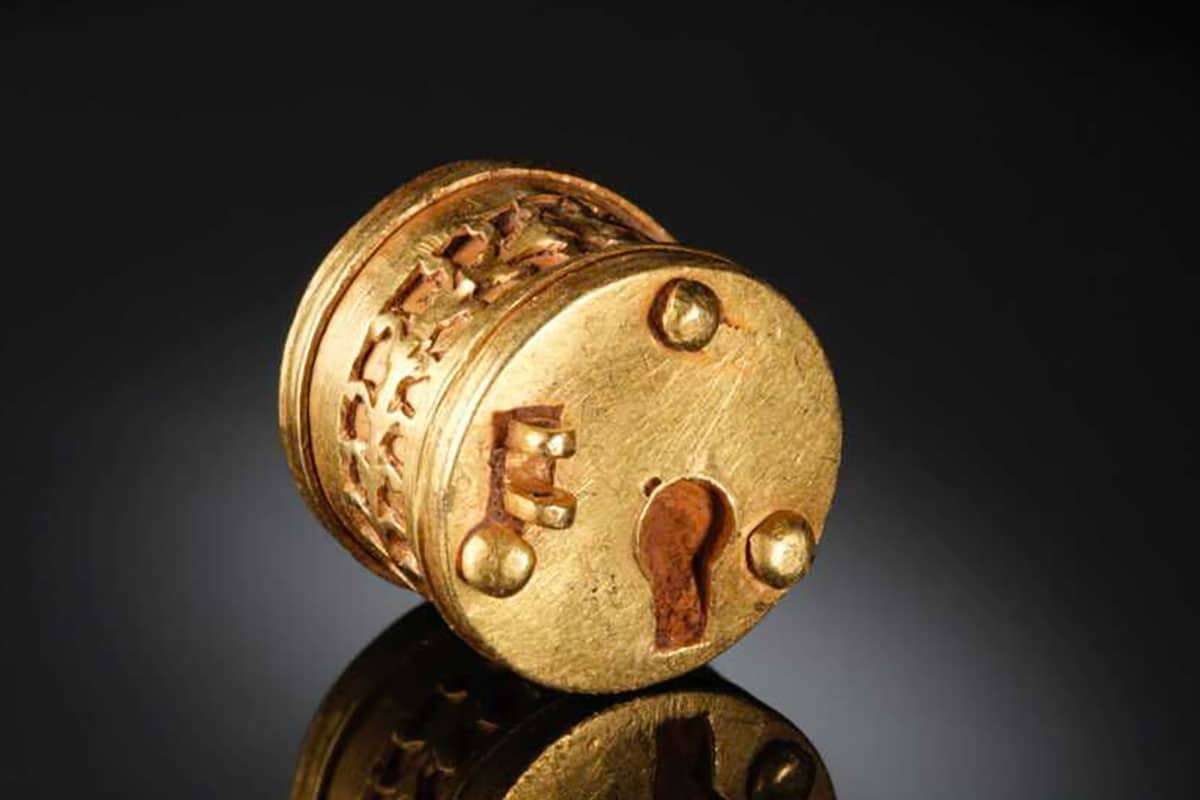
In western Germany’s Petershagen-Frille, an unexpected archaeological discovery has captured the attention of historians and archaeologists. A local man associated with the Westphalia-Lippe Regional Association (LWL) was plowing his field when he uncovered a tiny gold lock, roughly the size of a euro coin. Experts suggest this artifact is potentially unique in Europe based on current research, providing a rare glimpse into ancient craftsmanship. The lock dates from approximately the 3rd to 6th century AD and was probably designed to secure a Roman container.
The Artifact Details
Measuring just 0.47 by 0.43 inches, the gold lock features two small cylindrical plates covered and fastened by three rivets. Its surface is adorned with two rows of tiny punched hole patterns, showcasing impressive artisan skill. Initial X-rays yielded little information, prompting the team to employ neutron imaging—a cutting-edge technique offering detailed 3D visuals at very high resolution. Inside, they found a corroded iron core and a chain link.
Despite some wear, the lock’s mechanism remains largely preserved. Constantin Fried remarked, “One can clearly see [that it] is largely intact, although slightly damaged.” This excellent condition offers valuable insight into Roman metallurgical and mechanical technologies.

Recreating the Mechanism
To understand how the lock functioned, researchers manufactured a working replica at four times the original size, including all mechanical components and a hypothesized key design. The discovery of the chain link helped reconstruct an articulated chain consisting of at least six segments necessary for locking. Dr. Michael Rind explained, “Thanks to the chain link still attached [inside], we were also able to reconstruct an articulated chain, which had to have at least six elements to allow the lock to be locked.”
The design of the gold lock parallels traditional Roman locks typically made from iron or bronze, illustrating a fusion of classic design with rare materials.
Historical Context
The lock’s style and decoration date it to around the 3rd or 4th century AD in a Roman province. At this time, the region now known as Westphalia was part of Germania Magna, inhabited by tribes such as the Cherusci and Goths. Although not directly controlled by Rome, these lands maintained trade and military connections with the empire.
The exact journey of this exquisite lock to Petershagen-Frille remains unknown. Dr. Michael Rind speculates it may have been brought home by a Roman soldier as a keepsake or gift, prized even when damaged.
The lock’s rarity and preciousness suggest it could have doubled as decorative jewelry. Dr. Barbara Rüschoff-Parzinger emphasized its significance: “This exceptional discovery from Petershagen illustrates the remarkable craftsmanship of Roman blacksmiths and locksmiths.”
Unresolved Mysteries
This extraordinary find raises numerous questions about its provenance and purpose. Was it truly one-of-a-kind, or might similar artifacts still be waiting to be found? As investigations continue, researchers hope to unravel more of its history.
Beyond illuminating ancient technological expertise, this unique artifact invites both scholars and enthusiasts to ponder the untold stories hidden beneath the soil, awaiting rediscovery and recognition in the annals of history.
- Categories:
- News












0 comments
Sign in to Comment