
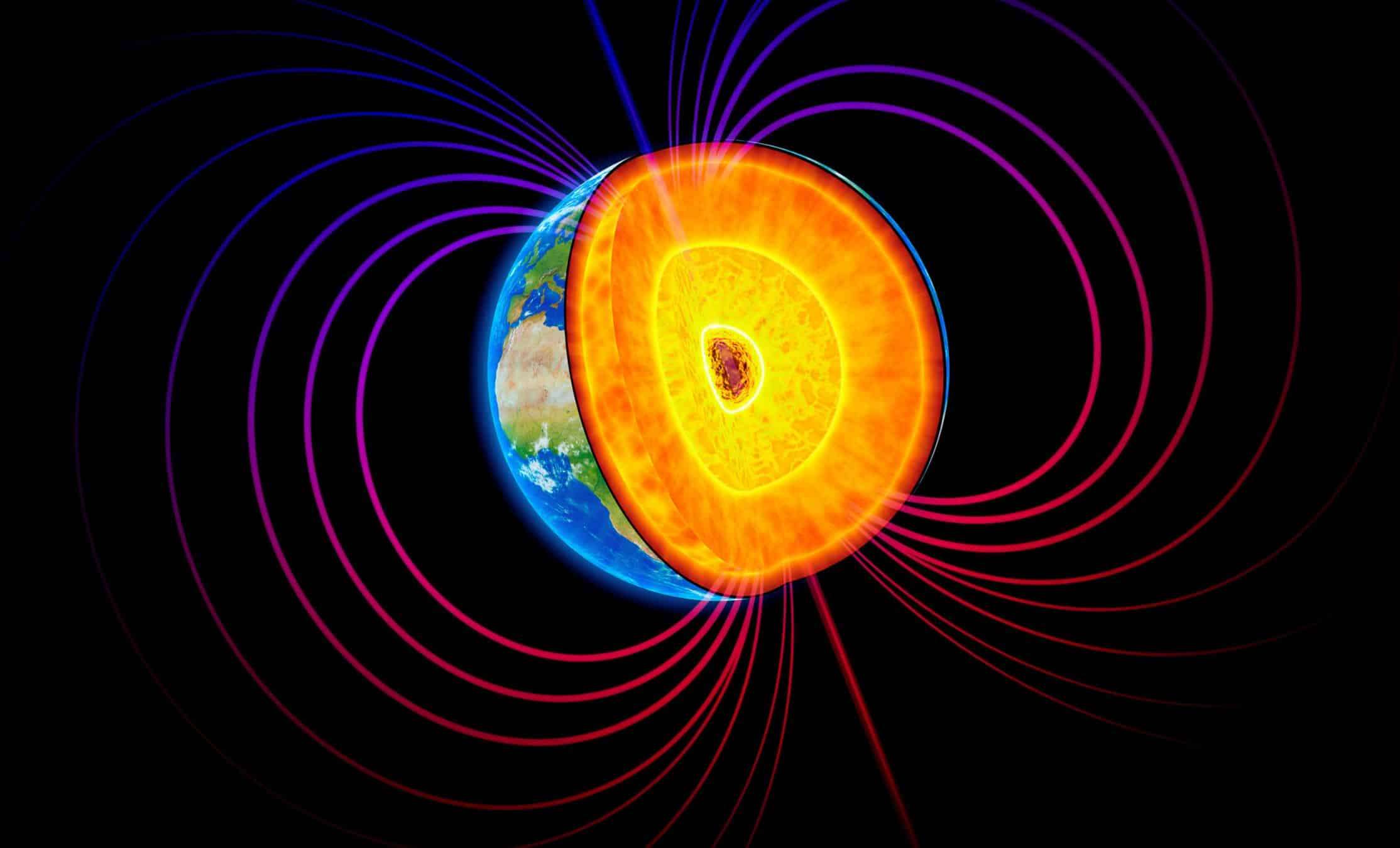
A recent investigation by scientists at the Australian National University (ANU), detailed in Seismological Research Letters, reveals that intense winter storms over the North Atlantic generate seismic waves that penetrate Earth's core, reaching distant areas such as Australia. These waves, detected far from their origin, open up new avenues to examine Earth's internal composition. This breakthrough not only advances geological knowledge but also offers innovative techniques to investigate the interiors of other celestial bodies in our solar system.
Innovative Approach to Investigating Earth’s Deep Interior
Traditionally, seismic waves have been associated with earthquakes, but the ANU team has found that oceanic disturbances from severe storms can also produce detectable seismic signals. Their research shows that seismic waves originating from North Atlantic storms travel through the Earth's core and appear thousands of kilometers away, notably in Australia. These observations allowed detection of elusive PKP waves, which journey through Earth's most profound layers, shedding light on its inner structure.
To monitor these faint signals, researchers installed specially-crafted spiral-shaped sensor arrays in secluded parts of Australia, including Queensland and Western Australia. These remote, low-noise environments provided optimal conditions for capturing microseismic activity that standard seismometers might miss. The customized instruments are essential for accurately registering these subtle seismic vibrations.

Exploring Planetary Interiors Beyond Earth
The implications of this research extend beyond our planet. Abhay Pandey, an ANU doctoral candidate and co-author, highlights that the techniques developed could be applied to investigate the cores of other planets and moons. “Our approach could identify cores in planetary bodies that lack plate tectonics, volcanic activity, or earthquakes, offering vital information for future space exploration,” Pandey stated.
This methodology holds promise for studying celestial objects like Mars or icy moons such as Europa, where conventional seismic activity is sparse or absent. This technology may become instrumental in unveiling the internal makeup of these worlds.
Methodology of the Research
ANU seismologists deployed two distinct spiral-arm seismometer networks strategically positioned in isolated Australian locations to detect subtle seismic waves transmitted through Earth’s core from powerful Atlantic storms. “We used a specialized system—two spiral-arm arrays placed carefully in Queensland and Western Australia—and analyzed the resulting waveforms to identify microseismic signals with long wave periods,” explained Pandey.
The arrays' strategic placement was designed to maximize sensitivity to weak vibrations often undetectable by typical seismometers. By aggregating data collected over several days, the team pinpointed regions with the strongest seismic wave signals, enhancing understanding of their propagation and sources. This pioneering work marks a significant stride in deep Earth seismology.
Overcoming the Difficulty of Capturing Weak Seismic Signals
Due to their minimal strength, these seismic waves are notoriously difficult to observe. To overcome this, the researchers developed advanced sensors designed to detect these low-amplitude signals with high precision.
Pandey noted the importance of selecting an appropriate frequency band for measurement. “We focused on seismic periods between four and six seconds, which is critical for isolating the waves of interest,” he remarked. Accurately capturing these faint signals is key to advancing knowledge of seismic phenomena caused by unconventional sources like ocean storm currents.
Why Australia is an Optimal Location for Seismic Studies
Australia’s remote areas provide an ideal environment for seismic observations. Their relative seismic calmness minimizes background noise, allowing detectors to record even the weakest signals. Pandey stressed Australia's unique role in making these measurements possible: “Given the tiny amplitudes of these waves, specialized instruments are required to detect them. Australia's remote and quiet regions, along with its geographic position, are perfectly suited for such observations.”
The carefully chosen locations of the sensor arrays in these quiet settings enabled the researchers to capture clearer data, enhancing insights into wave origins and their journey through Earth's core. This also helped differentiate signals originating across the North Atlantic, enabling more accurate interpretations of their movement through the planet’s interior.
- Categories:
- News






0 comments
Sign in to Comment