
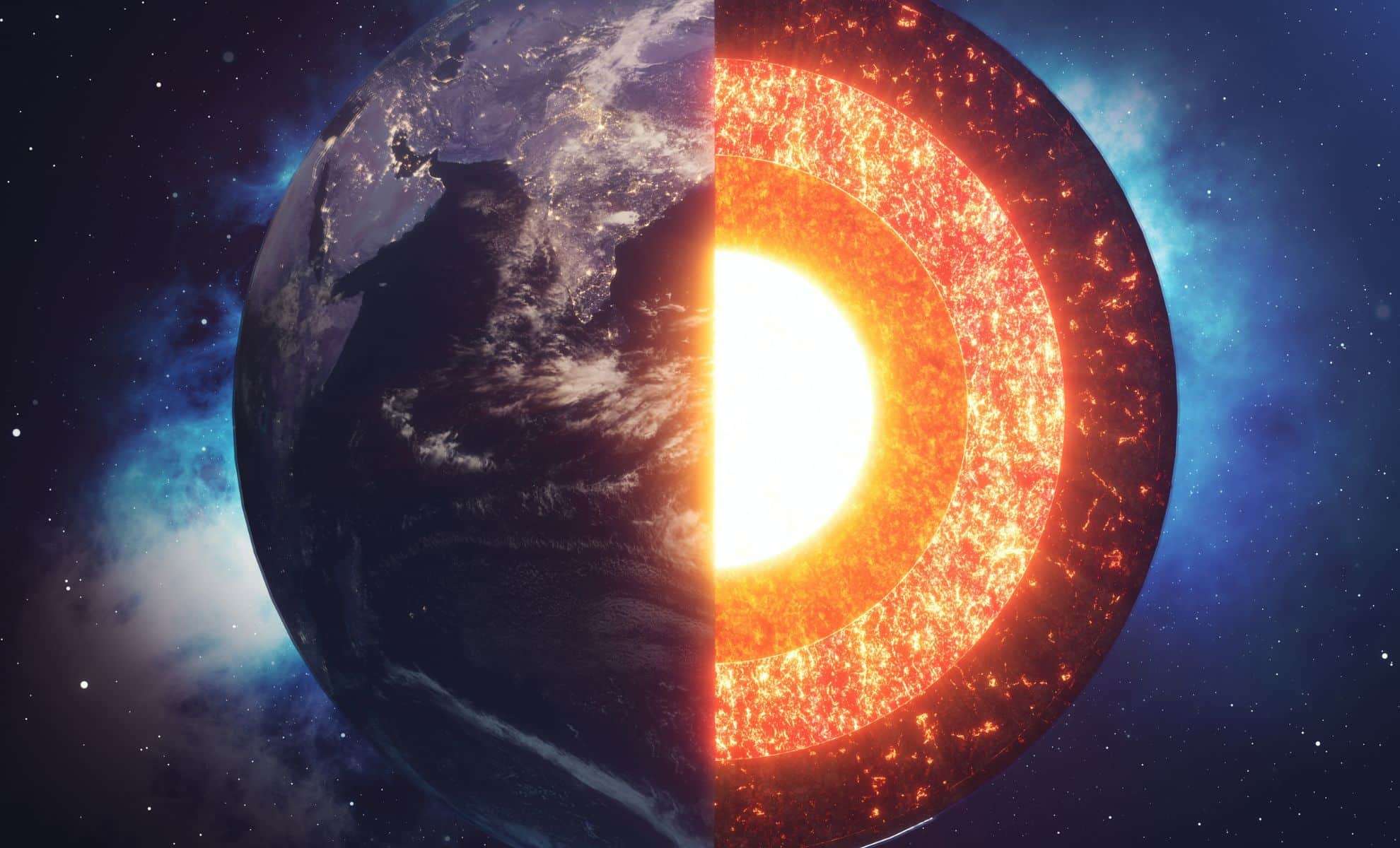
Recent findings are transforming the scientific perspective on Earth’s infancy, proposing that the core aspects of our planet’s inner structure were established within just 100 million years of its origin. Spearheaded by physicist Charles-Édouard Boukaré from York University, the investigation—featured in Nature—integrates geochemical data with fluid dynamics models to trace how Earth’s once molten interior gradually solidified, forming the geological framework that persists today.
These revelations challenge established ideas in planetary science and offer unprecedented insights into the developmental processes of rocky planets both within our solar system and beyond.
A Turbulent Early Earth
Earth’s formative stage featured a magma ocean—a churning layer of semi-molten silicate rock enveloping a fiery core. As cooling occurred, solidification began deep inside. Previous theories suggested this transition was slow, driven by intense pressures that determined the composition of the lower mantle, the thick layer just above Earth’s metallic core.

However, Boukaré’s research introduced a novel physical model to simulate crystal formation during mantle solidification. The results were surprising: crystal formation predominantly initiated at low pressures near the surface rather than in the deep mantle. This indicates that early surface-level processes had a significant impact on the chemical characteristics of the lower mantle.
“Previously, we believed high-pressure reactions governed the mantle’s chemistry,” Boukaré stated. “Our findings show that low-pressure factors must also be considered.”
Formative Forces Shaping Earth’s Identity
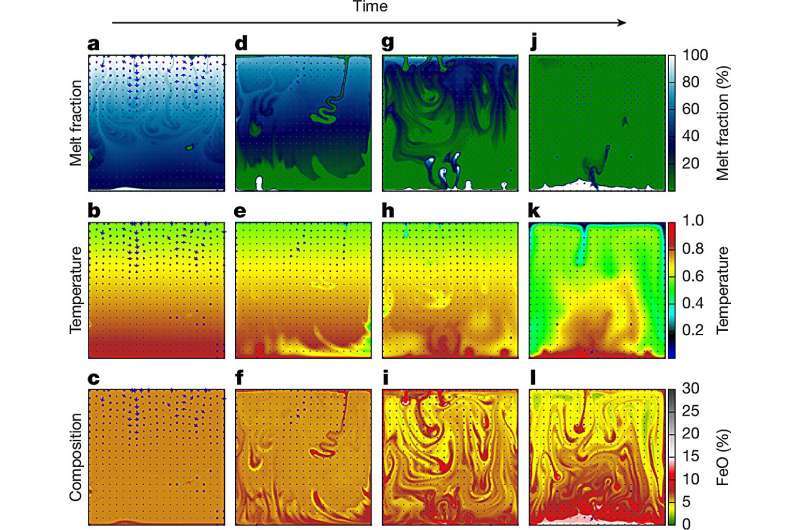
Employing a multiphase flow methodology, the team examined how various materials within Earth’s molten mantle segregated during cooling. Solid particles formed and either sank or floated depending on their density, resulting in the creation of distinct, compositionally unique layers.
Drawing a comparison to human development, Boukaré remarked, “Like energetic children exhibiting unpredictable behavior, young planets are dynamic and turbulent. Some features of these youthful stages are still evident in their present-day makeup.”
This dynamic early activity likely influenced the structure of the lower mantle, a crucial region responsible for regulating heat transfer, magnetic field production, and tectonic movements.
Ancient Crystals Predating Earth’s Final Assembly
Certain crystal formations identified in the study may record conditions predating Earth’s complete formation, dating back to when solar nebula material was still coalescing. These chemical traces could represent some of the planet’s oldest geological relics.
Beyond revising Earth’s geological timeline, these discoveries hint that other terrestrial planets might harbor similar early-stage markers, expanding our knowledge of planetary origins.
Advancing Planetary Evolution Predictions
This model’s ability to connect early chemical and thermal conditions with current planetary structures offers a powerful tool to forecast the developmental trajectories of other planets, including those beyond our solar system.
“Understanding initial conditions coupled with key evolutionary mechanisms enables us to anticipate how planets change over time,” Boukaré explained. Such insights are vital for evaluating planetary habitability, internal dynamics, and magnetic environment formation—factors essential to sustaining life.
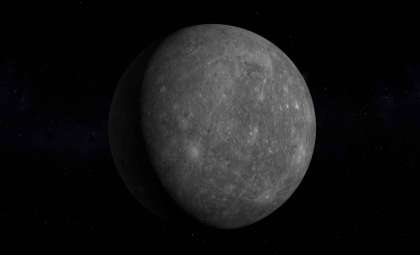
By contrasting Earth with neighboring rocky planets like Mars, Mercury, and Venus, scientists can now apply this framework to unravel the mysteries hidden beneath their surfaces by looking back to their earliest epochs.
- Categories:
- News





0 comments
Sign in to Comment