
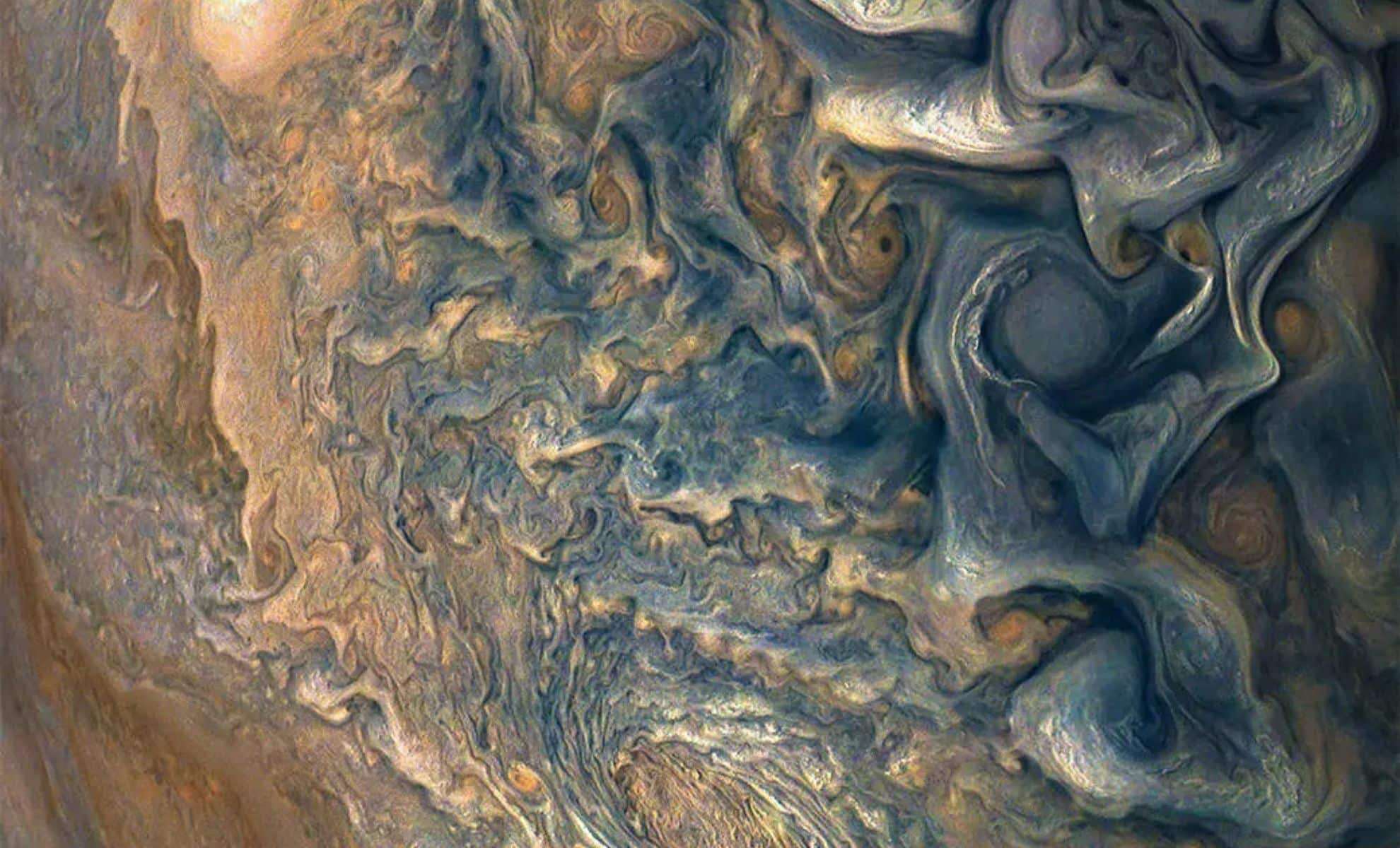
Jupiter’s distinctive cloud bands, swirling in stunning shades of orange, white, and brown, have fascinated astronomers and skywatchers for generations. These captivating patterns, formed by the planet’s massive storms and powerful jet streams, rank among the most iconic features in our solar system. Yet, the precise composition and structure of these clouds have long puzzled scientists—until now.
Recent investigations challenge the traditional belief that Jupiter’s visible clouds consist mainly of ammonia ice. A joint initiative involving dedicated citizen scientists and professional researchers revealed that these clouds lie far deeper in Jupiter’s atmosphere, where temperatures are too high for ammonia ice to exist. This finding not only revises existing atmospheric models of Jupiter but also sheds new light on the gas giant’s intricate weather systems and chemistry.
A Fresh Look at Jupiter’s Atmospheric Makeup
For many years, the consensus held that Jupiter’s upper cloud layers were composed mainly of ammonia ice, based on data from missions like NASA’s Galileo and Juno spacecraft, as well as terrestrial observatories. However, these assumptions left open questions about atmospheric processes and chemical layering on the planet.

The breakthrough began with Dr. Steven Hill, an amateur astronomer in Colorado, who utilized commercially available telescopes paired with color filters to observe Jupiter’s atmosphere. By taking images at targeted wavelengths, he generated high-resolution maps detailing ammonia concentrations and cloud altitudes. His analysis indicated that the visible clouds rest much deeper in the Jovian atmosphere than previously suspected.
Expanding on Dr. Hill’s data, Professor Patrick Irwin from Oxford University applied sophisticated atmospheric models to observations collected by the Multi Unit Spectroscopic Explorer (MUSE) instrument at the European Southern Observatory’s Very Large Telescope. By simulating light interactions within Jupiter’s atmosphere, Professor Irwin’s team verified that these clouds are not made solely of ammonia ice.
“I am astonished that such a simple method is able to probe so deep in the atmosphere and demonstrate so clearly that the main clouds cannot be pure ammonia ice!” exclaimed Professor Irwin.
Transient Ammonia Ice Clouds and Their Impact
While ammonia ice clouds are not the dominant component in Jupiter’s atmosphere, they do occasionally form under specific conditions. In areas with strong upward atmospheric movement, ammonia-rich air ascends into cooler regions, producing bright white clouds. Spacecraft missions have documented these ephemeral features as small, luminous patches above darker underlying cloud layers.
The creation of these clouds is influenced by photochemical reactions initiated by sunlight. Ammonia molecules exposed to solar radiation at higher altitudes undergo chemical transformations, generating smog-like substances that contribute to the reddish-brown coloration of Jupiter’s cloud bands.
“A special advantage of this technique is that it could be used frequently by amateurs to link visible weather changes on Jupiter to ammonia variations, which could be important ingredients in the weather,” explained John Rogers of the British Astronomical Association.
These insights help form a more detailed picture of how Jupiter’s weather patterns relate to changes in atmospheric chemistry.
The Power of Citizen Science in Astronomy
One of the most notable elements of this discovery is the prominent role played by citizen scientists. Dr. Hill’s inventive approach highlights how enthusiasts using accessible equipment can significantly aid professional research.
“I always like to push my observations to see what physical measurements I can make with modest, commercial equipment,” said Dr. Hill. “The hope is that I can find new ways for amateurs to make useful contributions to professional work. But I certainly did not expect an outcome as productive as this project has been!”
This teamwork underscores how integrating grassroots observations with expert analysis can lead to important scientific progress. Modern technology enables amateur astronomers to participate actively in unveiling new planetary phenomena.
Comparing Cloud Structures on Jupiter and Saturn
Inspired by these discoveries on Jupiter, scientists have applied similar techniques to study Saturn’s atmosphere. Professor Irwin’s group analyzed data from Saturn and found notable similarities. Like Jupiter, Saturn’s clouds are situated deeper than the ammonia condensation point, indicating related chemical and meteorological processes in both gas giants.
These parallels pave the way for comparative studies of giant planet atmospheres, focusing on layered structures formed by vertical air transport and sunlight-driven chemical reactions. Such investigations promise broader insights into planetary atmospheres within and beyond our solar system.
Advancing Our Understanding With New Tools
This discovery is a pivotal milestone in decoding Jupiter’s atmospheric mysteries. The combination of novel observational techniques and theoretical modeling breaks new ground for analyzing the gas giant’s complex meteorology and chemical profile.
The practical methods devised by Dr. Hill and refined by others facilitate frequent, high-detail monitoring of Jupiter’s atmospheric features. This capability allows astronomers—both amateur and professional—to track evolving storms, jet streams, and other dynamic events.
Looking ahead, instruments like NASA’s Juno probe and the James Webb Space Telescope will continue peeling back the layers of Jupiter’s atmosphere. These efforts promise to illuminate dynamic processes shaping not only Jupiter but also other giant planets in our cosmic neighborhood.
Discovering the Mysteries Beneath Jupiter’s Clouds
The unveiling of what lies beneath Jupiter’s clouds showcases the strength of collaboration and scientific curiosity. By uniting efforts between amateur and professional researchers, this advancement enriches our comprehension of the largest planet in our system and its multifaceted atmospheric behavior.
As Professor Irwin summed up, “These results show that an innovative amateur using a modern camera and special filters can open a new window on Jupiter’s atmosphere and contribute to understanding the nature of Jupiter’s long-mysterious clouds.”
This breakthrough serves as a reminder that even familiar celestial giants hold secrets awaiting discovery, inspiring ongoing exploration. Jupiter’s clouds—once assumed to be simple layers of ammonia ice—now invite us to explore a complex and evolving planetary story that captivates scientists and skyward observers alike.
- Categories:
- News




0 comments
Sign in to Comment