
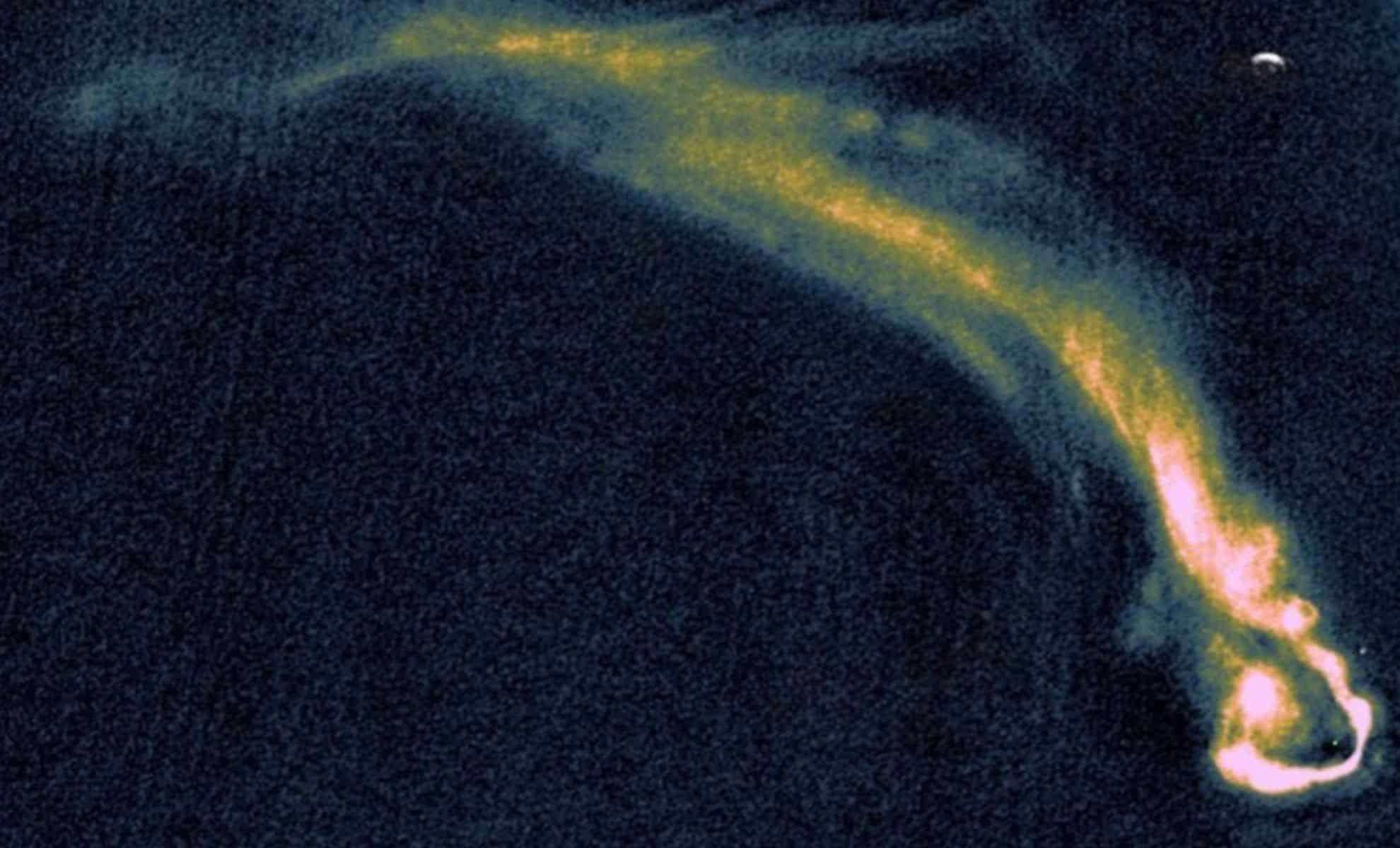
Scientists have produced a groundbreaking image of the galaxy cluster Abell 2255, unveiling delicate, radio-emitting filaments that extend more than 360,000 light-years across the vastness of space. Situated roughly 800 million light-years from our planet, this immense cluster houses up to 500 galaxies, many of which are in the process of interaction or merger.
Insight Into Ancient Radio Galaxy Activity
The investigation centered on radio galaxies, galaxies energized by supermassive black holes propelling jets of matter at nearly the speed of light. These galaxies emit intense radio waves, often producing extensive tails as their jets collide with surrounding cosmic materials. For Abell 2255, the VLBI mode of LOFAR allowed astronomers to capture details with an angular resolution reaching 0.3 arcseconds after 56 hours of observation at 144 MHz. The images revealed intricate filaments spanning three times the Milky Way’s width while remaining narrower than one-tenth of its diameter.
These enigmatic strands likely result from turbulence within the cluster. The researchers propose these filaments originate inside radio galaxies and are elongated by chaotic motions across Abell 2255. Over time, these threads of radio emission are expected to mix into the intergalactic medium, the immense, sparse substance of gas and dust between galaxies.

Discovering the Tailed Radio Galaxy and Its Cluster Neighbors
One of the cluster’s most remarkable objects is the Original Tailed Radio Galaxy, showcasing a complex, filament-rich tail unlike any previously observed. This entity sheds new light on the development and interaction of black hole jets within their environment. Further analysis via LOFAR unveiled unprecedented details within other uniquely shaped galaxies in Abell 2255, including the Goldfish, the Beaver, and the Embryo. Each features radio “tails” trailing over 200,000 light-years, molded by the intense cluster conditions.
“We processed 56 hours of observational data, split into multiple nights of about eight hours each,” said Emanuele De Rubeis, a scientist at the University of Bologna. “Each night produced roughly 4 terabytes of raw data. After calibration, the data volume swelled to between 18 and 20 terabytes, culminating in around 140 terabytes overall.” De Rubeis added that crafting high-resolution images from just one night of data can take up to a month.
Mapping the Magnetic Fields Within the Cluster
This breakthrough offers an exceptional chance to examine both the galaxies and the magnetic characteristics of the intergalactic gas permeating the cluster. “These discoveries pave the way for deeper studies not only of radio galaxies but also the properties of gas filling galaxy clusters,” noted Marco Bond, a researcher with the National Institute for Astrophysics (INAF).
Advanced radio observatories such as LOFAR and the upcoming Square Kilometre Array (SKA) are revolutionizing our view of diffuse cosmic structures. Their enhanced sensitivity and clarity enable astronomers to detect subtle phenomena previously hidden, revealing how galactic jets develop, how they impart energy into their surroundings, and the spread of cosmic magnetism across colossal cosmic distances.
- Categories:
- News




0 comments
Sign in to Comment