
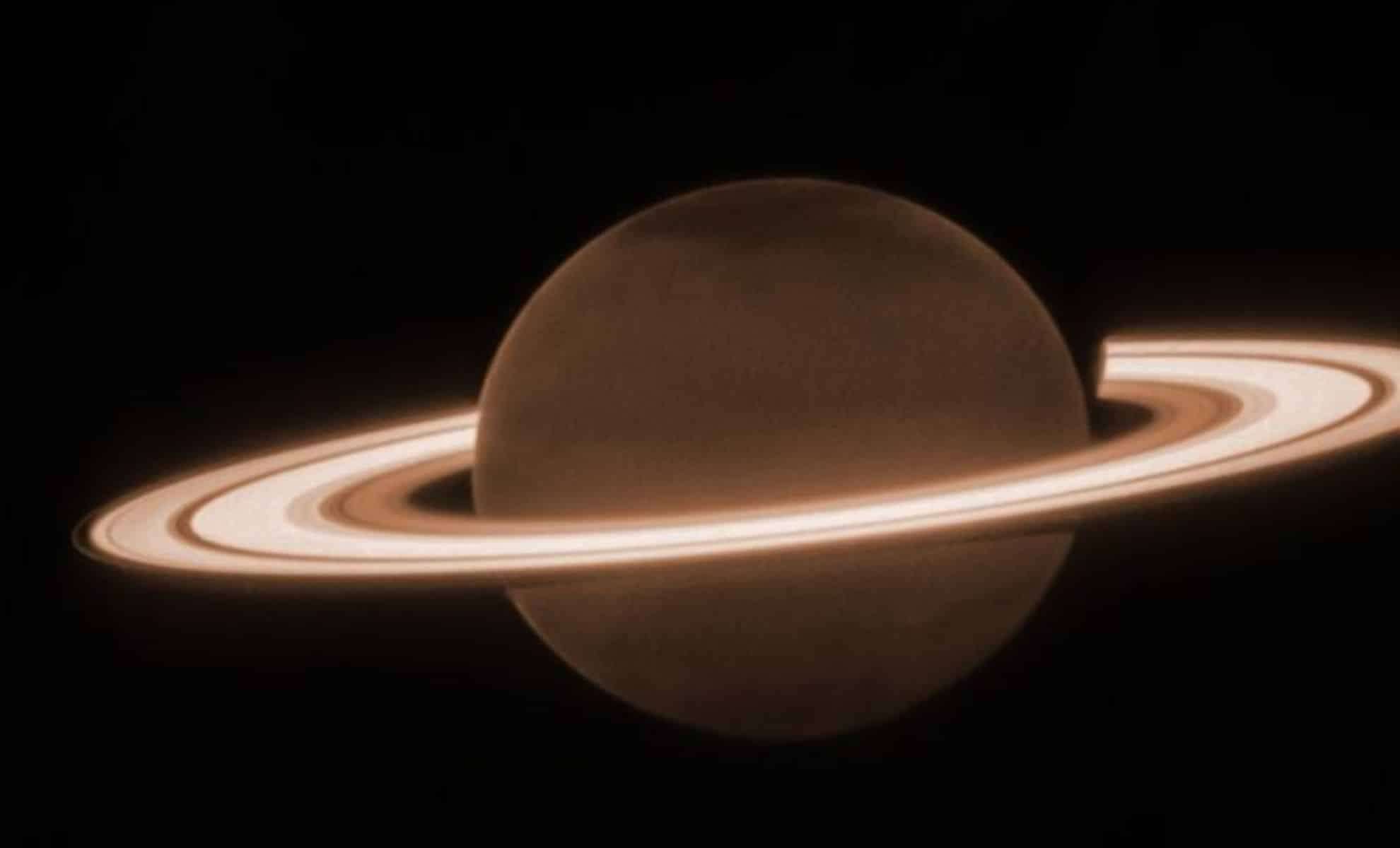
For generations, Saturn’s stunning rings have captivated astronomers and stargazers worldwide, standing out as one of the most recognizable features in the celestial landscape. However, in just a matter of weeks, a rare celestial alignment will cause these iconic rings to seemingly vanish from our view. On March 23, 2025, Saturn’s rings will present an edge-on profile from Earth, creating the striking illusion that they have entirely disappeared.
This event, known as a ring plane crossing, happens about every 15 years when Saturn’s tilt and orbital position align its narrowest ring edge toward Earth. Because the rings are incredibly thin — only about 10 meters (30 feet) thick in spots — they virtually disappear when viewed from this perspective. For several months, observers will see Saturn as a smooth, pale yellow orb without its distinctive ring system.
Rest assured, the rings aren’t truly gone. As Earth and Saturn continue their orbital dance, the planet’s orientation will shift, and by November 2025, the rings will once again become clearly visible in their full glory.

What Causes Saturn’s Rings to 'Disappear' Temporarily?
The key to this disappearing act is Saturn’s axial tilt, which affects how the rings appear from our vantage point. Like Earth, Saturn is tilted on its axis, causing its rings to shift their angle relative to Earth over time. This results in periods when the rings are fully extended and highly visible, followed by times when they appear edge-on and nearly invisible.
During a ring plane crossing, we observe the rings from the side, making them extremely difficult to detect, even with advanced telescopes. This infrequent event provides astronomers a rare vantage point to examine Saturn’s rings and the interactions within its moon system, offering valuable scientific insights.
How Will Saturn Appear During This Event?
At the time of the March 2025 ring plane crossing, Saturn will look like a smooth, yellow sphere, missing the bright, reflective ring bands that normally circle it. Although high-powered telescopes may hint at the faint edges of the rings, most amateur astronomers with backyard equipment will likely not detect them.
This fleeting disappearance is part of a long-standing natural cycle that has repeated for thousands of years. The last such event occurred in 2009, with the next predicted in 2040, giving researchers periodic opportunities to study Saturn’s environment under unique conditions.
Exploring the Structure of Saturn’s Rings
Saturn’s ring system is split into several distinct parts, including:
- A and B Rings – The largest and most luminous rings.
- C Ring – A dimmer inner ring situated closer to the planet.
- Cassini Division – A vast gap between the A and B rings, spanning roughly 4,800 kilometers (2,982 miles).
- D, E, F, and G Rings – Outer and generally less prominent rings.
Despite their solid appearance, these rings consist of millions of individual particles ranging from tiny dust grains to chunks of ice and rock comparable in size to buses. Scientists debate their origin, with theories including remnants of a shattered moon or leftover material from Saturn’s formation billions of years ago.
Saturn’s Moons and Their Role in Shaping the Rings
Saturn is accompanied by at least 145 known moons, many of which influence its ring structure in intriguing ways. Notably, shepherd moons orbit near the rings, using their gravitational pull to maintain the ring particles’ arrangement.
Among Saturn’s satellites, Titan stands out with its dense, nitrogen-rich atmosphere, surface methane lakes, and complex organic chemistry, making it a key focus in the search for potential life beyond Earth.
Enceladus has captured scientists’ attention after NASA’s Cassini mission revealed plumes of water vapor erupting from its frozen crust. These plumes, rich in organic molecules, hint at a hidden ocean beneath the ice that might support microbial life.
What to Expect Once the Rings Return?
Although the rings vanish from sight in March, they will make a spectacular comeback by November 2025. As Earth’s perspective continues to change, the rings will gradually reappear, eventually displaying their full, majestic glory.
This cyclical phenomenon highlights the ever-changing nature of our solar system, offering fresh perspectives on Saturn’s timeless beauty.
So, while we’ll temporarily lose sight of Saturn’s rings, they’ll soon reemerge, continuing their endless orbit around the planet, enchanting humanity for generations to come.
- Categories:
- News









0 comments
Sign in to Comment