

The Milky Way’s magnetic field has remained an enigmatic force, vital yet largely hidden from observation. A recent investigation offers a groundbreaking map detailing the galaxy’s magnetic landscape, uncovering surprising complexities in its flow across space. Led by Dr. Jo-Anne Brown and her research group, this study not only sheds light on the current structure of the Milky Way’s magnetic field but also traces its historical development.
Revealing the Invisible Influence Shaping Our Galaxy
Galactic magnetic fields are more than theoretical constructs; they are fundamental to the formation and stability of galaxies. The unseen magnetic field threading the Milky Way plays an indispensable role in balancing gravitational forces. “Absent a magnetic field, the galaxy would collapse inward under its own gravity,” explains Dr. Jo-Anne Brown, a professor in the Department of Physics and Astronomy at the University of Calgary. This insight highlights the necessity of mapping and understanding galactic magnetic fields to explain how cosmic structures persist without succumbing to gravitational collapse.
Thanks to the fresh data gathered by Dr. Brown’s team, scientists now have an unparalleled picture of this hidden force. Detailed measurements of the magnetic field’s strength, direction, and spatial distribution enable more accurate simulations of the Milky Way’s magnetic behavior and its future evolution. These findings represent a critical advancement toward decoding the forces that mold galaxies.

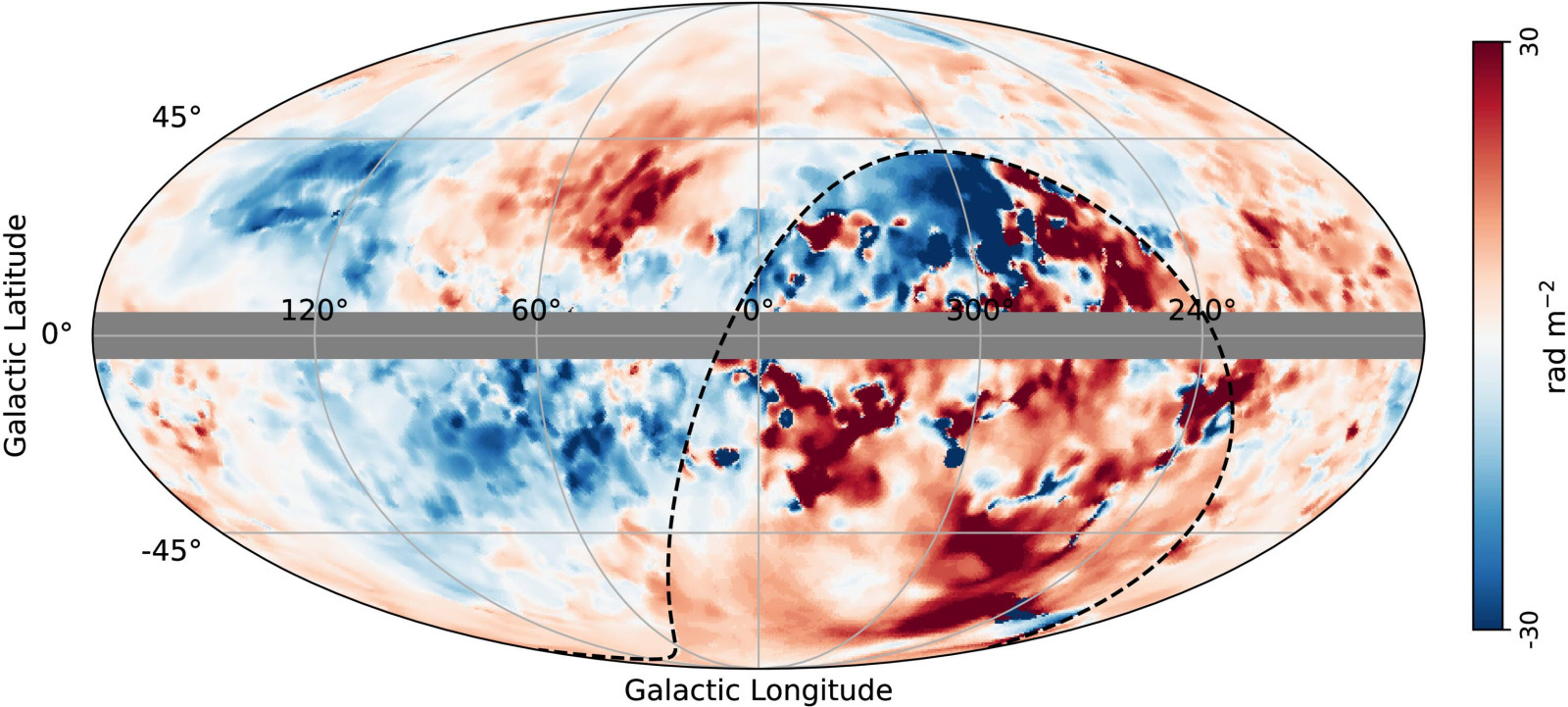
Utilizing Faraday Rotation to Chart Galactic Magnetism
To decode the magnetic field’s properties, the researchers applied a method called Faraday rotation. This effect happens when radio waves pass through space regions filled with free electrons and magnetic fields, causing the waves’ polarization to shift. This shift provides information about the magnetic field encountered along their path.
“You can think of it like refraction. A straw in a glass of water looks bent because of how light interacts with matter,” explains Rebecca Booth, a PhD candidate working alongside Brown. “Faraday rotation is a similar concept, but it’s electrons and magnetic fields in space interacting with radio waves.”
By studying these polarization changes in radio signals, the team successfully traced the otherwise invisible magnetic lines permeating our galaxy.
This approach enables astronomers to produce magnetic field maps with exceptional precision. As Dr. Anna Ordog, lead author of the study published in The Astrophysical Journal, notes, “Having such broad data coverage lets us capture intricate details of the magnetic field structure.” This detail is key to deepening our understanding of the Milky Way’s internal magnetic dynamics.
Discovering a Magnetic Field Flip in the Sagittarius Spiral Arm
A striking discovery centers on the magnetic characteristics of the Sagittarius Arm, where the magnetic field direction diverges from that seen elsewhere in the galaxy. While the Milky Way’s field generally flows clockwise, here it reverses, moving counterclockwise. Reflecting on this unexpected flip, Dr. Brown recalls:
“If you could look at the galaxy from above, the overall magnetic field is going clockwise. But, in the Sagittarius Arm, it’s going counterclockwise. We didn’t understand how the transition occurred. Then one day, Anna brought in some data, and I went, ‘O.M.G., the reversal’s diagonal!'”
This insight led to a novel 3D model explaining the magnetic reversal’s diagonal nature in this sector. This diagonal shift reshapes our grasp of the Milky Way’s complex magnetism and prompts fresh inquiries into galactic evolution mechanisms. Understanding such reversals is key to unraveling how magnetic fields influence galaxy development over cosmic time.
- Categories:
- Astronomy











0 comments
Sign in to Comment