
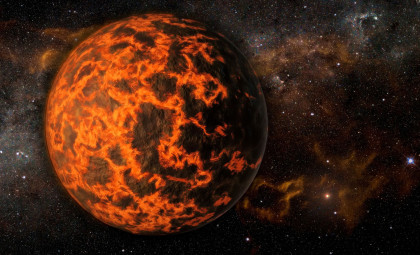
Researchers have unveiled an entirely new kind of exoplanet, distinct from any previously identified. Reported in Nature, this world boasts a fiery surface rich in molten rock and sulfur gases, challenging established planetary classifications. Designated L 98-59 d, this intriguing planet is located approximately 35 light-years away within the Volans constellation, offering scientists fresh insights into planetary diversity. Its extensive molten magma ocean coupled with a thick sulfur-laden atmosphere suggests a hostile environment, unlikely to support life, yet reveals the astonishing variation among planets beyond our solar system.
An Unprecedented Type of Planet
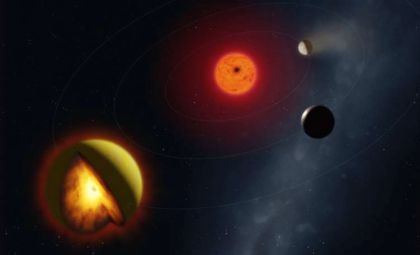
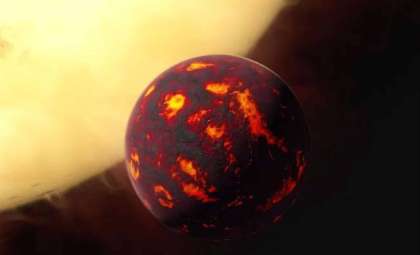
L 98-59 d defies the familiar characteristics of known exoplanets. Instead of a solid crust and liquid oceans like Earth, L 98-59 d features a mantle dominated by constantly molten silicate, similar to lava on Earth. The planet's surface temperature remains extraordinarily high due to a dense sulfur-enriched atmosphere that drives an extreme greenhouse effect, keeping the magma ocean persistent for billions of years. This makes L 98-59 d a truly exceptional planetary specimen.
“This discovery suggests that the categories astronomers currently use to describe small planets may be too simple,” says Dr. Harrison Nicholls, the lead author of the study from the University of Oxford. He continues, “While this molten planet is unlikely to support life, it reflects the wide diversity of the worlds which exist beyond the Solar System. We may then ask: what other types of planet are waiting to be uncovered?”
Add Cosmo Herald as a Preferred Source

Revolutionizing Understanding of Planet Formation
The study in Nature utilized cutting-edge simulations combined with observational evidence to show that L 98-59 d's evolution diverged considerably from typical planetary development. Originally similar in form to a sub-Neptune, the planet has diminished in size and shed much of its initial atmosphere, distinguishing itself by its unusual composition and low density. These attributes challenge current exoplanet formation models and position L 98-59 d as a peculiar outlier within the planet-size spectrum. Learn more about comparable discoveries in exoplanet research.
Co-author Professor Raymond Pierrehumbert adds, “What’s exciting is that we can use computer models to uncover the hidden interior of a planet we will never visit.”
This breakthrough enhances our ability to infer the internal composition of far-off planets through remote sensing techniques. It enables scientists to piece together the history and structure of alien worlds without the necessity of physical exploration missions.
The Path Forward in Exoplanet Exploration
Though L 98-59 d stands out as an extraordinary discovery, it only hints at the vast, uncharted diversity of exoplanets awaiting detection. Upcoming advanced telescopic technologies are expected to reveal more molten, sulfur-rich planets like this one. These emerging findings could fundamentally alter planetary classification systems and deepen our comprehension of planetary system evolution throughout the cosmos. Detecting more such molten worlds will allow for probing the mechanisms that govern planet formation on a universal scale.
“Although astronomers can only measure a planet’s size, mass and atmospheric composition from afar, this research shows that it is possible to reconstruct the deep past of these alien worlds – and discover types of planets with no equivalent in our own Solar System,” says Professor Pierrehumbert.
- Categories:
- Astronomy






0 comments
Sign in to Comment