

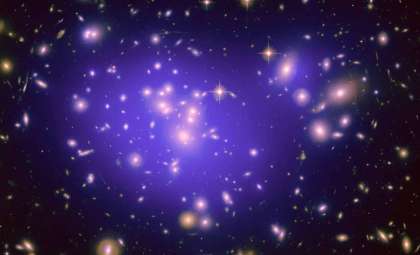
Dark matter accounts for about three-quarters of all matter in the cosmos, yet it remains undetected directly. Despite its elusive nature, dark matter significantly influences gravitational forces and the structure of galaxies. A recent theoretical development points to a warped fifth dimension as a possible explanation for dark matter’s origin.
Revisiting the Concept of Extra Dimensions
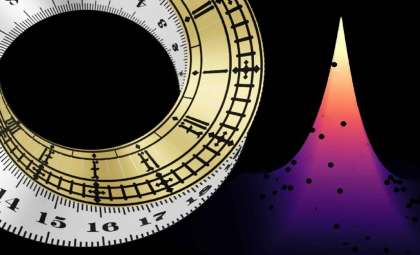
The notion of dimensions beyond the conventional three spatial and one temporal dimension has been explored for decades. The “warped extra dimension” theory, introduced in 1999, has gained renewed attention in a recent paper published in The European Physical Journal C. A team of researchers from Germany and Spain applied this model to explore the elusive nature of dark matter.
The team investigated how fermions, elementary particles like electrons and quarks, could be influenced by the presence of a warped fifth dimension. Their theory proposes that fermions might transition through so-called portals into this extra dimension, where they could form a “dark sector.” This hidden realm may host fermionic dark matter, offering an explanation beyond what the standard model of particle physics can currently provide.

Addressing Limits of the Standard Model
Although the standard model accurately describes many fundamental particles and interactions, it encounters significant challenges. Among them is the hierarchy problem, concerning why the Higgs boson’s mass is unexpectedly small relative to gravitational energy scales. More importantly, the model does not incorporate a viable candidate for dark matter.
The researchers highlight, “One of the most significant examples is the so-called hierarchy problem… [and] the existence of dark matter.” They argue that the presence of fermions in an additional warped dimension could offer answers to these unresolved questions, with their work focusing on the mass mechanisms of fermions in this extended geometry.
Gravitational Waves: A Potential Window into Dark Matter
One of the main obstacles in dark matter research is its weak interaction with standard particles, making it nearly invisible to detectors. However, this new framework suggests that advanced gravitational wave detectors, which capture spacetime distortions from powerful cosmic phenomena, might be capable of sensing effects linked to fermions inhabiting the warped fifth dimension.
As gravitational wave observatories continue to evolve and proliferate globally, the prospects for detecting signals indicative of this hidden realm improve. The scientists note, “We know that there is no viable [dark matter] candidate in the [standard model of physics], so already this fact asks for the presence of new physics.”
Opening New Paths to Unraveling Dark Matter
This cutting-edge hypothesis offers promising avenues for researchers aiming to decode the universe’s missing mass. By suggesting that fermions could traverse portals into a warped fifth dimension, the study connects elements of particle physics and cosmology and points toward unexplored dimensions potentially hosting dark matter. This could explain the invisible yet pervasive force sculpting the universe that current instruments have not yet detected.
The findings call for intensified experimental efforts, especially in gravitational wave research, to test this theory and enhance our grasp of the fundamental structure of reality.
- Categories:
- News








0 comments
Sign in to Comment