
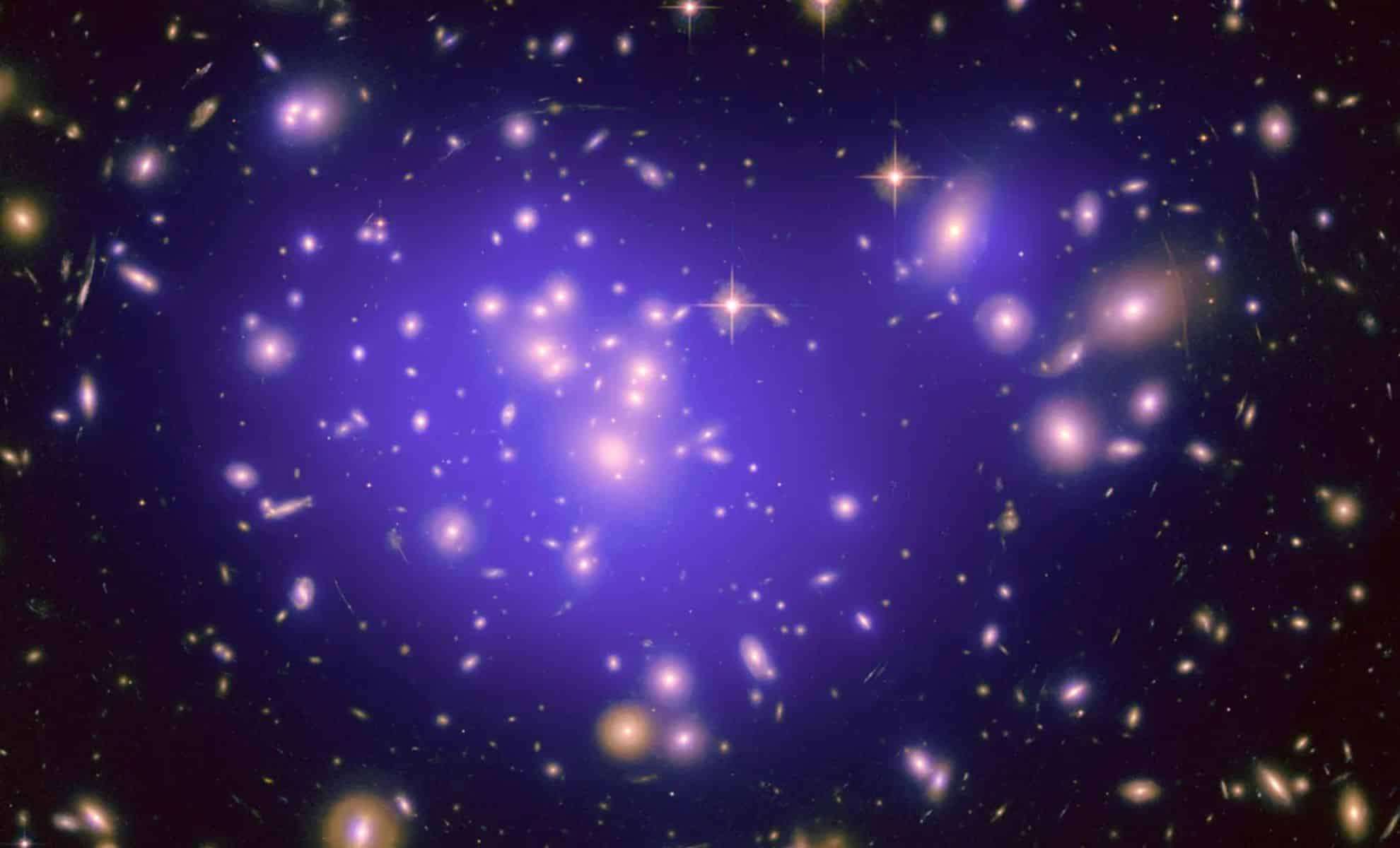
A recent breakthrough suggests that the enigmatic activity observed at the core of our galaxy could be evidence of a form of dark matter considerably lighter than traditional theories have proposed. This finding offers potential progress toward resolving one of astrophysics’ most enduring mysteries: the actual composition of dark matter. The investigation focuses on unexpected ionization patterns of hydrogen gas within the Central Molecular Zone (CMZ) of the Milky Way, a puzzle that may now have a connection to dark matter.
Featured in Physical Review Letters, the research examines unusual energy emissions emanating from the densely populated CMZ, situated at the galaxy’s center. These emissions suggest an unknown energy source capable of ionizing hydrogen—a phenomenon that has defied explanation for many years. Where previous hypotheses pointed at cosmic rays or Weakly Interacting Massive Particles (WIMPs), the study proposes a much lighter dark matter candidate as the plausible origin of this energy.
A Novel Contender for Dark Matter
Dr. Shyam Balaji, a Postdoctoral Scholar at King’s College London and a principal investigator on the project, discussed the new theory: “Massive clouds of positively charged hydrogen reside in the galactic core, which has perplexed scientists since these gases are typically neutral by nature. The key question remains: what energy source can strip electrons from them?” This discovery challenges current dark matter frameworks and might provide fresh perspectives on this elusive cosmic substance.

The energy patterns detected hint at a continuous and active energy output, which the team attributes to a type of dark matter with much lower mass than the conventionally accepted WIMP particles. Further elaborating, Dr. Balaji stated, “Our observations reveal a persistent source generating enough energy to ionize hydrogen, which our data suggests is linked to a considerably lighter dark matter particle than those commonly proposed.”
This insight could transform our grasp of dark matter, believed to comprise about 85% of the cosmos’ mass but remaining largely invisible. Contrary to traditional views favoring massive, slow particles, this research indicates that much smaller, lighter particles might be responsible for the observed effects.
Expanding Dark Matter Investigations Beyond Terrestrial Labs
Dr. Balaji emphasizes that most current dark matter experiments rely on Earth-based detectors waiting for particle interactions. This study, however, advocates for a more direct strategy—monitoring naturally occurring phenomena at the galactic center—to better understand dark matter: “Dark matter research is arguably the grandest pursuit in science, yet many tests occur on Earth, awaiting interactions. By using the gas in the CMZ to observe these processes, we approach the problem at its source. The findings suggest that dark matter could be significantly lighter than previously assumed.”
This fresh perspective offers a unique window into studying dark matter under natural conditions, where its influence is measurable through the ionization of hydrogen in the CMZ. Such observations could provide critical insights into how dark matter interacts with ordinary matter and propel the search for this mysterious component forward.
Potential Ramifications for Future Research
Beyond challenging established theories, this study may elucidate other enigmatic galactic characteristics, like the 511-keV X-ray line detected at the Milky Way’s core. Dr. Balaji concludes: “Unveiling dark matter’s nature is among science’s most vital goals, but many experiments involve Earth-based detection methods hoping the particles reveal themselves. By examining the Milky Way’s center, the behavior of hydrogen in the CMZ implies we could be closer to confirming the true properties of dark matter.”
This discovery represents a significant leap forward in astrophysics, positioning scientists on the cusp of identifying a new dark matter form that may finally unlock answers to the universe’s profound secrets. Continued investigation promises to bring us closer to grasping what constitutes the vast majority of cosmic mass and why it has remained so untraceable for so long.
- Categories:
- News







0 comments
Sign in to Comment