
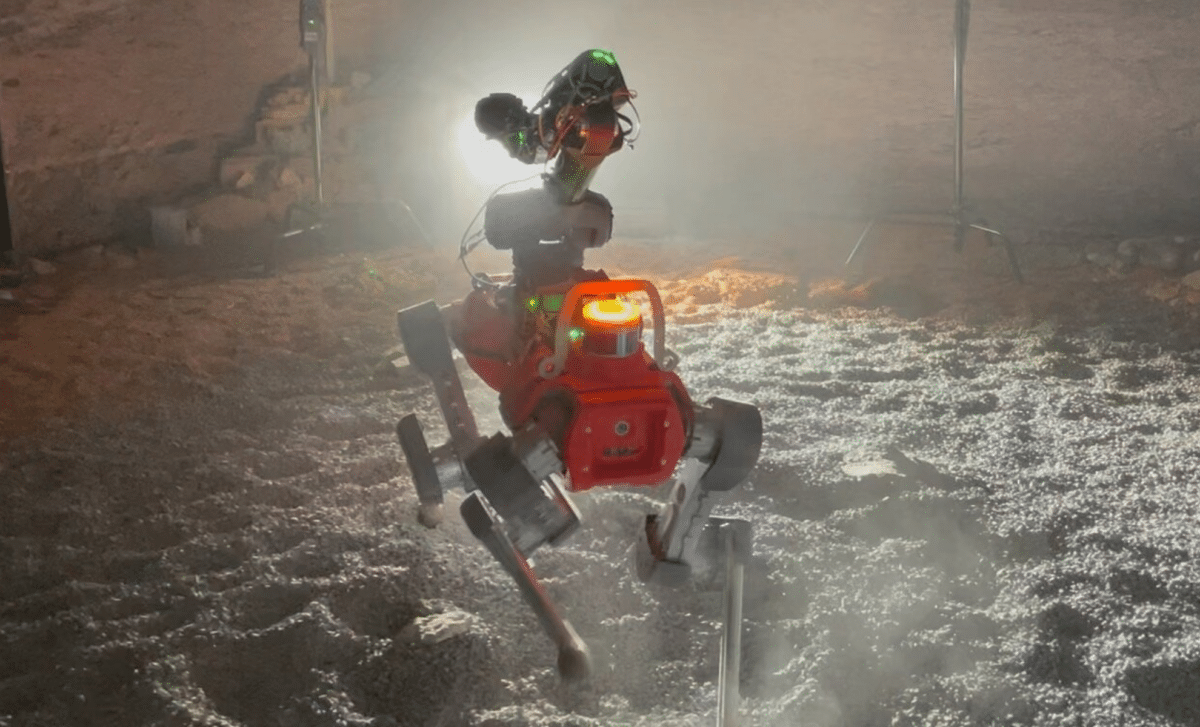
Space exploration has traditionally been a gradual, painstaking effort, with rovers cautiously traversing the rugged landscapes of Mars and the Moon. Communication lags and careful, deliberate planning slow these missions, limiting how much ground can be covered. However, recent research published in Frontiers in Space Technologies suggests that legged robots equipped with compact scientific instruments could transform this process. These semi-autonomous robots can independently survey broad regions and collect vital data quickly, accelerating discoveries about extraterrestrial resources and signs of life.
A Breakthrough in Planetary Exploration
Conventional planetary rovers make slow progress due to delays in communication—often ranging from four to 22 minutes—and the necessity for precise commands from Earth. Consequently, only small portions of landing sites have been explored over extended missions. The study outlined in Frontiers in Space Technologies challenges this approach by proposing semi-autonomous robots that can rapidly explore larger terrains with minimal human intervention.
Led by Dr. Gabriela Ligeza from the University of Basel and the European Space Agency, the team presents legged robotic platforms capable of navigating various planetary landscapes autonomously. These robots are designed to operate scientific instruments that enable swift and effective analysis of diverse geological targets on multiple sites without ongoing human control.

More Agile and Effective Semi-Autonomous Explorers
In their trials, researchers utilized the quadruped robot "ANYmal," outfitted with a robotic arm fitted with two advanced instruments: a microscopic imager (MICRO) and a transportable Raman spectrometer. These devices helped the robot perform detailed examinations of a range of rock specimens, simulating real planetary investigations focused on astrobiological markers and resource identification.
Experiments conducted in the “Marslabor” research facility at the University of Basel demonstrated the robot’s ability to independently approach and analyze targets such as gypsum, carbonates, and basalts—rocks that hold geological importance and potential resource value for space missions.
Notably, the semi-autonomous system significantly outpaced human-directed operations, completing complex multi-target analysis within 12 to 23 minutes compared to 41 minutes under manual supervision. This enhanced speed promises more extensive and efficient surveys of planetary surfaces, enabling missions to gather richer datasets in less time.
Advancing Space Exploration with Autonomy
This research heralds a new phase where autonomy and scientific investigation merge seamlessly. Traditionally, exploration vehicles have relied on deliberate, controlled maneuvers commanded remotely, limiting their range and data-acquisition speed. The introduction of semi-autonomous technology enables robots to independently explore wide areas, collect crucial information, and relay findings back to Earth with unparalleled efficiency.
Such autonomy is vital to the search for life on Mars. Instead of directing every movement from Earth, these robots can traverse from one scientific promise to another, gathering evidence that could uncover traces of ancient microbial organisms. Rapid analysis over broad landscapes could significantly boost the likelihood of detecting past life.
Transforming Lunar Resource Exploration
Beyond biosignature detection, this robotic technology also holds promise for locating resources on the Moon. Rocks like anorthosite, identified during testing, may contain essential materials for sustaining future lunar outposts. Current lunar prospecting is labor-intensive, but autonomous robots could swiftly locate valuable deposits, supporting plans for prolonged human habitation on the Moon and eventual Martian missions.
As humanity prepares missions to both the Moon and Mars, the deployment of smaller, nimble robots carrying focused instrument packages could change the landscape of space exploration. These machines will be capable of covering more territory, detecting sites of interest independently, and delivering critical scientific data back to Earth with remarkable speed.
- Categories:
- News




0 comments
Sign in to Comment