

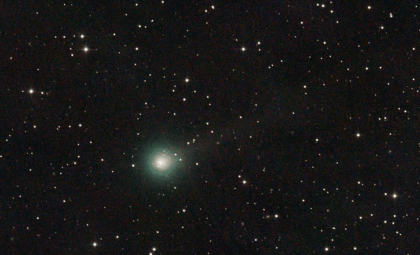
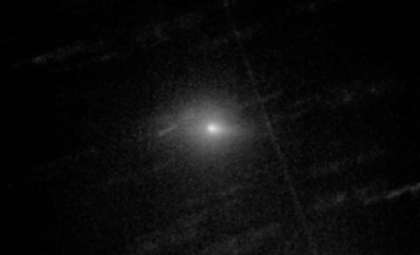
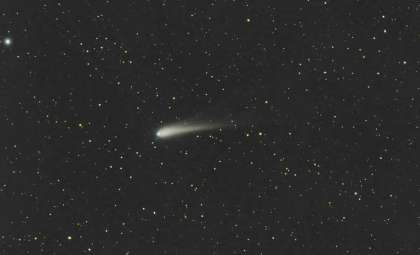
On Thursday evening, October 16, 2025, astronomy enthusiasts have an incredible chance to observe Comet Lemmon (C/2025 A6) as it sweeps past the northern sky, shining close to the luminous star Cor Caroli. Whether you're a dedicated astronomer or a casual star admirer, this stunning celestial display is among the finest opportunities to witness the vibrant green comet. The comet’s path near prominent stars like those in the Big Dipper and Cor Caroli makes it an accessible target without needing advanced equipment.
The Distinctive Green Radiance of Comet Lemmon
Comet Lemmon has captivated observers with its characteristic green glow, caused by diatomic carbon molecules emitting light in its tail. As it draws nearer to Earth, its brightness intensifies, providing a rewarding view for both amateur and professional stargazers. According to Forbes, on October 16, the comet becomes visible about an hour and a half after sunset in the northwest, visible from many northern locations.
The prime window for observing Comet Lemmon will be shortly after twilight, as darkness deepens and the comet’s glow becomes more prominent against the night sky. Its proximity to Cor Caroli, situated in the Canes Venatici constellation, serves as a natural landmark, making the comet easier to locate. Witnessing the comet near such a notable star enhances the viewing experience.

Best Viewing Spots for Comet Lemmon
To maximize your chances of spotting Comet Lemmon, it’s important to choose a dark site free from artificial lights. Light pollution can obscure faint celestial objects, so binoculars or small telescopes may improve the view. The silhouetted northwest horizon offers the best vantage point around 30 minutes post-sunset when the comet’s brilliance peaks. For example, observers in New York City can expect to see it at about 7:41 p.m. EDT at an elevation roughly 11 degrees above the horizon.
Early risers have an alternative viewing opportunity just before dawn. Near 5:39 a.m. EDT, before the sun rises, the comet will be visible in the northeast, positioned near the Big Dipper stars Alkaid and Mizar. This quiet morning viewing combines the comet’s glow with the first light of day, offering a serene spectacle.
Cor Caroli: A Stellar Guide
A captivating feature of the October 16 event is Comet Lemmon’s closeness to the star Cor Caroli, part of the Canes Venatici constellation. This star, historically named in honor of King Charles II of England, is linked to a legendary brightening that coincided with the monarch’s return in 1660.
Today, Cor Caroli serves as a practical beacon for locating Lemmon in the night sky. The comet will traverse the constellation Ursa Major, just beside the Big Dipper, appearing near Cor Caroli and offering observers a unique pairing of celestial objects within the same view.
Using Digital Tools to Track Comet Lemmon
If locating the comet proves challenging, modern star-gazing apps provide effective assistance. Tools like Sky Guide, Stellarium, and SkySafari offer interactive maps that display Comet Lemmon’s real-time position, guiding viewers directly to its location in the sky.
Complementing these apps, websites such as In-The-Sky publish detailed finder charts with exact times and coordinates. These resources make comet-watching approachable, even for first-timers eager to catch a glimpse of this green visitor.
The Journey of Comet Lemmon
Comet Lemmon’s path through the solar system is a point of scientific interest. Discovered in January 2025 by the Mount Lemmon Survey in Arizona, it follows an elongated orbit stretching beyond the outer planets. Although it originally took about 1,350 years to circle the Sun once, a close encounter with Jupiter recently shifted its course, reducing its orbital period to approximately 1,150 years.
Comet Lemmon will reach its nearest point to Earth on October 21, 2025, passing at a safe distance of 55.4 million miles (89.2 million kilometers). This close approach raises no threat but boosts its brightness, making it a thrilling sight for stargazers worldwide.
Spotting Comet SWAN on October 16
Besides Comet Lemmon, sky enthusiasts can also look for Comet SWAN (C/2025 R2) on the evening of October 16. This blue-green comet will appear low in the southwestern sky around 90 minutes after sunset, near the Sagittarius constellation’s recognizable “Teapot” asterism. While dimmer than Lemmon and less visible to the unaided eye, it remains an intriguing binocular target.
The combined display of two comets in contrasting hues and different sky regions offers a rare astronomical treat. As Lemmon shines close to Cor Caroli in the northwest, SWAN lights up the southwest, giving observers a diverse cosmic vista.
- Categories:
- News








0 comments
Sign in to Comment